
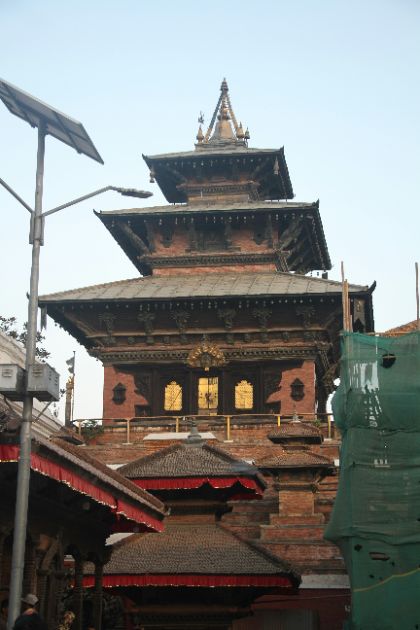
The Kathmandu Valley wasn’t designed to be convenient, scenic, or easy to navigate. It was designed to support ritual life. Every street curve, courtyard, shrine, and public square exists because people needed space to worship, gather, process, pause, and repeat the same actions day after day for centuries. Tourism arrived recently. Ritual came first.
Understanding this changes how the valley feels. What looks chaotic begins to feel intentional. What feels inconvenient starts to make sense.
What does it mean to say the valley was built for ritual?
It means the valley’s cities were organized around religious practice, not movement or efficiency. Kathmandu, Patan, and Bhaktapur grew as ceremonial landscapes. Temples weren’t added later. They were the anchors. Homes, markets, and streets grew outward from sacred points.
Rituals required space to walk, stop, circle, gather, and perform. The built environment followed those needs. Streets narrow where processions slow. Squares open where crowds assemble. Courtyards sit quietly where daily offerings happen.
Nothing here exists by accident.
Why don’t the streets feel planned or logical to visitors?
Because they weren’t planned for vehicles or visitors at all. They were shaped for feet, memory, and repetition. Streets curve because processions curve. Alleys narrow because they weren’t meant to move large volumes quickly. Routes overlap because ritual paths intersect.
In many places, the most important paths aren’t the widest ones. They’re the ones used during festivals, funerals, or seasonal ceremonies. These routes don’t appear on maps, but locals know them instinctively.
How do temples shape the valley’s urban layout?
Temples are not landmarks here. They are reference points. Neighborhoods orient themselves around shrines. Daily life bends around prayer times, offerings, and observances.
Small roadside shrines appear at junctions where people naturally pause. Larger temples sit at points where communities gather. Courtyards exist because people needed shared ritual space close to home.
This is why the valley feels dense with sacred sites. It is dense because ritual required proximity.
Why are there so many festivals and processions?
Because ritual in the Kathmandu Valley is cyclical, not occasional. Festivals are not special events added to the calendar. They are the calendar.
Processions move deities through streets to renew space, bless neighborhoods, and reaffirm community bonds. Chariots roll through routes that temporarily override traffic. Music replaces engines. Time stretches.
From a modern perspective, this feels disruptive. From the valley’s perspective, it is essential.
How does ritual override efficiency in daily life?
Ritual always comes first. Shops close for ceremonies. Traffic stops for processions. Work pauses for offerings. These interruptions aren’t considered delays. They’re obligations.
This is why the valley can feel unpredictable to travelers. Schedules matter less than cycles. What happens today may not happen tomorrow. The rhythm adjusts to lunar calendars, festivals, and local observances rather than clocks.
Why do public squares matter more than roads?
Because squares are ritual stages. Durbar Squares were never just political centers. They were ceremonial grounds where kings, priests, and communities interacted with the divine.
Even today, these squares host dances, offerings, chariot assemblies, and seasonal rituals. Roads exist to connect spaces. Squares exist to activate them.
This is why the valley’s most important places feel open, uneven, and alive rather than polished.
Why does tourism struggle to fit neatly into this system?
Tourism expects clarity, access, and predictability. The Kathmandu Valley offers none of these by design.
Temples don’t exist to be photographed. Streets don’t prioritize smooth flow. Ritual doesn’t pause for convenience. Visitors are welcomed, but they are not centered.
This mismatch explains why some travelers feel disoriented at first. The valley is not performing for an audience. It is continuing a way of life.
How should travelers adjust their expectations?
By letting go of control. Walk instead of plan. Observe instead of interpret immediately. Accept interruptions. Sit when movement stalls. Watch what people are doing rather than where they are going.
Understanding comes from repetition, not explanation. Once you recognize that ritual shapes space, movement, and time, the valley stops feeling confusing and starts feeling coherent.
Why does this make the Kathmandu Valley so compelling?
Because few places in the world still operate this way. The Kathmandu Valley is not a preserved relic. It is a functioning ritual landscape. People don’t act out tradition for visitors. They live it.
This is why the valley leaves such a deep impression. It doesn’t adjust itself to you. You adjust to it.
Staying somewhere that respects this rhythm helps travelers settle in, and places like Boudha Mandala Hotel offer a calm base close enough to experience the valley as it actually functions.