
Key Takeaways
• Nirvana in Buddhism is the state of awakening, freedom from suffering, and release from the cycle of rebirth
• It is not a place, but the extinction of craving, aversion and ignorance
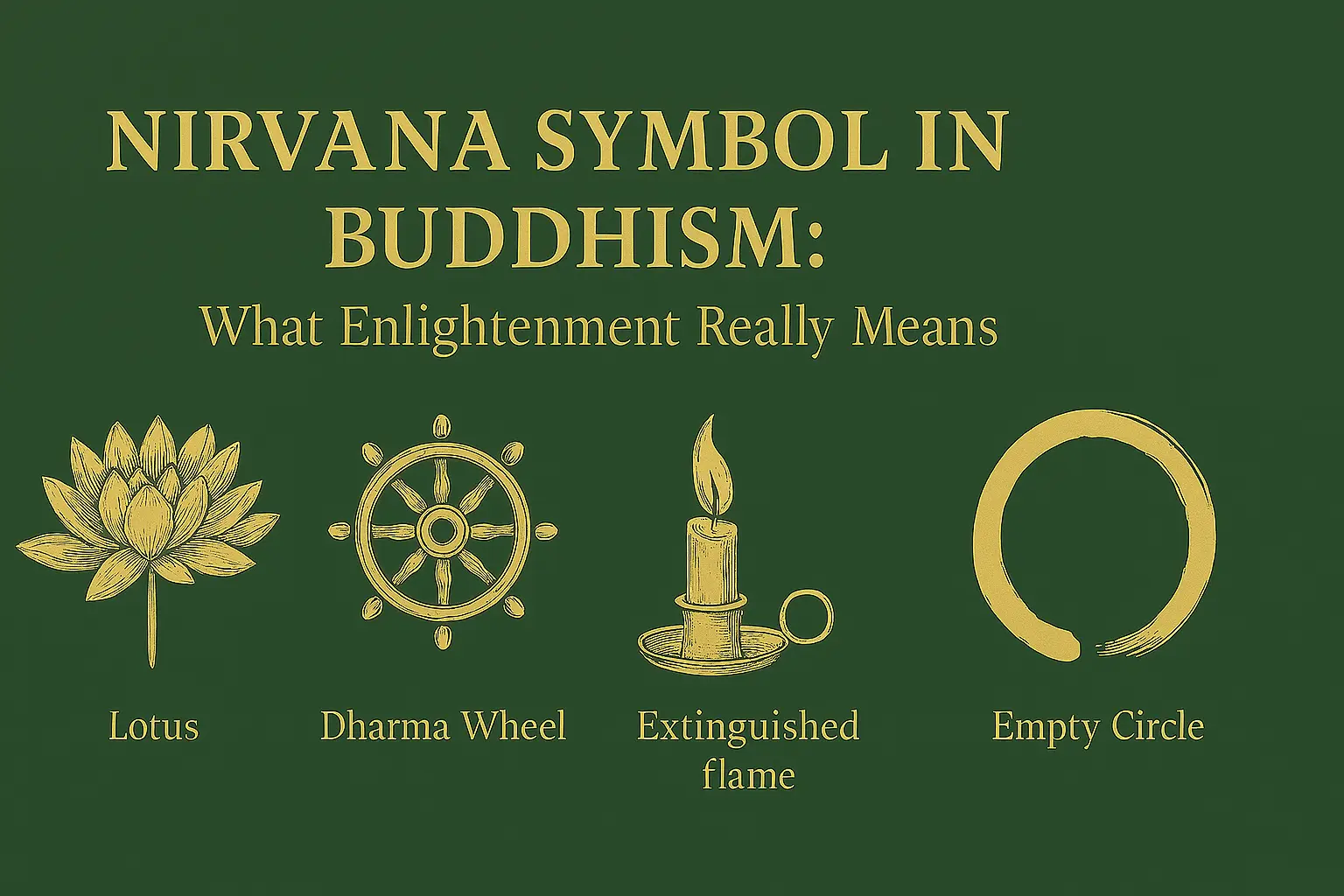
• Symbols like the lotus flower, the Eightfold Path, the Dharma Wheel, and the extinguished flame hint at the experience of nirvana
• Buddhist teachings emphasize that nirvana cannot be depicted, only realized through deep inner transformation
• Practicing meditation, ethics and mindfulness is the path toward that realization
What is Nirvana in Buddhism?
To understand the symbol of nirvana, we must first understand nirvana itself.
In Buddhist teachings, nirvana (or nibbāna in Pali) is the highest state of liberation, the end of suffering, the extinguishing of delusion, and the freedom from the endless cycle of birth and death.
It is often described by negation: not clinging, not craving, not ignorance. But at its heart, nirvana is not nihilism. It is peace without conditions, clarity without conflict.
Unlike religious heavens, nirvana is not a paradise. It’s not somewhere we go. It is something we uncover by removing what clouds the mind.
As Oxford Reference puts it, nirvana is “the extinction of all desires, passions, and delusions that bind one to the cycle of rebirth.”
Why Nirvana Has No Image
In a tradition rich with sacred art, why does nirvana have no fixed image?
The answer is simple. Nirvana is unconditioned. It lies beyond all things that arise and pass, including symbols themselves. Any attempt to draw it, define it, or box it in becomes something less than what it points to.
That said, Buddhist culture has long used indirect symbols to evoke the qualities of nirvana,its stillness, clarity, and spaciousness. These are not meant to describe nirvana, but to guide us toward it.
Symbols That Point Toward Nirvana
The Lotus Flower
The lotus, rising from muddy water, is one of Buddhism’s most powerful metaphors. It represents the practitioner’s journey from samsara (confusion and suffering) into the purity and openness of enlightenment.
In many traditions, the Buddha is shown seated on a lotus, not as decoration, but to remind us: awakening is possible in this very life, even amidst our pain.
The Dharma Wheel (Dharmachakra)
The Eight-Spoked Wheel, or Dharmachakra, symbolizes the Eightfold Path, the practical path the Buddha taught for walking toward nirvana. Each spoke represents a part of that path: right view, intention, speech, action, livelihood, effort, mindfulness, and concentration.
This wheel spins not in theory, but in daily life.
The Extinguished Flame
The literal meaning of nirvana is “to blow out,” like a flame going out. But it is not a flame extinguished in despair; it is the extinguishing of the fire that burns within: greed, hatred,and delusion.
Some early Buddhist images used a small empty circle, or a lamp being put out, to symbolize this freedom.
The Empty Circle or Open Sky
In some Zen or Mahāyāna traditions, nirvana is represented as an open circle, or even a blank space. These are reminders that what we seek cannot be grasped, only experienced.
As the Buddha said, “There is a realm where there is no earth, no water, no fire, no air… and that, monks, I call the end of suffering.”
You can read more about these interpretations at BuddhaNet, which provides trustworthy explanations from canonical texts.
The Path to Nirvana: A Daily Practice, Not a Concept
Buddhism is not a system of belief, but a system of practice. The way to nirvana is not through worship, but through ethical living, meditation, and insight.
• Practicing right speech and right action cultivates clarity.
• Mindfulness and meditation help untangle craving and illusion.
• Letting go of self-centered views gradually loosens the grip of suffering.
For lay practitioners, nirvana is not always a dramatic experience. It can begin as a subtle cooling, a release from clinging in the moment, a deep breath after long struggle.
Some traditions honor the bodhisattva vow, where enlightened beings choose to remain in the world rather than fully enter nirvana, so they can help others wake up. This points to another truth: compassion and awakening are not separate.
Final Thoughts
We live in a world full of striving. We reach for more, avoid pain, chase meaning. Nirvana is the gentle reminder that peace isn’t found by adding more, but by letting go.
It’s not about perfecting yourself. It’s about seeing clearly, perhaps for the first time, what has always been here.
You may never see a statue or mural that says, “This is nirvana.” But in the quiet moment after you release resentment, or in the pause before a reaction, you may glimpse it.
The symbol of nirvana is not a thing. It is the space where craving ends and freedom begins.
A Quiet Place to Begin Your Journey
If you are visiting Kathmandu to reflect, study, or simply breathe more deeply, staying near sacred sites can support your path.
At Boudha Mandala Hotel, we welcome seekers from all walks of life. Whether you’re beginning to explore Buddhism, attending a retreat, or walking the kora at dawn, our calm atmosphere helps you listen inward.
If you’re looking for a peaceful hotel near Boudhanath Stupa, or simply want the best boutique stay in Boudha where you can rest between temples, we are just 30 seconds from the stupa and surrounded by monasteries.
Sometimes, the journey toward nirvana begins with stillness. And stillness begins with where you choose to be.