Where Did Buddhism Begin?

Key Takeaways

• Buddhism began in the 6th century BCE in Lumbini, present-day Nepal, with the birth of Siddhartha Gautama

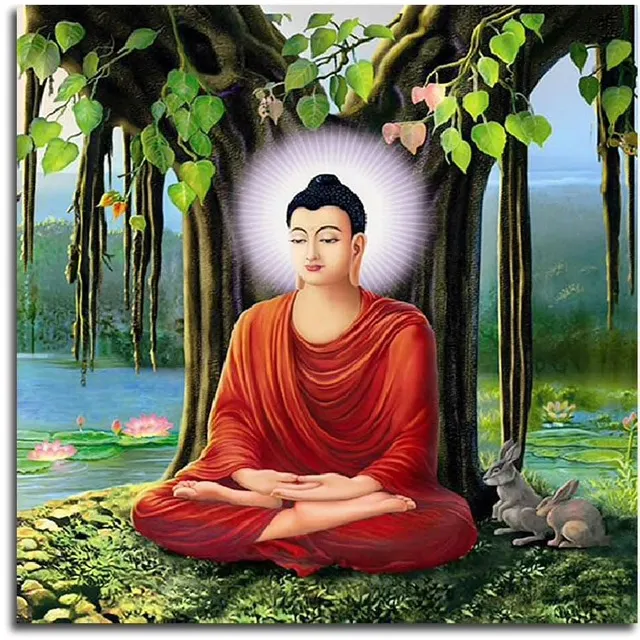
• The Buddha awakened under a bodhi tree in Bodh Gaya, India, after years of sincere practice

• His first teaching, the Four Noble Truths, was shared at Sarnath, marking the beginning of the Sangha

• Buddhism’s origin is not just history, but a spiritual geography that shaped how awakening was lived, taught, and shared

• These sites, Lumbini, Bodh Gaya, Sarnath, remain living places of pilgrimage, reverence, and inner return

Lumbini: The Beginning Beneath the Sal Trees

I remember walking barefoot through the quiet gardens of Lumbini just before dawn. A soft breeze passed through the prayer flags. Somewhere, a monk’s bell rang. And for a moment, I understood why so many come here to begin their inner journey.

Lumbini isn’t just a UNESCO site, it’s the very place where Prince Siddhartha was born over 2,600 years ago. According to tradition, his mother, Queen Māyā, gave birth standing under a sal tree while on pilgrimage. Even then, the path was framed by intention, not accident.
What began there wasn’t a religion, but a question: What causes suffering, and how can it end? That question still echoes in the stillness of the Lumbini monastic zone, where pilgrims from dozens of Buddhist traditions come not to agree, but to remember.

UNESCO – Lumbini, the Birthplace of the Lord Buddha

Bodh Gaya: The Silence of Realization

Not far from the banks of the Niranjana River, in the town of Bodh Gaya, Siddhartha sat beneath a fig tree and resolved not to rise until he understood the nature of suffering. Days passed. His mind turned inward, then opened.

What unfolded there was not revelation from a divine voice, but a direct seeing into impermanence, craving, and liberation. He became the Buddha, the Awakened One.

When I visited Bodh Gaya years ago, I saw monks from Tibet, Thailand, Burma, and Bhutan taking turns circumambulating the Mahabodhi Temple. Each brought their own language and robes, yet the devotion felt the same, quiet, humble, unwavering.

This is not a place for tourists. It’s a place for those ready to meet themselves.

Sarnath: When Wisdom Was Shared

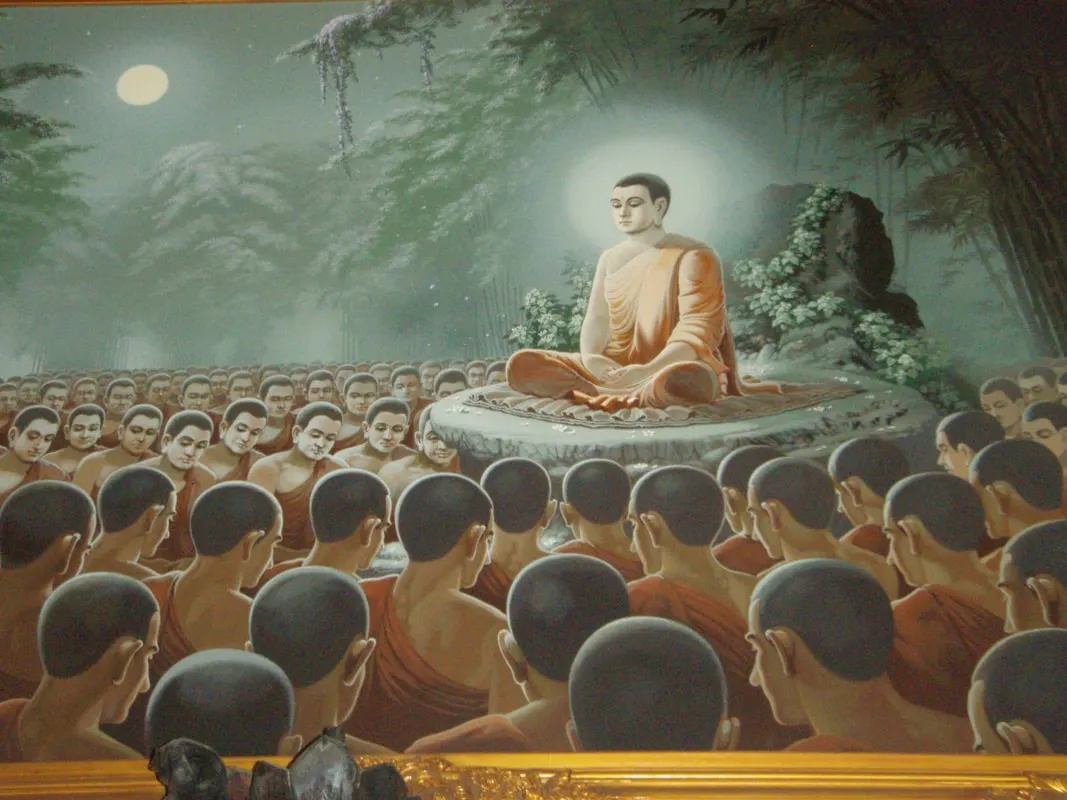
After awakening, the Buddha walked to Sarnath, where five former companions were practicing asceticism. There, in the deer park, he offered his first teaching, the Four Noble Truths. In doing so, he turned the Wheel of Dharma, and the Sangha was born.

Unlike modern lectures, this wasn’t an intellectual exercise. It was a compassionate offering. A way to describe a path that anyone, monk or layperson, could walk toward peace.

I always tell our long-stay guests at Boudha Mandala Hotel, if you ever feel ready to hear the Dharma for the first time, read the Dhammacakkappavattana Sutta as if you were sitting among those five. Then listen to your breath.

Britannica – Origin and Spread of Buddhism

From India and Nepal, the Path Blossomed Outward

Buddhism did not remain local. Within a few centuries, the teachings traveled, carried not by conquest, but by monks on foot, pilgrims with alms bowls, and hearts stirred by compassion.

Emperor Ashoka played a critical role, sending emissaries across Asia. In Sri Lanka, Buddhism became deeply rooted as Theravāda. In Tibet, it flourished through ritual and tantric practice. In China, it blended with local thought to give birth to Chan (Zen). In Japan, it became embedded in art, tea, and temple life.

Yet the heart of it all still pulses in three places: Lumbini, Bodh Gaya, and Sarnath. Not as monuments to the past, but as mirrors for the present.

Why These Origins Matter Today

For many spiritual seekers today, Buddhism begins with a book, a retreat, or a YouTube talk. But something changes when you connect to its physical beginnings.

To stand where the Buddha walked is to see the teachings not as abstract ideas, but as lived truths. The silence of Bodh Gaya is not metaphor. It’s palpable. The morning chants in Lumbini are not performance. They are remembrance.

Whether you’re a pilgrim, a digital nomad seeking clarity, or someone simply longing for inner stability, the origins of Buddhism invite you to pause. To step out of theory and back into place. Into ground. Into being.

FAQs

Q1: Where did Buddhism begin?

A: Buddhism began in Lumbini, in present-day Nepal, with the birth of Siddhartha Gautama in the 6th century BCE. He later attained enlightenment in Bodh Gaya, India.

Q2: What are the key places tied to early Buddhism?

A: Lumbini (birth), Bodh Gaya (awakening), Sarnath (first teaching), and Kushinagar (passing into parinirvana). These form the core pilgrimage sites of Buddhism.

Q3: Was Buddhism always a religion?

A: No. It began as a path of liberation. The Buddha offered tools, mindfulness, ethics, meditation, for awakening, not worship.

Q4: Can I visit these places today?

A: Yes. Each is a maintained pilgrimage site. Lumbini and Bodh Gaya are especially vibrant with global monastic communities and daily rituals.

Q5: How does knowing the origin help my practice?

A: It roots your understanding. The teachings become not just philosophy, but part of the human journey, shaped by place, time, and silence.

Looking for a Place to Reflect on the Buddhist Path?

Just 10 seconds from the great stupa of Boudhanath lies a quiet space held with care. At Boudha Mandala Hotel, we host those who seek more than a room. We host those seeking refuge, rhythm, and return.

Whether you’re a pilgrim retracing the Buddha’s footsteps or a mindful traveler looking for a peaceful hotel near Boudha, let us be your base. Our stupa-view rooms, calm café, and retreat-like quiet offer more than comfort, they offer belonging.

You’re always welcome to begin again.

Best Buddhism Books for Every Stage of the Journey

Key Takeaways

• The best books on Buddhism depend on your path, whether you are just beginning, deepening, or remembering.

• Buddhist books are not merely to be read, but absorbed. They are companions for inner clarity.

• Start with Thich Nhat Hanh, Bhikkhu Bodhi, or Walpola Rahula for grounding.

• As you deepen, Pema Chödrön, Ajahn Chah, and the Dalai Lama become gentle yet radical voices.

• Buddhist scriptures are not reserved for scholars, they’re living texts meant to be lived.

• The most important book is the one that makes you stop, breathe, and soften.

How to Choose a Buddhist Book That Truly Resonates

If you walk into a monastery library, you’ll often see not just rows of texts, but flowers on the shelves. In Buddhism, the right book isn’t just a source of knowledge, it’s an offering. Something sacred. Something that meets the reader exactly where they are.

Some books speak when we’re broken. Others arrive when we’re ready. Your journey matters more than the book list. Ask yourself:

“Do I need to understand? Or do I need to feel held?”

For Beginners: Books That Gently Open the Dharma

When I first came across the Dharma, I was overwhelmed. So many teachings. So many traditions. But the right book felt like a hand on my back.

If you’re beginning, these books are clear, honest, and simple without being simplistic:

• “The Heart of the Buddha’s Teaching” by Thich Nhat Hanh
This is the kind of book that makes the Dharma feel like home. Gentle, poetic, but deeply rooted in core teachings, suffering, mindfulness, compassion.

• “What the Buddha Taught” by Walpola Rahula
Direct and scholarly, yet accessible. A Theravāda classic that lays out the Four Noble Truths and Eightfold Path with no frills or mysticism.

• “In the Buddha’s Words” edited by Bhikkhu Bodhi
A remarkable collection of sutta translations, carefully organized by theme. Bhikkhu Bodhi adds helpful introductions that bring ancient texts to life.

These are not just books for learning Buddhism. They are books for living it.

For Practitioners: Books That Deepen the Path

Once the teachings settle into your bones, you begin to see how real they are, in joy, in grief, in love, in confusion. These are the books that meet you there.

• “When Things Fall Apart” by Pema Chödrön
This is not a comforting book. It’s a truthful one. Pema speaks from the messy middle: heartbreak, impermanence, and the fierce grace of letting go.

• “The Art of Happiness” by the Dalai Lama & Howard Cutler
A dialogue between Tibetan wisdom and Western psychology. Kind, accessible, and surprisingly personal.

• “Being Dharma” by Ajahn Chah
A collection of talks from one of Thailand’s great forest masters. Practical, humorous, and sometimes painfully direct.

These books don’t offer escape. They offer mirrors.

For Meditators and Contemplatives

Meditation is not an achievement. It’s a returning. These books are practical and poetic roadmaps for that return.

• “Mindfulness in Plain English” by Bhante Gunaratana
As honest as the title suggests. Perfect for anyone starting or restarting their practice.

• “The Miracle of Mindfulness” by Thich Nhat Hanh
One of the most beloved introductions to present-moment awareness. More than a guide, it’s a meditation in itself.

• “The Attention Revolution” by B. Alan Wallace
A deeper dive into śamatha practice (calm abiding). Ideal for those wanting to refine focus and clarity.

These texts are best read slowly, like tea. Sip, pause, return

Buddhist Scriptures and Classical Texts (For Serious Study)

Some books are not just read, they are bowed to.

• The Dhammapada
Short verses with endless depth. You’ll return to this again and again.

• The Tibetan Book of Living and Dying by Sogyal Rinpoche
A bridge between Tibetan Buddhist views on death and modern spiritual inquiry. Especially powerful for hospice workers, healers, and those in grief.

• The Majjhima Nikāya (Middle-Length Discourses)
If you want to hear the Buddha’s voice as close to original as possible, start here. Not easy, but immensely rewarding with guidance.

For deeper study, you can explore Oxford Centre for Buddhist Studies or the Plum Village Library.

Final Reflection

Books in Buddhism are not meant to impress you. They’re meant to transform you. You might read a hundred titles and remain stuck. Then one sentence, at the right time, opens the sky.

Sometimes that sentence appears in a monastery. Sometimes in a guesthouse. Sometimes, alone, in the quiet of your own questioning.

Let the book find you. And when it does, don’t rush. Let it whisper. Let it challenge. Let it remind you that wisdom is not elsewhere, it’s here, in your breath, your body, your moment-to-moment response to life.

FAQs on Buddhist Books

What’s the best Buddhist book to start with?

“The Heart of the Buddha’s Teaching” by Thich Nhat Hanh is often the gentlest and clearest doorway for beginners.

Are Buddhist books religious or philosophical?

Both. But they’re also deeply experiential. Good books don’t just explain, they help you practice, reflect, and live differently.

Can I read Buddhist scriptures without being a monk?

Absolutely. The teachings were meant for all beings. With good commentary or a teacher, even dense texts become accessible.

What if a book feels too intellectual or abstract?

Set it down. Find another. Buddhism is vast. Your heart will recognize the book that’s right for you now.

Is it better to read many books or go deep into one?

Depth is better than quantity. Let one book change you, rather than reading ten that only touch the surface.

Want to Read, Reflect, and Stay in a Space That Honors the Teachings?

At Boudha Mandala Hotel, we meet travelers, monks, artists, and readers who arrive with a book in one hand and a quiet longing in the other.

Just steps from the great stupa of Boudhanath, we offer a peaceful base where the teachings feel close, whether you’re reading The Dhammapada in our garden or journaling after a monastery walk.
If you’re looking for a peaceful hotel near Boudha, we invite you to stay, breathe, and begin again.

Buddhist Meditation Techniques You Should Know

If you’ve ever searched for a meditation retreat in Kathmandu, you’ve likely felt that pull, the need to step away from noise and move toward something quieter and more grounded.

That’s why so many end up in Boudha.

Boudha feels like a different rhythm. Mornings begin with the low hum of chants and the soft turning of prayer wheels. So, what do you actually learn on a meditation retreat in Boudha?

Let’s take a closer look at the Buddhist meditation techniques from foundational breath practices to compassion-based methods rooted in Tibetan Buddhism.

Key Takeaways

The most common Buddhist meditation techniques techniques taught at Boudha retreats include:

– Shamatha (Calm-Abiding Meditation): A foundational breath-based practice to develop focus and mental stillness.

– Vipassana (Insight Meditation): Teaches you to observe sensations, thoughts, and impermanence with clarity and presence.

– Tonglen & Loving-Kindness (Metta): Compassion-based techniques that help open the heart and reduce self-centered thinking.

– Walking Meditation Around the Stupa: A unique local ritual of mindful walking and mantra recitation around Boudhanath Stupa.

– Mantra & Chanting Meditation: Sound-based practices using Tibetan mantras to calm the mind and connect with intention.

Why Boudhanath Feels Different

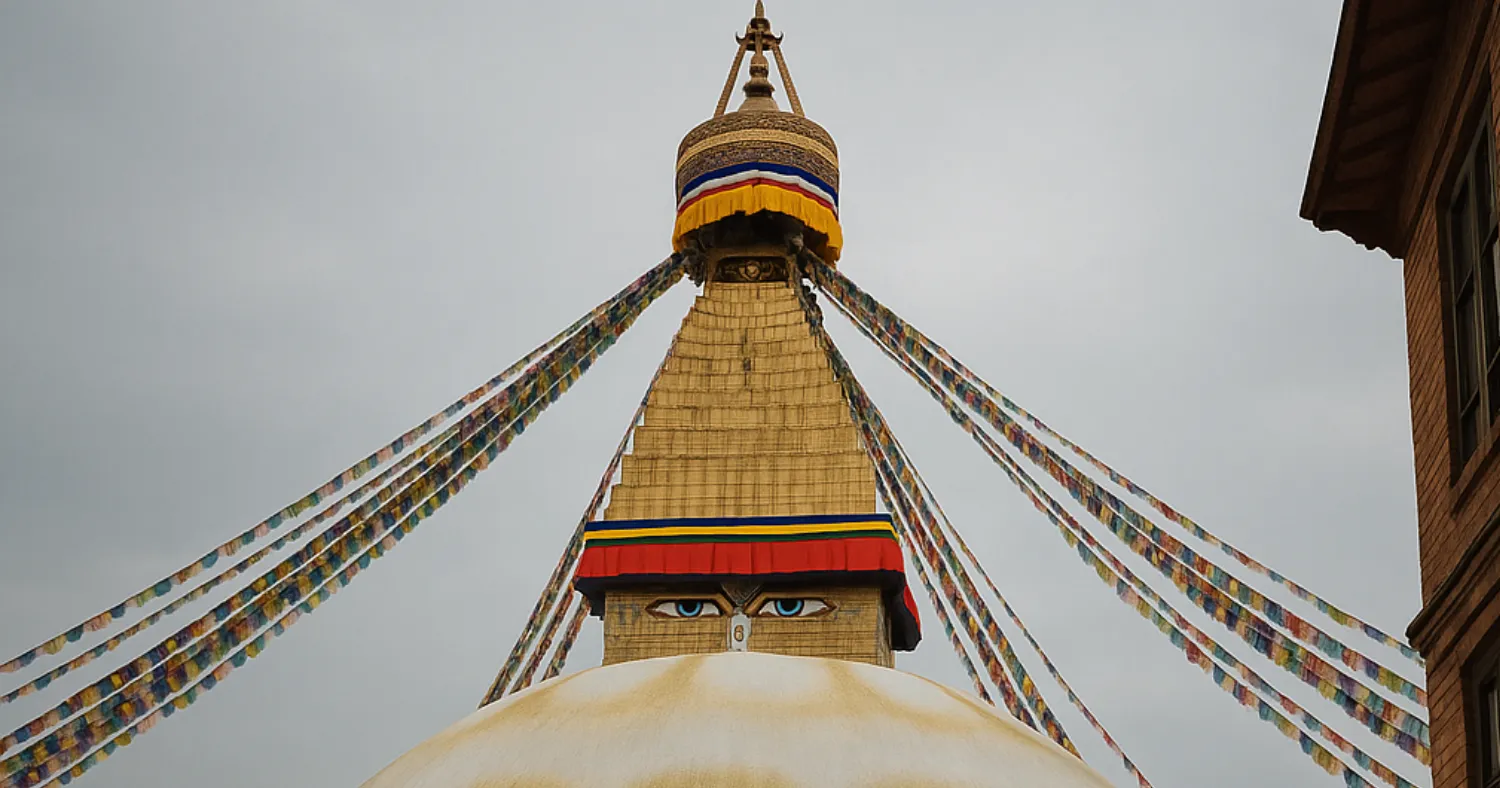
The stupa here has stood for centuries. It’s one of the most important sites in Tibetan Buddhism not just in Nepal, but in the world.
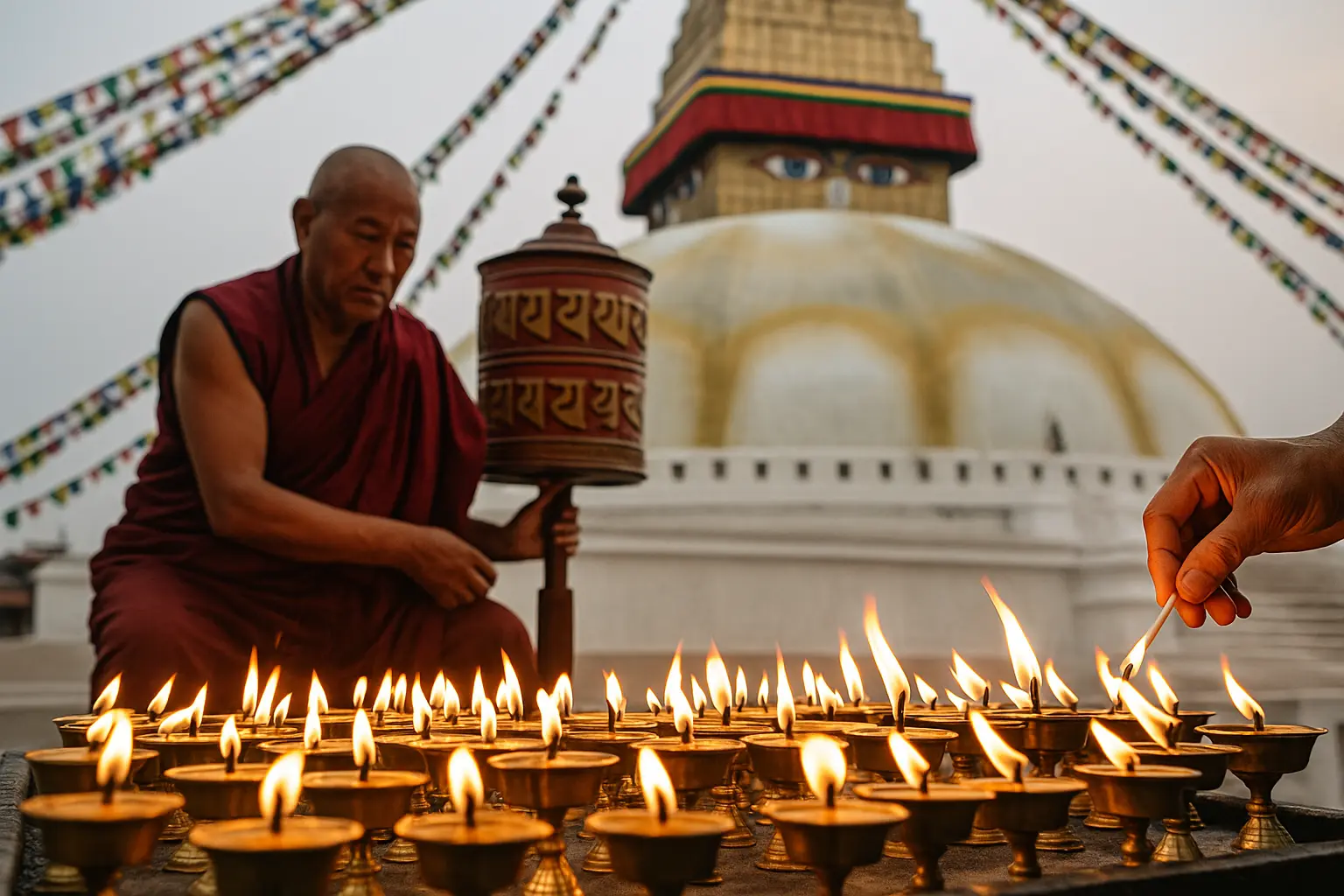
Around it, over fifty monasteries form a living circle of practice. You’ll hear chants, see butter lamps flickering at dusk, and feel something hard to describe.
Unlike Thamel or other tourist-heavy areas, Boudha moves slowly. It gives you permission to do the same.

Buddhist Meditation Techniques Taught in Boudha Retreats

Most retreats in this area are grounded in Buddhist tradition, especially Tibetan lineages. Whether you’re joining a group or practicing on your own, these are the buddhist mediation techniques you’re likely to learn.

Shamatha (Calm-Abiding Meditation)

This is the foundation. You focus on the breath, or sometimes a visual object. When your mind wanders which it will, you gently return.

That’s it. No pressure.

Shamatha trains attention and steadies the nervous system. You begin to notice space between thoughts. Many meditation retreats in Kathmandu use this as a base for deeper practices.

Vipassana (Insight Meditation)

Vipassana helps you see clearly. It’s not dramatic. You sit, observe sensations, and notice how everything changes, breath, sound, mood, thought.

This technique can be taught in both silent retreats and more interactive sessions. In Boudha, you’ll often find a Tibetan approach that includes guided reflection and time for questions.

It’s not about analyzing your life. It’s about learning to be with it, as it is.

Tonglen and Loving-Kindness (Metta)

These practices shift the focus from clarity to compassion.

In Tonglen, you breathe in discomfort or pain your own, or the world’s and breathe out relief, warmth, kindness.

Metta practice involves sending goodwill to others. You might begin with someone you love, then extend it to someone neutral, and eventually, even someone difficult.

Both techniques are common in retreats around Boudha, especially those led by Tibetan teachers. They balance awareness with heart.

Walking Meditation Around the Stupa

This isn’t always listed in retreat brochures, but it’s one of the most powerful practices here.

Each morning and evening, people walk slowly around Boudhanath Stupa. Some spin prayer wheels. Some count mala beads. Others just walk quietly, steady and present.

It’s informal but deeply meditative. You’re welcome to join anytime. No one will stare. No one will stop you.
You just walk.

Mantra and Sound Practices

Chanting is part of daily life in Boudha. Retreats often begin or end sessions with mantras, Om Mani Padme Hum is the most common.

You don’t need to sing well or believe in anything specific. You just let the rhythm carry your focus.

Some retreats include explanations. Others let the practice speak for itself. Both work.

Who Teaches These Practices?

Teachers in Boudha come from different traditions. Some are Tibetan lamas who’ve trained since childhood.

Others are Nepali monks, Western practitioners, or nuns fluent in English.

Most retreats are beginner-friendly. No robes, no dogma. Just real people sharing what they’ve learned, often with great care and humility.

You’ll find both structured retreats and informal drop-in sessions. The common thread is kindness and clarity.

What a Retreat Day Feels Like

Here’s a simple flow many Boudha retreats follow:

– Early morning meditation

– Silent breakfast

– Teaching or group practice

– Breaks for journaling or rest

– Afternoon session (chanting, compassion practice, walking meditation)

– Light dinner and evening reflection

Some retreats are silent. Others allow for questions and conversation. Most are gentle, respectful, and allow space for your own rhythm.

Where to Stay If You’re Practicing Near Boudha

Not everyone comes for a formal retreat. Some arrive needing quiet, and create their own rhythm.

Boudha Mandala Hotel is the one of the best hotels in Boudha that feels like a retreat.

It’s about 10 seconds from the stupa gates, but far enough from the crowds to stay peaceful. Here’s what it offers:

– Stupa-view rooms with small balconies

– Long-stay apartments with kitchens

– An organic café for quiet breakfasts

– Staff who understand retreat culture and respect your space

If you’re attending a meditation retreat in Kathmandu, or looking to do your own in a gentle way, this is a solid base.

What You’ll Actually Learn

The techniques matter. The teachers matter. But what you’ll really learn in Boudha is how to slow down.

How to listen. How to sit with yourself without fixing anything. How to walk a little more lightly in the world.

If that’s what you’re looking for, you don’t need to have it all figured out. Just come. Stay a few days. Let the place do its work.

Sometimes, the simplest practice is the most honest one.

Does Buddhism Believe in Karma? Teachings Explained

What Karma Really Means in Buddhism

In my early years of monastic life, I asked a senior teacher what karma was. He didn’t reach for scriptures. He didn’t even speak right away. He held up a cup of tea and simply said, “Everything that led to this moment, and what you choose next.”

In Buddhism, karma means volitional action. It’s not fate, not superstition, not reward or punishment from above. It is the natural echo of intention. What you plant in your speech, your thoughts, your hands, those seeds grow.

And here’s the nuance: karma is not only about the act. It’s about the intention behind it. Two people can give the same donation. One gives to impress, the other out of compassion. The outer action looks identical. But karmically, they are as different as storm and stillness.

Karma Isn’t About Blame. It’s About Possibility.

We often hear people say, “That’s my karma.” Usually with resignation, as if they’re stuck. But in the Buddha’s teaching, karma isn’t a prison. It’s an invitation. A chance to look closely at how our lives unfold, not because we’re being judged, but because we’re being shown something.

Think of karma as a kind and unrelenting teacher. If I speak with anger, I carry the heaviness of that anger in my body. If I lie, I fracture trust in the world around me. But if I respond with patience or generosity, peace becomes a little more available.

This is why mindfulness matters. Without seeing what we’re planting, how can we hope for a harvest of peace?

According to the Dhammapada:Key Takeaways

• Buddhism recognizes karma as intentional action, what we think, say, and do matters

• It’s not divine punishment, nor destiny. It’s a mirror, and a chance to wake up

• Karma influences not just rebirth, but how peace or suffering unfolds in each moment

• Buddhist practice invites us to see karma clearly, so we can live and respond with freedom

Our past shapes us, but never defines us. The future is shaped by how we meet this moment

“Mind is the forerunner of all actions. All deeds are led by mind. If one speaks or acts with an impure mind, suffering follows… If one speaks or acts with a pure mind, happiness follows.”
Source: Access to Insight

Does Karma Carry Into the Next Life?

Yes, in Buddhist cosmology, karma travels. It moves across lifetimes like wind shaping dunes. But it’s not a simple bookkeeping of good versus bad. It’s subtler.

At the time of death, the quality of mind we’ve nurtured matters deeply. Have we practiced letting go? Are we still clinging? That momentum carries forward, shaping where and how we’re reborn.
But, and this is essential, karma is not deterministic. A single moment of true insight can shift lifetimes of conditioning. The past is influential, yes. But never absolute.

According to the BBC, karma in Buddhism is both cause and condition, but the emphasis is always on responsibility, not guilt.

How Karma Differs From Other Views

Many religious traditions speak of karma, but Buddhism approaches it differently. There is no eternal soul (no atman), no divine scorekeeper. Karma in Buddhism flows through causal interdependence, the same principle that governs wind, decay, and sunrise.

Western interpretations often reduce karma to “you get what you deserve.” But the Dharma doesn’t moralize that way. It simply says: action has consequence. Craving creates suffering. Clarity opens peace.

And crucially, karma is not just about what happens to us. It’s about how we respond. Even if pain arises from past causes, our present response can transform that trajectory.

The Role of Karma in Liberation

Why does karma matter so deeply on the Buddhist path?
Because it helps us wake up to our patterns. The moment you realize that reacting with irritation only strengthens the roots of restlessness, you begin to soften. The first time you hold your tongue in compassion, a different path opens.

Through mindfulness, precepts, meditation, and especially wise intention, we begin to interrupt the cycles of suffering. Karma becomes less about avoiding pain, and more about planting conditions for awakening.

We are not bound by our past. We are bound by unawareness of our past. That’s what the Dharma helps undo.

Final Reflection

If you remember one thing from this, karma is not there to trap you. It’s there to reveal you, to reflect the causes we’ve set in motion, and the freedom we still have to choose differently.

At the heart of Buddhist hospitality is this: we greet each guest as a being with stories, causes, and possibilities. Just as we care for the outer space, we learn to care for the karmic space, the unseen atmosphere shaped by thought, speech, and deed.

You are not the sum of your past actions. You are the potential for a new one, right now.

A Space to Reflect on Karma

If you’re seeking a space in Kathmandu where the teachings aren’t just read, but lived, where the silence of the stupa echoes the stillness you’re cultivating, consider staying at Boudha Mandala Hotel.

If you’re searching for a peaceful hotel near Boudha, we welcome you with warmth, clarity, and the stillness to walk your path.

FAQs on Karma in Buddhism

Is karma the same as fate?

No. Karma is not fixed or final. It’s dynamic. We are always shaping it. Each mindful breath, each kind gesture, can shift old patterns.

Can karma be changed or purified?

Yes. Not through magic, but through sincere effort, ethical living, and awareness. Karma isn’t about punishment, it’s about patterns. And all patterns can be softened with clarity and love.

Is karma only about rebirth?

Not at all. While it influences rebirth, karma is also moment-to-moment. What you do now shapes your experience of now.

Can good karma cancel bad karma?

It’s not arithmetic. Karma isn’t a ledger. It’s a flow. Skillful actions shift the flow toward freedom, unskillful actions toward suffering. Both can exist simultaneously. But clarity changes everything.

Enlightened Buddhist Crossword Clue, More Than Just a Puzzle Key Takeaways

Key Takeaways
The crossword clue “Enlightened Buddhist” usually points to Buddha, Arhat, or Bodhisattva, depending on the letter count

• These aren’t just answers, they represent real paths of awakening in the Buddhist tradition

• Buddha means the one who fully awakened to the nature of suffering and liberation

• Arhat refers to a practitioner who has reached Nirvana, especially in Theravāda Buddhism

• Bodhisattva is a figure of deep compassion in Mahāyāna, who stays behind to help others

• Behind the crossword clue lies a profound invitation to reflect on what enlightenment truly means

Solving the Clue: A Glimpse Into the Dharma

If you came here searching for help with a crossword puzzle, you’re not alone. Every day, thousands type into search engines things like:

“Enlightened Buddhist, 6 letters”
“Buddhist enlightened being”
“Crossword clue: awakened teacher”

The answer you’re looking for might be Buddha, or Arhat, or Lama, depending on your grid. But if you’ll stay a little longer, we can offer more than an answer, we can offer some clarity.

Which Words Appear in the Puzzle (and Why)

Here’s what shows up most commonly in major crosswords:
Buddha (6 letters): The most direct answer. “The awakened one,” who founded Buddhism.

• Arhat (5 letters): A being who has reached final liberation in Theravāda Buddhism.

• Lama (4 letters): A teacher or guide in Vajrayāna Buddhism, especially Tibetan traditions.

• Bodhi (5 letters): Sometimes used poetically to refer to enlightenment, from bodhi, “awakening.”

• Sage, Guru, or Saint: Looser terms used more in general religion-themed puzzles.

Each of these carries centuries of history and a depth that deserves more than a passing guess.

Who Is the Buddha, Really?

The word Buddha means “awakened one.” Not chosen, not born divine,awakened. That’s an important distinction.

Siddhartha Gautama, the historical Buddha, was a seeker like many of us. He lived in what is now Nepal and northern India more than 2,500 years ago. Disturbed by the realities of aging, sickness, and death, he walked away from a life of wealth to search for the root of human suffering.

What he found was not a dogma, but a path. A way of seeing life clearly. A way of being present with pain, desire, joy, and impermanence without clinging. What he taught wasn’t about worship,it was about waking up.

In Buddhist countries today, people still say they are “walking the path of the Buddha,” not because he is a distant icon, but because his footsteps still ring true. Learn more about the life and meaning of the Buddha from this contextual biography by Britannica.

What Is an Arhat?

In the Theravāda tradition, especially in Southeast Asia, the goal of practice is to become an Arhat,a fully liberated being.
An Arhat has seen through the illusion of ego, has let go of all grasping and aversion, and no longer returns to the cycle of rebirth. They live with a deep steadiness, free from mental defilements.

The word Arhat is sometimes translated as “worthy one.” Not in the sense of achievement, but in the sense of profound humility,they are worthy because they have ceased to harm, to grasp, to cling.

You won’t find Arhats on Instagram. But in monasteries across Myanmar and Sri Lanka, their quiet presence lives in the teachings, in the silence, and in the way young monks bow as they pass a senior.

Bodhisattva: The Compassionate Return

In Mahāyāna Buddhism, particularly in Tibet, China, and Japan, the ideal shifts. Rather than seeking one’s own liberation, the Bodhisattva takes a vow:

“I will not cross the threshold of final Nirvana until all beings are free.”

The Bodhisattva has the wisdom to leave, but the heart to stay. They return to the world, again and again, as teachers, healers, artists, protectors. Avalokiteśvara, the Bodhisattva of Compassion, is perhaps the most widely loved. In Nepal and Tibet, he appears as Chenrezig. In Japan, as Kannon. In China, as Guanyin.

This ideal is not for the proud. It’s for the broken-hearted. The ones who feel the world’s pain and choose to serve anyway.

Learn more about these paths from Access to Insight’s guide to Buddhist practice, including Arhats and Bodhisattvas.

Crossword to Contemplation: A Sacred Shift

It’s funny how something as simple as a crossword clue can open a door.

Maybe you were just filling out your morning puzzle. But now you’re reading about compassion, awakening, liberation. That’s no accident.

In Buddhism, we often speak of seeds. The right word at the right moment can be a seed that blooms years later.

Maybe Buddha is just your six-letter answer today. Or maybe it’s the start of a question that stays with you.

A Place to Reflect on These Words with Your Whole Being

Just a few steps from Boudhanath Stupa, in Kathmandu, the air itself seems to chant. Monks walk quietly at dawn. Pilgrims spin prayer wheels with weathered hands. And the question of what it means to be “enlightened” doesn’t feel academic,it feels alive.

If you find yourself drawn to this question, you’re not alone.

At Boudha Mandala Hotel, we host guests who come not to escape life, but to understand it more deeply. Some are on pilgrimage. Some are artists or thinkers. Some come with grief. Some with curiosity. But all are welcome.

If you’re seeking a peaceful hotel near Boudha, a place where spiritual words are more than crossword clues,this is where your journey deepens.

FAQs

Q1: Is “Buddha” the most common crossword answer?

A: Yes, especially in six-letter formats. It’s the most direct reference to an enlightened Buddhist figure.

Q2: What’s the difference between Arhat and Bodhisattva?

A: An Arhat seeks personal liberation; a Bodhisattva chooses to delay final Nirvana to help others.

Q3: Are these terms still used in modern Buddhism?

A: Absolutely. They remain central to both monastic and lay practice, especially in Southeast and East Asian traditions.

Q4: Why would a crossword include these terms?

A: They’re part of world religion literacy and increasingly common in modern spiritual discourse.

Q5: Can solving a puzzle be a spiritual act?

A: Sometimes. Any moment of curiosity, when met with presence and openness, becomes a doorway.
How Nepal’s Landscape Shapes Mindset, Patience, and Daily Life

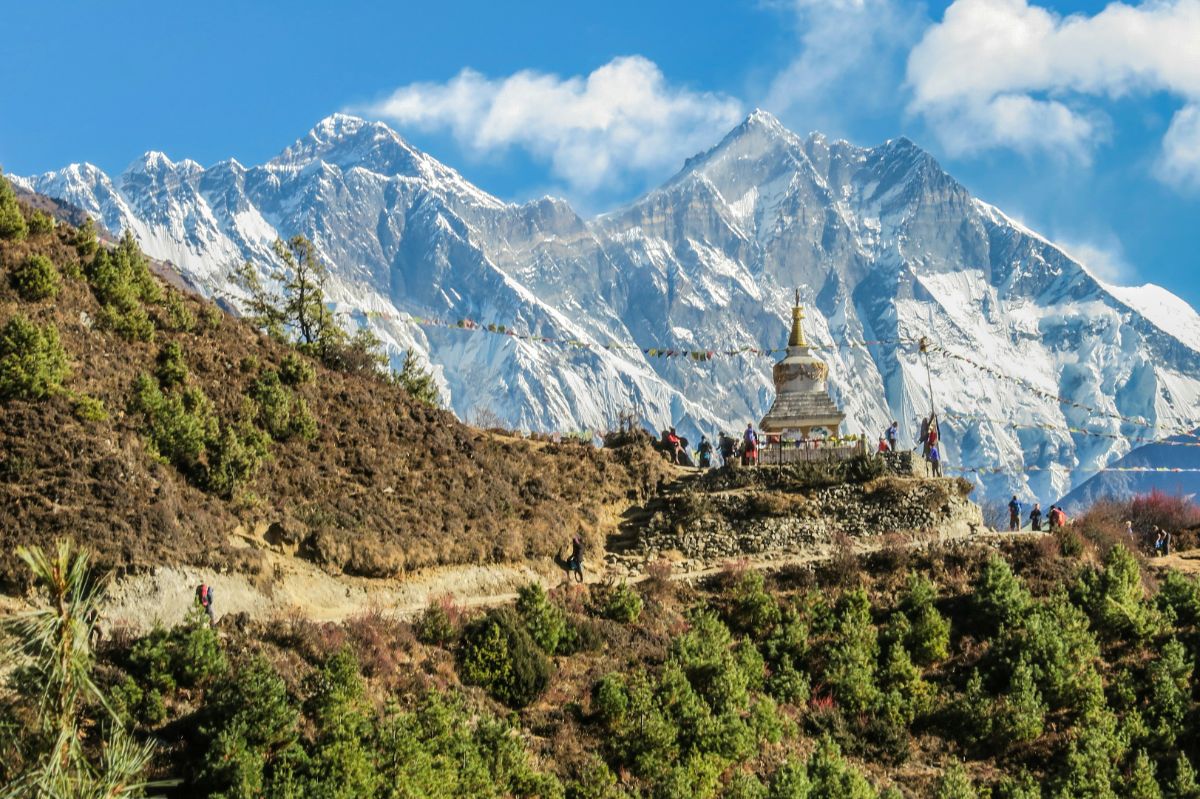
Nepal doesn’t just look different on a map. It thinks differently because of that map. When you understand how mountains, hills, valleys, and plains shape daily life here, Nepali attitudes toward time, effort, patience, risk, and community start to make sense. Geography in Nepal isn’t background. It’s the quiet force behind how people move, decide, and relate to the world.

This is not abstract. You feel it the moment you start traveling through the country.

Why geography matters more in Nepal than most places?

Because geography is unavoidable here, Nepal rises from near sea level to the world’s highest mountains in a short horizontal distance. Roads bend, disappear, and reappear. Weather changes fast. Access is never guaranteed.

In many countries, infrastructure overcomes geography. In Nepal, people adapt to it instead. That adaptation shapes mindset. You plan less rigidly. You accept uncertainty. You measure effort realistically rather than optimistically.

The land sets the tone, not the other way around.

How mountains shape patience and perspective?

Living among mountains teaches a long view. Nothing happens quickly when terrain decides the pace. A short distance can take hours. A delayed journey isn’t failure. It’s expected.

This is why impatience feels out of place in Nepal. People learn early that pushing harder doesn’t always get results. Waiting, adjusting, and trying again tomorrow often works better. Mountains train people to think in terms of endurance rather than speed.

That mindset extends beyond travel. It influences work, relationships, and problem-solving.

Why distance in Nepal is felt, not measured

In Nepal, distance isn’t counted in kilometers. It’s counted in time, effort, and energy. Two places close on a map can feel far apart if terrain intervenes. Two places far apart can feel connected if movement is familiar.

This changes how people plan. You don’t ask how far something is. You ask how long it takes and what conditions are like. Geography teaches practical thinking over theoretical thinking.

This is also why visitors often underestimate travel here. Locals don’t. They’ve learned to respect land rather than challenge it.

How hills and valleys encourage community thinking

Hills and valleys create natural pockets of life. Villages form where land allows, not where grids make sense. Access can be limited. Neighbors matter.

In these environments, self-reliance exists alongside deep interdependence. You learn to do many things yourself, but you also rely on others when terrain makes independence impossible. This balance shapes a collective mindset that values cooperation without constant coordination.

Community isn’t romantic here. It’s practical.

What living between extremes does to decision-making

Nepal stretches from tropical plains to alpine regions. People are constantly adjusting to contrast. Heat to cold. Flat to vertical. Scarcity to abundance depending on season and location.

This teaches flexibility. Fixed expectations don’t survive long. Decisions are made with contingencies in mind. People expect plans to change and rarely treat that as a crisis.

That adaptability is one reason Nepalis often appear calm in situations that unsettle visitors. Uncertainty is familiar territory.

Why risk is understood differently in Nepal?

Geography introduces real risk into daily life. Landslides, floods, snow, and weather shifts are not rare events. They are part of lived experience.

This produces a nuanced attitude toward risk. People don’t ignore it, but they don’t dramatize it either. Caution exists alongside acceptance. You prepare where possible and accept what can’t be controlled.

This outlook influences everything from travel choices to farming to business decisions. Risk is weighed against reality, not ideal outcomes.

How geography shapes work ethic without glorifying struggle

Work in Nepal is often physical and terrain-dependent. Effort is visible. Carrying, climbing, walking, and waiting are part of daily labor.

This creates respect for effort rather than obsession with speed. Hard work is normal, not performative. Complaining doesn’t change terrain. You do what’s needed and rest when you can.

This is why Nepali resilience often looks quiet. Strength isn’t announced. It’s practiced.

Why time feels different across the country

Time in Nepal stretches and compresses depending on location. In remote areas, time follows daylight, weather, and season. In cities, it bends around traffic, festivals, and social obligations.

Geography prevents full synchronization. This makes Nepalis comfortable with flexible timing. Being late is rarely moralized. Context matters more than clocks.

For travelers used to precision, this can feel frustrating. For locals, it feels logical.

How geography influences humility

Mountains dwarf everything. Rivers erase roads. Weather overrides plans. Nature asserts itself constantly.

Living with that reality encourages humility. Not submission, but awareness. People understand their place within a larger system they don’t fully control. This shapes how success, failure, and ambition are viewed.

Achievement is respected. Arrogance isn’t.

Why this mindset stays with travelers

Travelers who spend real time in Nepal often leave with a changed relationship to control. The land teaches indirectly. You stop forcing outcomes. You adapt. You observe. You recalibrate expectations.

This shift doesn’t happen because someone explains it. It happens because geography makes resistance exhausting and attention rewarding.

Nepal doesn’t persuade. It demonstrates.

What understanding this changes about your visit

When you recognize geography as the quiet architect of Nepali thinking, many things click into place. Delays feel less personal. Flexibility feels wiser than frustration. Conversations make more sense.

You stop comparing Nepal to how things work elsewhere and start understanding it on its own terms. That’s when the country opens up.

Staying somewhere that reflects this calm, grounded approach helps travelers settle into the rhythm, and places like Boudha Mandala Hotel offer a thoughtful base for exploring Nepal with patience rather than pressure.

How to Start Practicing Buddhism: A Gentle Guide for Curious Beginners

TL;DR

• You don’t need to convert, change your identity, or join a monastery to begin Buddhist practice.

• Start with basic meditation, ethical living, and mindful awareness of daily life.

• The Four Noble Truths and the Eightfold Path are the foundation of the Buddhist worldview.

• Explore Buddhist teachings through trusted books, local temples, or quiet observation.

• Buddhism encourages personal experience over belief and is a path of insight, not ideology.

• You can begin simply, wherever you are, with a single breath or a moment of silence.

Do You Have to Be a Buddhist to Practice Buddhism?

The short answer is no. Buddhism does not demand conversion. There’s no initiation, no ceremony, no expectation to leave behind your background, culture, or beliefs. You don’t have to be “a Buddhist” to practice Buddhist values or learn from the teachings.

The Buddha himself encouraged people to see for themselves. He often said, “Do not accept my words out of reverence, but test them as you would gold.” That spirit of inquiry continues today.

Many people begin by simply sitting. Breathing. Observing their mind. This is already a practice.

The Foundations: Four Noble Truths and the Eightfold Path

All schools of Buddhism begin with the Four Noble Truths. They are not commandments, but insights drawn from observation of life:

1. Life contains suffering (dukkha), not always agony, but a quiet unease, craving, or dissatisfaction

2. This suffering has mainly caused craving, clinging, and misperception

3. There is a way to end this sufferingliberation is possible

4. That way is the Eightfold Path

The Eightfold Path is not linear, but a set of interwoven practices:
Right View

• Right Intention

• Right Speech

• Right Action

• Right Livelihood

• Right Effort

• Right Mindfulness

• Right Concentration

Don’t feel overwhelmed. Many begin by simply becoming more aware of their speech, or sitting quietly for ten minutes. That alone plants seeds.

Begin With Meditation: Sitting, Breathing, Noticing

The most accessible gateway to Buddhist practice is meditation. You don’t need robes or a cushion. You need a quiet space, an upright posture, and attention to your breath.

Start with a few minutes a day. Focus on the in-breath, then the out-breath. When the mind wanders and it will gently return. That act of returning is the heart of meditation.

In Theravāda practice, samatha meditation helps calm the mind. Vipassana, or insight meditation, allows one to see clearly into the nature of thoughts, emotions, and impermanence.

Buddhist meditation is not for performance. It’s a mirror. A place to meet yourself.

If you want a practical, modern introduction, Buddha Net offers free guided meditations and reading lists for beginners.

Living the Dharma in Daily Life

You don’t need to retreat to the mountains to live the Dharma. It begins in the way you treat others, speak to yourself, and move through the day.

Buddhism teaches the Five Precepts as ethical guidelines for laypeople:

• Refrain from harming living beings

• Refrain from taking what is not freely given

• Refrain from sexual misconduct

• Refrain from false speech

• Refrain from intoxicants that cloud the mind

These are not sins, but reminders to create space for clarity and compassion.

Even more simply, practicing Buddhism might look like:

• Pausing before reacting

• Listening fully to someone in pain

• Walking mindfully instead of rushing

• Speaking kindly, especially when it’s difficult

Learn From the Teachings, the Teachers, and the Temples

There’s a quiet joy in discovering the Dharma. You can begin with timeless books like:

• What the Buddha Taught by Walpola Rahula

• The Heart of the Buddha’s Teaching by Thich Nhat Hanh

• In the Buddha’s Words, edited by Bhikkhu Bodhi

Or visit a local temple, monastery, or stupa to worship, but to sit, observe, and feel the atmosphere. In Nepal, the early morning kora around Boudhanath Stupa is a living teaching. The sound of prayer wheels, the hush of incense, the slow rhythm of devotion teach presence without a single word.

You can also explore online communities like Tricycle, which offers teachings across all traditions for modern practitioners.

Start Where You Are, with What You Have

You don’t need to change your clothes, name, or location to begin this path. The most powerful Buddhist practices begin right where you are.

One breath. One moment of stillness. One kind act. That’s it.

You may read a passage and feel nothing for weeks. Then one day, it opens something. You may sit in meditation and only feel restlessness. Then suddenly, peace arrives. Or not. Buddhism teaches us not to chase states, but to be fully present with whatever is here.

And in that presence, everything begins to shift.

Final Thoughts: It Begins With a Breath

Starting to practice Buddhism is less about joining a group and more about remembering what’s already within you. Clarity. Compassion. Stillness. Awareness.

It’s a path that doesn’t begin with belief. It begins with seeing. With a single, honest breath. With bowing not to a statue, but to the possibility of waking up even just a little.

No matter where you are in the world, the first step of the Buddhist path is always the same: stop, breathe, and see clearly.
And you’ve already taken it.

A Place to Begin in Boudha

If you’re traveling to Nepal to begin or deepen your practice, staying close to sacred sites can help ground your journey. At Boudha Mandala Hotel, we offer a peaceful space just seconds from the stupa, where the air carries mantras and the mornings begin in silence.

If you’re looking for a peaceful boutique stay in Boudhanath, or simply a quiet place to reflect, this is a space where your inner journey is honored.

Visit Boudha Mandala Hotel – the best stupa view hotel in Boudha

Is Buddhism Ethnic or Universalizing? Explore a Path That Transcends Borders Yet Honors Roots

TL:DR
Buddhism is a universalizing religion, offering teachings that apply to anyone, anywhere

Its core is not based on ethnicity, race, or nationality, but on shared human experience

However, Buddhism often takes ethnic and cultural forms, especially in countries like Thailand, Bhutan, Japan, and Tibet.

This dual nature, universal in spirit, cultural in form, is part of Buddhism’s timeless appeal.

Today, Buddhism thrives in both traditional temples and modern retreat centers across the world.

What Do “Ethnic” and “Universalizing” Mean in Religion?

In the study of world religions, scholars often group traditions as either ethnic or universalizing.

• Ethnic religions are usually tied to a specific group of people, region, or culture. Their teachings are deeply rooted in
heritage. A clear example is Hinduism, closely linked to Indian society, traditions, and rituals.

• Universalizing religions aim to reach all people, regardless of background. They offer teachings meant for the entire human family. Think of Christianity, Islam, or Buddhism, faiths that have traveled far beyond their place of origin.

However, this isn’t a rigid binary. Religions evolve. They carry their history but adapt to the world. Buddhism is a beautiful example of this complexity.

For deeper academic definitions, the term universalizing religion in Oxford Reference provides a helpful starting point.

Why Buddhism Is Considered Universalizing

From the very beginning, the Buddha didn’t preach only to a particular caste or nation. He walked from village to village in ancient India, speaking not to a chosen few, but to anyone willing to listen, merchants, kings, farmers, outcasts, and seekers.

His teaching, the Dharma, was based on truth, not revelation from a god, but observation of how human suffering arises, and how it can be eased. This makes it inherently human, not ethnic.

Buddhism spread across Asia not through conquest, but through translation, adaptation, and dialogue. It shaped and was shaped by the cultures it touched, China, Japan, Sri Lanka, Burma, Tibet, Mongolia.

The Four Noble Truths, the Eightfold Path, and the insight into impermanence, suffering, and non-self, these aren’t exclusive to one language or lineage. They speak to what it means to be alive and to wish for peace.

Even today, one can become a Buddhist by simply taking refuge in the Three Jewels: the Buddha (the teacher), the Dharma (the teachings), and the Sangha (the community). This doesn’t require birth into any ethnic group.

How Cultural Expressions Make Buddhism Feel Ethnic

Though the Dharma is universal, its expression is often deeply local.

• In Thailand, orange-robed monks walk barefoot through villages each morning.

• In Tibet, prayer flags flutter in the mountain wind, mantras echo from monastery walls.

• In Japan, Zen temples blend into minimalist gardens, inviting silence.

• In Bhutan, Buddhism and national identity are intertwined in the daily rhythm of life.

These variations show how Buddhism has adapted, not by abandoning its core, but by honoring local beauty.

Language, ritual, dress, art, all of these shape how Buddhism is practiced in different places. For many people, their Buddhism is also their heritage, passed through family and community.

But this ethnic flavor doesn’t cancel the universal message. It adds color and depth, like different instruments playing the same melody.

The Modern View: A Global Buddhism with Local Roots

Today, Buddhism exists in countless forms:

• A young woman in Boston practices mindfulness from her smartphone.

A Tibetan lama gives teachings to students in Berlin.

• A Sri Lankan monk offers Metta Bhavana (loving-kindness meditation) to people recovering from trauma in Australia.

• A Nepali artist paints thangka in Boudha for pilgrims from three continents.

These aren’t distortions of Buddhism. They are its living branches.

Modern Buddhism now includes Western convert sanghas, interfaith communities, and even secular mindfulness practitioners. While some may not call themselves Buddhists, they still walk with the teachings.

The global distribution of Buddhists from Pew Research shows how deeply Buddhism has spread, and adapted, without coercion.

Final Thoughts

So is Buddhism ethnic or universalizing?

The answer is both, and neither in the rigid sense.

Buddhism originated in a particular place, but was never meant to stay there. It honors culture, but it’s not confined by it. It’s a teaching about life itself, not just about tradition.

Whether you wear robes or jeans, chant mantras or sit silently, whether you grew up in Kathmandu or Kansas, Buddhism can meet you there.

Its truth doesn’t depend on heritage. It depends on your willingness to look into your heart, your mind, and your suffering, and walk gently through it.

FAQs

Q1: Was Buddhism always meant to be universal?

A: Yes. The Buddha invited all beings to follow the path, regardless of caste, gender, or background.

Q2: Do I need to adopt Asian customs to practice Buddhism?

A: No. While many find beauty in cultural forms, the essence of Buddhism is internal transformation and ethical living.

Q3: Are there Western forms of Buddhism today?

A: Yes. Many Westerners practice mindfulness, insight meditation, and Zen in local sanghas. These communities often teach in English and adapt rituals for modern life.

Q4: How does Buddhism compare with Christianity in this regard?

A: Both are considered universalizing, but Buddhism tends to adapt to local cultures rather than seek uniformity or conversion.

Q5: Where can I experience traditional and modern Buddhism together?

A: Sacred sites like Boudhanath Stupa in Nepal are powerful places where ancient rituals and modern seekers coexist peacefully.

Looking for a Space That Reflects Buddhism’s Living Spirit?

If you’re traveling to Nepal and wish to rest in a place where universal teachings meet local peace, we invite you to stay at Boudha Mandala Hotel.

Located just 10 seconds from the sacred stupa, it’s a peaceful hotel near Boudha, designed for reflection, restoration, and spiritual stillness.

You don’t need to be anyone special to walk the path. You just need a quiet place to begin.

What Are the 3 Main Beliefs of Buddhism? A Gentle Guide for Those Beginning to Walk the Path

TL;DR
• Buddhism rests on three foundational teachings: the Three Universal Truths, the Four Noble Truths, and the Eightfold Path.

• These are not beliefs in the conventional sense, but tools to understand life, suffering, and freedom.

• Rooted in personal inquiry, they help us see clearly, act wisely, and live with greater peace.

• These teachings are shared across nearly all schools of Buddhism, and remain deeply relevant for modern seekers.

Why These Beliefs Matter: Buddhism Is a Path, Not a Commandment

If you’ve ever watched your mind, really watched it, you know that peace doesn’t come easily. One moment you’re calm, the next you’re restless, wanting something else, or trying to escape discomfort. Buddhism begins here, not with a god, not with blind faith, but with this honest noticing.

What makes Buddhism unique is that its “beliefs” are not declarations, but invitations to look again. These three core teachings are maps drawn by those who have seen the terrain of the mind and walked beyond its traps.

The Buddha didn’t ask us to accept these ideas. He asked us to test them against our own experience.

1. The Three Universal Truths (Tilakkhaṇa)

When the Buddha awakened under the Bodhi tree, he didn’t declare a doctrine. He described three simple, profound truths that apply to everything conditioned in life:

Anicca – Impermanence

Nothing stays the same. Relationships shift. Emotions rise and fall. Our bodies age. Even the most beautiful sunrise fades into day. Understanding impermanence helps us hold things more lightly, not with indifference, but with tenderness.

Dukkha – Suffering or Unreliability

Because things change, they cannot permanently satisfy us. We cling to comfort, but it slips. We push away pain, but it returns. Dukkha is not just pain, it’s the frustration of trying to make impermanent things behave.

Anattā – Not-Self

This may be the hardest to grasp. We imagine a solid “I” behind our thoughts and emotions, but Buddhism teaches that what we call self is a process, not a thing. A flow of changing elements, body, feelings, perceptions, reactions. Seeing this clearly brings release from ego-based suffering.

These truths aren’t morbid. They’re freeing. They turn our attention away from chasing permanence, toward cultivating presence.

2. The Four Noble Truths

After his awakening, the Buddha taught these first. They are the foundation of the entire path:

• There is suffering (dukkha)

• Suffering has a cause (craving, aversion, delusion)

• Suffering can end

• There is a path that leads to the end of suffering

These are not just intellectual truths. They are meant to be felt, explored, and realized. We each carry suffering. These truths remind us that it’s not personal, it’s human. And that there is a way through.

You might be carrying grief, anxiety, or spiritual restlessness. The Four Noble Truths don’t offer escape, they offer understanding. And from that understanding comes compassion.

3. The Noble Eightfold Path

The final core belief isn’t just an idea, it’s a practice. The Eightfold Path is how the Buddha described the journey out of suffering. It has eight parts, grouped into three areas:

Wisdom (Paññā):

Right View – Seeing clearly, especially the Four Noble Truths

Right Intention – Acting from compassion, not greed or hatred

Ethical Conduct (Sīla):

Right Speech – Speaking truthfully and kindly

Right Action – Behaving ethically, avoiding harm

Right Livelihood – Choosing work that supports peace and wellbeing

Mental Discipline (Samādhi):

Right Effort – Cultivating wholesome states of mind

Right Mindfulness – Being aware of body, feelings, thoughts, and reality

Right Concentration – Deepening meditation for clarity and calm

The path is not linear. Some begin with meditation, others with ethics. Wherever you begin, the point is not perfection, but presence.

Access to Insight – The Noble Eightfold Path

Why Understanding These Beliefs Changes How We Live

For many of us, suffering comes not from major tragedies, but from subtle stress, tightness around control, unmet expectations, inner noise. Buddhism doesn’t remove life’s challenges, but it shows how to meet them with wisdom.

Understanding these three core teachings gives us a compass. Not a moral scoreboard, but a way to turn toward the moment with awareness. To stop running. To breathe. To respond instead of react.

Even a small act of mindful speech or silent reflection on impermanence can change how we move through the world.

Final Thoughts

These three teachings are not doctrines to be accepted blindly. They’re mirrors that invite us to look within. Buddhism doesn’t demand belief. It invites exploration.

To the question “Do you believe these teachings?” a sincere practitioner might say, “I don’t know yet. But I’m looking. I’m living into them.”

And that is the real heart of Buddhism, not belief, but awakening.

FAQs on the Main Beliefs of Buddhism

Q1: Are these beliefs the same in all Buddhist traditions?

A: Yes, though expressions vary. Theravāda, Mahāyāna, and Vajrayāna all share these core teachings as the foundation, even as practices differ.

Q2: Is meditation part of these beliefs?

A: Yes. Meditation is central to the Eightfold Path. It trains the mind to see clearly and respond with awareness.

Q3: Do Buddhists believe in a god?

A: No. Buddhism doesn’t center around a creator god. The focus is on personal liberation through wisdom and ethical living.

Q4: Can non-Buddhists follow these teachings?

A: Absolutely. These teachings are universal and open to all who wish to understand suffering and live with more peace.

Q5: How do I begin practicing these teachings in daily life?

A: Start with mindfulness. Watch your breath. Reflect on impermanence. Speak kindly. Study the Four Noble Truths. And return again tomorrow.

Want to Deepen Your Understanding in a Sacred Space?

At Boudha Mandala Hotel, we welcome seekers, pilgrims, and mindful travelers who are drawn to the stillness near the great stupa.

If you’re looking for a peaceful hotel near Boudha to rest, reflect, and reconnect with the heart of Buddhist wisdom, our doors are open. With stupa-view rooms, quiet retreat energy, and warm local hospitality, your path has a place to rest here.

Nirvana Symbol in Buddhism: What Enlightenment Really Means

Key Takeaways

• Nirvana in Buddhism is the state of awakening, freedom from suffering, and release from the cycle of rebirth

• It is not a place, but the extinction of craving, aversion and ignorance

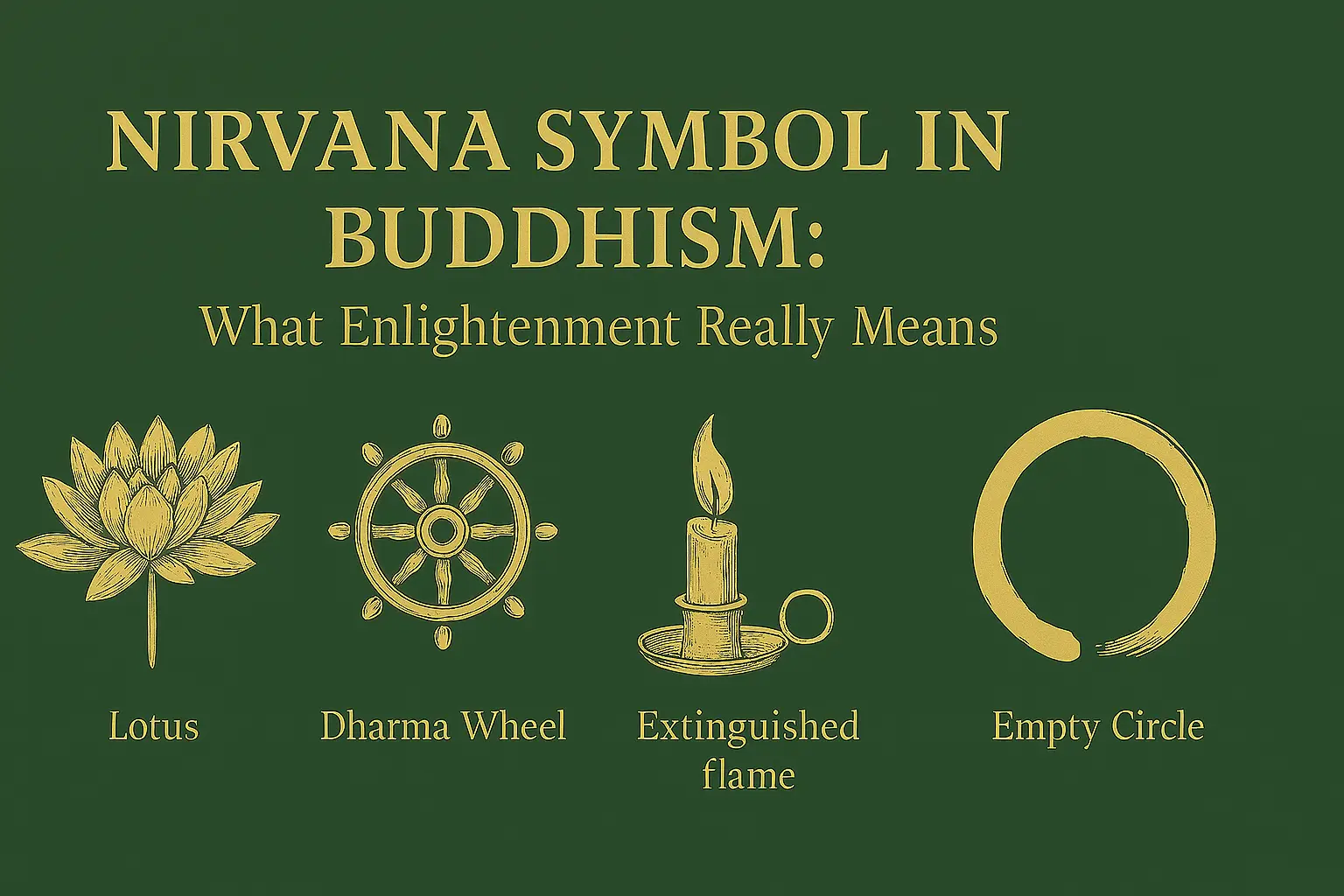
• Symbols like the lotus flower, the Eightfold Path, the Dharma Wheel, and the extinguished flame hint at the experience of nirvana

• Buddhist teachings emphasize that nirvana cannot be depicted, only realized through deep inner transformation

• Practicing meditation, ethics and mindfulness is the path toward that realization

What is Nirvana in Buddhism?

To understand the symbol of nirvana, we must first understand nirvana itself.

In Buddhist teachings, nirvana (or nibbāna in Pali) is the highest state of liberation, the end of suffering, the extinguishing of delusion, and the freedom from the endless cycle of birth and death.

It is often described by negation: not clinging, not craving, not ignorance. But at its heart, nirvana is not nihilism. It is peace without conditions, clarity without conflict.

Unlike religious heavens, nirvana is not a paradise. It’s not somewhere we go. It is something we uncover by removing what clouds the mind.

As Oxford Reference puts it, nirvana is “the extinction of all desires, passions, and delusions that bind one to the cycle of rebirth.”

Why Nirvana Has No Image

In a tradition rich with sacred art, why does nirvana have no fixed image?

The answer is simple. Nirvana is unconditioned. It lies beyond all things that arise and pass, including symbols themselves. Any attempt to draw it, define it, or box it in becomes something less than what it points to.

That said, Buddhist culture has long used indirect symbols to evoke the qualities of nirvana,its stillness, clarity, and spaciousness. These are not meant to describe nirvana, but to guide us toward it.

Symbols That Point Toward Nirvana

The Lotus Flower

The lotus, rising from muddy water, is one of Buddhism’s most powerful metaphors. It represents the practitioner’s journey from samsara (confusion and suffering) into the purity and openness of enlightenment.
In many traditions, the Buddha is shown seated on a lotus, not as decoration, but to remind us: awakening is possible in this very life, even amidst our pain.

The Dharma Wheel (Dharmachakra)

The Eight-Spoked Wheel, or Dharmachakra, symbolizes the Eightfold Path, the practical path the Buddha taught for walking toward nirvana. Each spoke represents a part of that path: right view, intention, speech, action, livelihood, effort, mindfulness, and concentration.
This wheel spins not in theory, but in daily life.

The Extinguished Flame

The literal meaning of nirvana is “to blow out,” like a flame going out. But it is not a flame extinguished in despair; it is the extinguishing of the fire that burns within: greed, hatred,and delusion.
Some early Buddhist images used a small empty circle, or a lamp being put out, to symbolize this freedom.

The Empty Circle or Open Sky

In some Zen or Mahāyāna traditions, nirvana is represented as an open circle, or even a blank space. These are reminders that what we seek cannot be grasped, only experienced.
As the Buddha said, “There is a realm where there is no earth, no water, no fire, no air… and that, monks, I call the end of suffering.”
You can read more about these interpretations at BuddhaNet, which provides trustworthy explanations from canonical texts.

The Path to Nirvana: A Daily Practice, Not a Concept

Buddhism is not a system of belief, but a system of practice. The way to nirvana is not through worship, but through ethical living, meditation, and insight.

• Practicing right speech and right action cultivates clarity.

• Mindfulness and meditation help untangle craving and illusion.

• Letting go of self-centered views gradually loosens the grip of suffering.

For lay practitioners, nirvana is not always a dramatic experience. It can begin as a subtle cooling, a release from clinging in the moment, a deep breath after long struggle.

Some traditions honor the bodhisattva vow, where enlightened beings choose to remain in the world rather than fully enter nirvana, so they can help others wake up. This points to another truth: compassion and awakening are not separate.

Final Thoughts

We live in a world full of striving. We reach for more, avoid pain, chase meaning. Nirvana is the gentle reminder that peace isn’t found by adding more, but by letting go.

It’s not about perfecting yourself. It’s about seeing clearly, perhaps for the first time, what has always been here.

You may never see a statue or mural that says, “This is nirvana.” But in the quiet moment after you release resentment, or in the pause before a reaction, you may glimpse it.

The symbol of nirvana is not a thing. It is the space where craving ends and freedom begins.

A Quiet Place to Begin Your Journey

If you are visiting Kathmandu to reflect, study, or simply breathe more deeply, staying near sacred sites can support your path.

At Boudha Mandala Hotel, we welcome seekers from all walks of life. Whether you’re beginning to explore Buddhism, attending a retreat, or walking the kora at dawn, our calm atmosphere helps you listen inward.

If you’re looking for a peaceful hotel near Boudhanath Stupa, or simply want the best boutique stay in Boudha where you can rest between temples, we are just 10 seconds from the stupa and surrounded by monasteries.

Sometimes, the journey toward nirvana begins with stillness. And stillness begins with where you choose to be.