
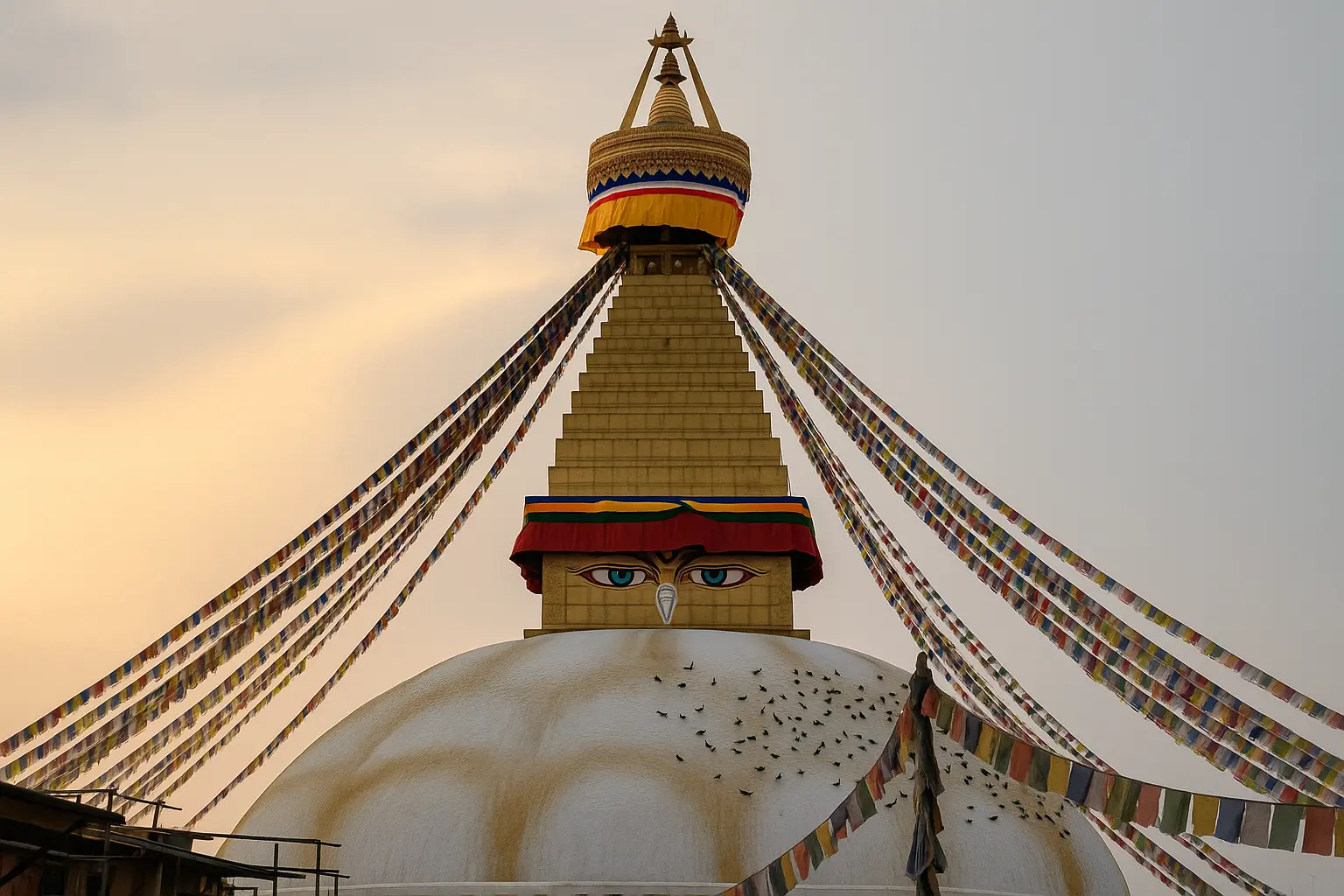
Boudha Stupa is part of the UNESCO-listed Kathmandu Valley World Heritage Site and one of Kathmandu’s most iconic Tibetan Buddhist pilgrimage landmarks. Known for its giant white dome, all-seeing Buddha eyes, prayer wheels, and the daily kora (clockwise circumambulation), Boudhanath is one of the best places in the city for cultural immersion in a powerful spiritual atmosphere, especially outside peak festival times.
Tip: For an easy sunrise visit, staying in the Boudha neighborhood lets you walk over before the crowds and traffic build. Boudha Mandala Hotel is located near Boudhanath Stupa, making early-morning and evening visits effortless.
Boudhanath Stupa quick visitor essentials
- Where: Boudha, Kathmandu (near Tribhuvan International Airport)
- Best time to visit: dawn or sunset
- What to do: kora (clockwise; keep the stupa on your right), spin prayer wheels, light butter lamps, visit nearby monasteries
- Ticket: required for non-Nepali visitors (SAARC discounted); Nepalis and children under 10 enter free
1. Boudhanath Stupa at a Glance (Quick Facts for Visitors)
Boudhanath sits in the Boudha neighborhood of Kathmandu, a short ride from Tribhuvan International Airport. It’s among the world’s largest stupas and the spiritual heart of Tibetan Buddhism in Nepal, especially vibrant at dawn and dusk when locals, monks, and visitors circle the stupa with prayer beads and spinning wheels.
Quick facts (visitor-friendly):
- Location: Boudha, ~6–8 km northeast of central Kathmandu
- Entry fee: NPR 400 (foreign nationals), NPR 100 (SAARC), free for Nepalis and children under 10
- Access & hours (important distinction):
- Stupa area/plaza: often accessible very early and late
- Ticketed entry points/booths: typically run morning to evening (commonly reported around ~5:00 AM–9:00 PM, but can vary; booths may close earlier)
For the most peaceful experience (and best photos), arrive early before the plaza fills or come near sunset when butter lamps glow and chanting drifts from nearby monasteries.
2. Why Boudhanath Is a UNESCO World Heritage Site
Boudhanath is recognized by UNESCO as one of the seven “Monument Zones” that make up the Kathmandu Valley World Heritage property, inscribed in 1979. In the UNESCO listing, Boudhanath is singled out as the largest stupa in Nepal, an extraordinary religious ensemble that still functions as a living pilgrimage site rather than a museum piece.
UNESCO highlights the Valley’s Outstanding Universal Value through its rare concentration of sacred architecture, exceptional craftsmanship, and continuous cultural life. The Kathmandu Valley inscription is based on criteria (iii), (iv), and (vi) recognizing it as an exceptional testimony to the Valley’s civilization and Newar traditions, an outstanding set of architectural ensembles, and a place deeply tied to rituals, legends, and festivals in Boudha. UNESCO also notes that the integrity of these monument zones is safeguarded within formally defined boundaries (with a boundary modification accepted in 2006).
Boudhanath embodies those values in a single, instantly recognizable landmark: its massive white dome and gilded tower with the all-seeing Buddha eyes express powerful Buddhist symbolism, while the daily rhythm of prayer, circumambulation (kora), and monastic life keeps the heritage actively practiced.
3. History of Boudhanath Stupa (Origins, Legends, and Timeline)
The history of Boudhanath blends verifiable records with powerful sacred storytelling. Many visitor-facing histories date the stupa to around the 5th century CE, during the Licchavi era, when Kathmandu Valley was emerging as a major Buddhist crossroads. Its location mattered: Boudha lay along historic trade and pilgrimage routes linking Tibet and the Kathmandu Valley, making it a natural place for merchants and pilgrims to rest, pray, and exchange culture.
Local and Tibetan traditions add the legends that made Boudhanath unforgettable. One of the best-known stories tells of Jhazima (or Jyazima) a poor widow/poultry keeper who requested land “as big as a buffalo skin,” then cleverly cut it into a long strip to mark out enough space to build the stupa. In Tibetan Buddhism, this origin myth is closely tied to the name Jarung Khashor and the idea that devotion (not wealth) can create a monument of immense merit.
4. Architecture and Symbolism (Dome, Mandala, Buddha Eyes, Prayer Flags)
Boudhanath’s design is often described as a three-dimensional mandala, a sacred map of the universe built as a massive white hemispherical dome crowned by a square tower (harmika) and a gilded spire. The harmika, clad in gilded metal, features the Buddha’s all-seeing eyes painted on each side.
Symbolically, every layer reads like a visual teaching. The mandala base represents the ordered cosmos and the spiritual path; the dome is often explained as the universe or a “treasure vase” of blessings; the harmika is the “seat” of enlightened mind; and the 13 steps on the spire are commonly interpreted as progressive stages toward awakening. The famous Buddha Eyes looking out in all directions reinforce the idea of wisdom and awareness that sees beyond appearances.
Prayer flags strung around the stupa flutter as wind-borne prayers Tibetan tradition holds that mantras on the flags spread goodwill on the breeze. The classic five-color set (in order blue, white, red, green, yellow) represents the five elements, which is why you’ll often see them kept together rather than separated.
5. Tibetan Buddhist Culture Around Boudha (Monasteries and Local Life)
Boudha isn’t just a stupa, it’s Kathmandu’s most visible pocket of Tibetan Buddhist life. After the 1959 Tibetan uprising, many Tibetans settled around Boudhanath, and the neighborhood grew into a dense ring of gompas (monasteries), pilgrim hostels, cafés, and artisan shops the kind of place where you’ll see monks, elders, and families doing kora from dawn to nightfall.
Monasteries near Boudha shape the area’s daily rhythm. Shechen Tennyi Dargyeling, reviving the lineage of one of Tibet’s great Nyingma monasteries, was re-established in exile near Boudha under Dilgo Khyentse Rinpoche and remains a major center for teachings and ceremonies. Nearby, Ka-Nying Shedrub Ling (a Kagyu–Nyingma community) became another cornerstone of practice and education in the 1970s.
For visitors, “local life” at Boudhanath is wonderfully tangible: prayer wheels turning clockwise, offerings at shrines, lanes lined with thangkas and ritual items, and rooftop viewpoints where the stupa feels close enough to touch. For a quieter extension of the same culture, Kopan Monastery on the valley’s hills is a well-known Tibetan-tradition monastery welcoming visitors for courses and practice.
6. Things to Do at Boudhanath Stupa (Kora, Rooftops, Markets, Meditation)
Start with a kora (clockwise circumambulation) the classic Boudhanath experience. Join pilgrims as you circle the stupa clockwise, keeping the stupa on your right, pausing to spin prayer wheels and watch offerings being made at shrines around the square. If you can, come at dawn or dusk when the atmosphere feels most devotional and at night you may see rows of butter lamps/candles glowing around the base.
Next, head upstairs: the ring of buildings around the stupa is packed with rooftop cafés and restaurants designed for one thing, stupa views. A slow tea or meal from a rooftop is one of the easiest ways to appreciate the scale of Boudhanath and the constant movement of the kora below.
Finally, explore the markets and mindful corners around the plaza. The lanes are lined with shops selling thangkas, malas, incense, statues, and ritual items, making it a great place for meaningful souvenirs (and people-watching). For a quieter reset, step into nearby gompas respectfully or pair your visit with a dedicated meditation experience at a Tibetan-tradition monastery like Kopan, which welcomes visitors for courses and retreats.
7. Entry Fee and Access Hours (Visitor Info)
For most travelers, Boudhanath entry fees are straightforward: NPR 400 for foreign nationals, NPR 100 for SAARC nationals, and free for Nepali citizens (children under 10 are also free).
On hours, it helps to separate two meanings of “open”:
- The stupa area/plaza can often be experienced very early and late.
- Ticket checks/booths and controlled entry points typically follow a more limited daily schedule (commonly reported around ~5:00 AM–9:00 PM, and booths may close earlier).
Pro tip: Buy your ticket at the entry point and keep it handy especially if you plan to step out for a rooftop café and come back in. If anything seems different on the day (holiday, festival, or local adjustments), follow onsite signage.
8. Rules, Etiquette, and Dress Code (What Tourists Should Know)
At Boudhanath, etiquette is simple yet important because the site is both a major tourist destination and an active place of worship. Always walk clockwise (pradakṣiṇa) around the stupa, keeping the stupa to your right and if you spin prayer wheels, do so clockwise as well. Keep the flow moving by avoiding sudden stops in narrow sections, and don’t block the kora path, especially during busy prayer hours.
Dress and behavior should match the sacred setting. Aim for modest clothing (cover shoulders and knees) and keep your voice low; this is one of the easiest ways to show respect to monks, pilgrims, and families doing their daily rounds. If you enter monasteries or prayer halls, remove your shoes and follow any signs or instructions from residents and caretakers.
Photography is generally fine around the stupa, but be mindful: avoid interrupting rituals, and assume you’ll need permission inside gompas/shrines. If someone is praying, chanting, or making offerings, give them space capturing the moment should never come before honoring it.
9. How to Reach Boudhanath (From Thamel, Airport, and Patan)
From Thamel: The easiest option is a taxi/private car, a straightforward cross-city ride, with travel time varying widely by traffic. Public buses/minivans also go to Boudha via the Ring Road (slower, more “local” experience).
From Tribhuvan International Airport (TIA): Boudhanath is one of the closest major landmarks. Many travelers use a taxi, which takes roughly 15–30 minutes, depending on congestion. Pre-arranged pickups through hotels/tour operators can be simplest if you have luggage.
From Patan (Lalitpur), you’ll usually head toward eastern Kathmandu. A taxi or private car is the most direct; public options often involve switching vehicles at busy junctions.
Tip: In Kathmandu, time matters more than distance, plan buffer time during rush hours, and aim for dawn or sunset for the best atmosphere.
10. Earthquake Damage, Repairs, and Restoration (2015 and After)
The 7.8-magnitude Gorkha earthquake on April 25, 2015, shook Boudhanath hard, damaging key parts of the monument most notably the gold spire (pinnacle) while the main white dome was largely spared. Because the stupa is a focal point for daily pilgrimage, the impact was immediate for worship and the wider Boudha community.
Restoration moved forward through a mix of private donations from Buddhist groups and local community support. After about a year and a half of work, the stupa reopened to the public on November 22, 2016, marked by ceremonies and a surge of pilgrims returning to complete their kora.
11. Festivals and Best Time to Visit (Buddha Jayanti, Losar, Quiet Hours)
Boudhanath comes alive during major Buddhist dates, and two big ones to know are Buddha Jayanti (Buddha Purnima/Vesak) and Losar (Tibetan New Year).
- Buddha Jayanti is observed on the full moon of Vaisakha/Baishakh (usually April–May) and is one of the most atmospheric days to be at Boudhanath except butter lamps, offerings, and devotional crowds into the evening.
- Losar falls in late winter to early spring, typically February or March, and Boudha becomes a focal point for Tibetan community celebrations, fresh prayer flags, incense, monastery rituals, and families gathering for the new year. Dates shift each year because Losar follows the Tibetan lunisolar calendar.
For the best overall visit, aim for autumn (late September–November) when skies are clearer, and conditions are comfortable. Within a day, the most peaceful quiet hours are early morning and late afternoon to sunset.
12. Nearby Attractions (Pashupatinath, Kopan, and More)
A classic combo with Boudhanath is Pashupatinath Temple, a vast Hindu temple complex on the Bagmati River and, like Boudhanath, one of the key monument zones inside UNESCO’s Kathmandu Valley World Heritage listing. Many travelers visit them back-to-back for two different (but equally powerful) sides of Kathmandu’s sacred life.
For a quieter, panoramic escape, head to Kopan Monastery, set on a hill just north of Boudhanath. Kopan is known for calm grounds, sweeping valley views, and a meditation-friendly atmosphere.
If you want “nearby but less crowded,” look toward Chabahil, home to the Licchavi-era Dhando Chaitya (often cited as among the valley’s oldest stupas), plus the nearby Guhyeshwari Temple, a Shakti shrine associated with the Pashupati area. And if you’re up for another iconic stupa with big views, Swayambhunath (Monkey Temple) is also part of the same UNESCO Kathmandu Valley listing and makes a great half-day add-on.
Tip: Visit Boudha Stupa, experience one of the holiest buddhist pilgrimage sites in the world. Boudha Mandala Hotel is located near Boudhanath Stupa, making early-morning and evening visits effortless allowing you to be at peace with the all seeing eyes of Buddha.
Frequently Asked Questions
Boudha Stupa (Boudhanath Stupa) is in the Boudha/Boudhanath neighborhood in northeastern Kathmandu, close to Tribhuvan International Airport (TIA) and an easy taxi ride from Thamel.
For navigation, search “Boudhanath Stupa” or “Bouddhanath Stupa” on Google Maps (both work). The location is approximately 27.721° N, 85.362° E.
Boudha Stupa is very close to Kathmandu airport, typically about 4–6 km by road, depending on the route.
By taxi/private car, it usually takes 15–30 minutes, but traffic in Kathmandu can increase travel time during rush hours.
Boudha Stupa is an open public monument zone, so “hours” can mean two things:
Outer area (streets, cafés, outer ring): often accessible early and late
Ticketed monument zone (main stupa plaza/kora area): entry is typically enforced during daytime hours
In practice, many travelers plan around a rough window from early morning to evening (often cited as ~5:00 AM–9:00 PM, though it can vary). Always follow on-site signage and local guidance, especially on festivals/holidays.
Boudha Stupa entry fees are usually tiered by nationality. A commonly posted structure is:
Foreign nationals: NPR 400
SAARC nationals: NPR 100
Nepali citizens: free
Children under 10: free
Tickets are purchased at the entry gates. Fees can change, so treat the ticket booth signage as the final word on the day you visit.
Usually, yes. If you plan to step out for a rooftop café or shopping and return, keep your ticket and be ready to show it at the gate.
Tip: snap a quick photo of the ticket as a backup.
Kora means clockwise circumambulation, a devotional walking loop around the Boudha Stupa that serves as both a pilgrimage and a moving meditation.
People walk clockwise as a sign of respect, typically keeping the stupa on their right. Prayer wheels are also spun clockwise.
Boudha Stupa is a living religious site, so small etiquette details matter:
Walk clockwise (stupa on your right) and don’t block the kora flow
Dress modestly (cover shoulders and knees), especially if entering monasteries
In gompas (monasteries): remove shoes (and often hats)
Photography: fine in open areas, but be discreet, avoid interrupting rituals and ask before photographing people up close.
Treat butter lamps/offerings as look, don’t touch.
Generally, yes the main plaza is often active in the evening with pilgrims doing kora and cafés open.
Basic precautions apply: stick to well-lit central areas, watch for pickpocketing, and take a taxi back if it’s late rather than walking quiet side streets. If there are protests/large gatherings, avoid the area and follow local guidance.
Mostly yes, especially compared to many heritage sites in Kathmandu. The main kora path is generally wide and manageable, but expect:
uneven paving and occasional curbs/short steps
tight spots when crowds are heavy
limited access in many rooftop cafés and older monasteries (stairs are common)
Best tip: visit early morning for fewer crowds and easier movement.