Key Takeaways
• The Dharma Wheel (Dharmachakra) is the official and most widely recognized religious symbol of Buddhism, representing the Buddha’s teachings
• Its eight spokes reflect the Noble Eightfold Path, guiding principles for liberation
• Other major Buddhist symbols include the lotus flower, Bodhi tree, stupa, and Ashtamangala (Eight Auspicious Symbols)
• Buddhist symbols are deeply woven into monastic life, temple architecture, and visual arts throughout Asia
• The Dharma Wheel is not just an image, it is a daily reminder to live ethically, mindfully, and with compassion
What Is the Main Religious Symbol of Buddhism?
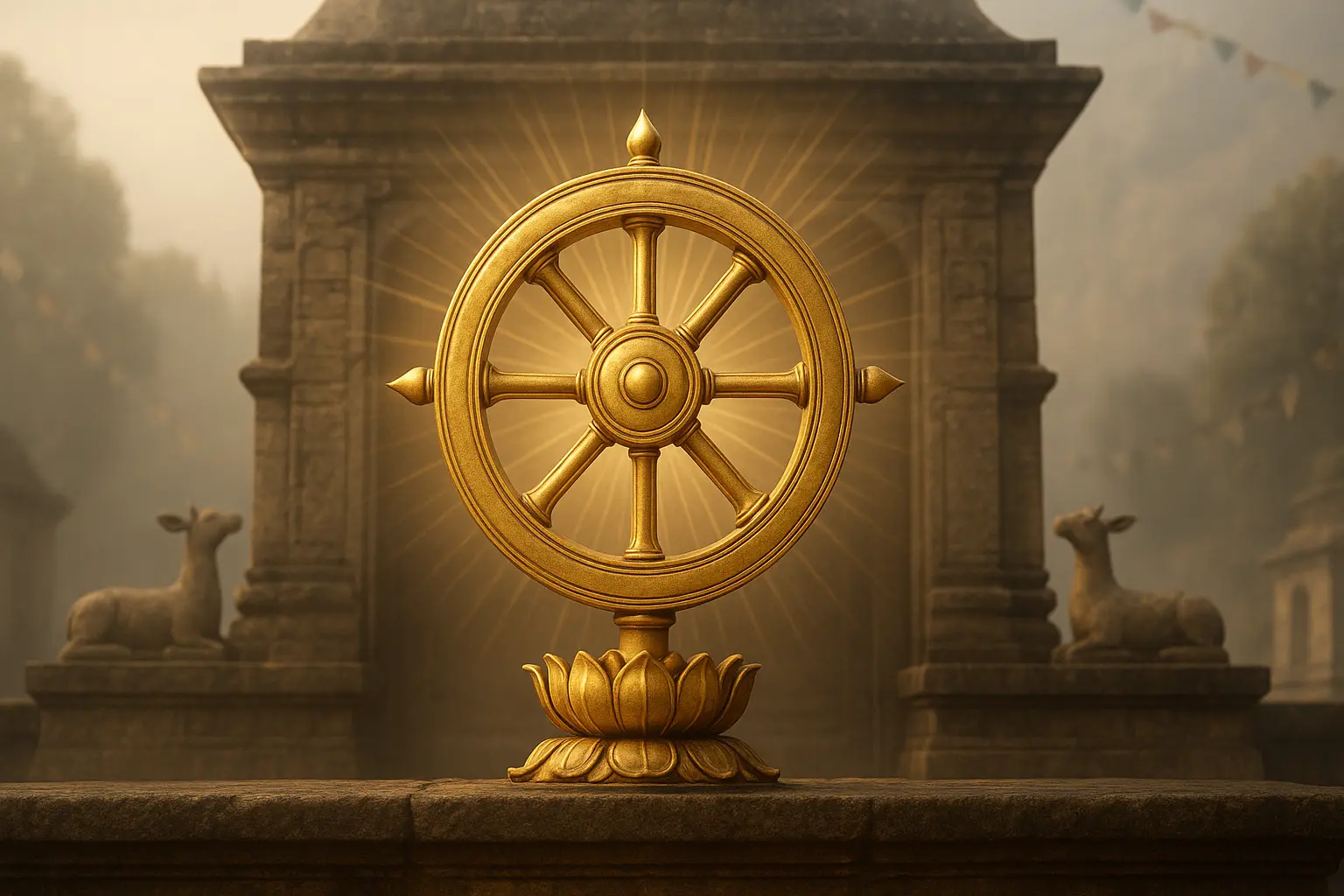
If you had to choose one symbol to represent the entire Buddhist path, it would be the Dharma Wheel, also known as the Dharmachakra. It is an ancient symbol, a wheel with eight spokes, a circular hub, and sometimes intricate rims. This wheel represents the cycle of life and rebirth, but more importantly, the Buddha’s teaching that helps liberate us from it.
The turning of the Dharma Wheel is a metaphor the Buddha used when he first began to teach. With his first discourse in Sarnath, he said he had “set the wheel of Dharma in motion.”
Each spoke stands for a path:
• Right view
• Right intention
• Right speech
• Right action
• Right livelihood
• Right effort
• Right mindfulness
• Right concentration
This is the Noble Eightfold Path, the heart of Buddhist ethics and meditation. The Dharma Wheel reminds practitioners that each moment offers the chance to take one step on this path.
As noted in Britannica, the wheel is also found on temple gates, statues, prayer wheels, and even on national emblems like India’s Ashoka Chakra.
The Eightfold Path and the Spokes of Liberation
The symbolism of the Dharma Wheel is not abstract. It is deeply practical. Every spoke corresponds to a domain of practice. The right view and intention cultivate clarity. Right speech and action encourage ethical living. Right effort and mindfulness train the heart-mind. And right concentration anchors the awareness.
So, when you see a Dharma Wheel carved above a temple door or painted on a monastery wall, it’s not merely art. It’s a roadmap for liberation.
This is what makes it the most universal symbol of Buddhism as a religion: it contains the path, the purpose, and the perspective.
Other Important Symbols in Buddhism
While the Dharma Wheel is the official emblem, Buddhist symbolism is richly layered. Other symbols deepen and complement the meaning of the Wheel:
• Lotus Flower: Symbolizes purity and awakening. It grows from mud but remains unstained, just like our ability to awaken despite the challenges of samsara.
• Bodhi Tree: Under this tree, Siddhartha attained enlightenment. A living symbol of the possibility of realization.
• Stupa: A dome-shaped structure holding relics or symbolizing the Buddha’s awakened mind. It represents both remembrance and refuge.
• Ashtamangala: The Eight Auspicious Symbols used especially in Vajrayāna Buddhism:
– Parasol (protection)
– Golden fish (freedom)
– Treasure vase (spiritual wealth)
– Lotus (purity)
– Conch shell (proclamation)
– Endless knot (interdependence)
– Victory banner (overcoming obstacles)
– Wheel (Dharma)
According to Oxford Reference, these symbols are found in temple murals, ritual implements, and monastic offerings.
Where You’ll See These Symbols Today
Across Nepal, Tibet, Bhutan, and beyond, these symbols are living elements of the Buddhist cultural landscape.
• The gates of Boudhanath Stupa feature the Dharma Wheel flanked by two deer, symbolizing the Deer Park where the Buddha first taught
• The lotus appears on altars, murals, and in every monastery garden
• The Eight Auspicious Symbols are printed on prayer flags, engraved on bronze bowls, and painted across Tibetan thangkas
They are not decorations. They are reminders. Each one pulls the mind back to the path.
Why Symbols Matter on the Inner Path
Buddhism often warns against clinging to form. But it also embraces the power of symbolic form to transmit timeless truths.
These symbols act as bridges between visible and invisible realities. You may forget a teaching, but a symbol stays with you. A wheel over a temple door may call you to pause. A lotus beside a stupa may help you breathe through difficulty.They are the quiet language of awakening, available without words.
The Eightfold Path and the Spokes of Liberation
The wheel keeps turning. Not because we chase it, but because the path of Dharma continues in each breath, step, and choice.
You don’t need to wear the Dharma Wheel to live its meaning. Just take one step. Choose one spoke. Live it sincerely. And the wheel turns. If you’re walking the path, the symbols will meet you wherever you are.
Stay Near the Dharma Wheel Itself. There’s no better place to reflect on Buddhist symbols than Boudha, one of the most sacred pilgrimage sites in the world.
Just steps from the great stupa, you’ll find a peaceful retreat where the wheel turns quietly.
At Boudha Mandala Hotel, you can wake to the chants of monks, sip tea while gazing at the stupa, and feel surrounded by the same symbols that have guided seekers for centuries.
If you’re looking for a peaceful boutique hotel in Boudha, our space is designed to support your inner and outer journey.