
TL;DR
• You don’t need to convert, change your identity, or join a monastery to begin Buddhist practice.
• Start with basic meditation, ethical living, and mindful awareness of daily life.
• The Four Noble Truths and the Eightfold Path are the foundation of the Buddhist worldview.
• Explore Buddhist teachings through trusted books, local temples, or quiet observation.
• Buddhism encourages personal experience over belief and is a path of insight, not ideology.
• You can begin simply, wherever you are, with a single breath or a moment of silence.
Do You Have to Be a Buddhist to Practice Buddhism?
The short answer is no. Buddhism does not demand conversion. There’s no initiation, no ceremony, no expectation to leave behind your background, culture, or beliefs. You don’t have to be “a Buddhist” to practice Buddhist values or learn from the teachings.
The Buddha himself encouraged people to see for themselves. He often said, “Do not accept my words out of reverence, but test them as you would gold.” That spirit of inquiry continues today.
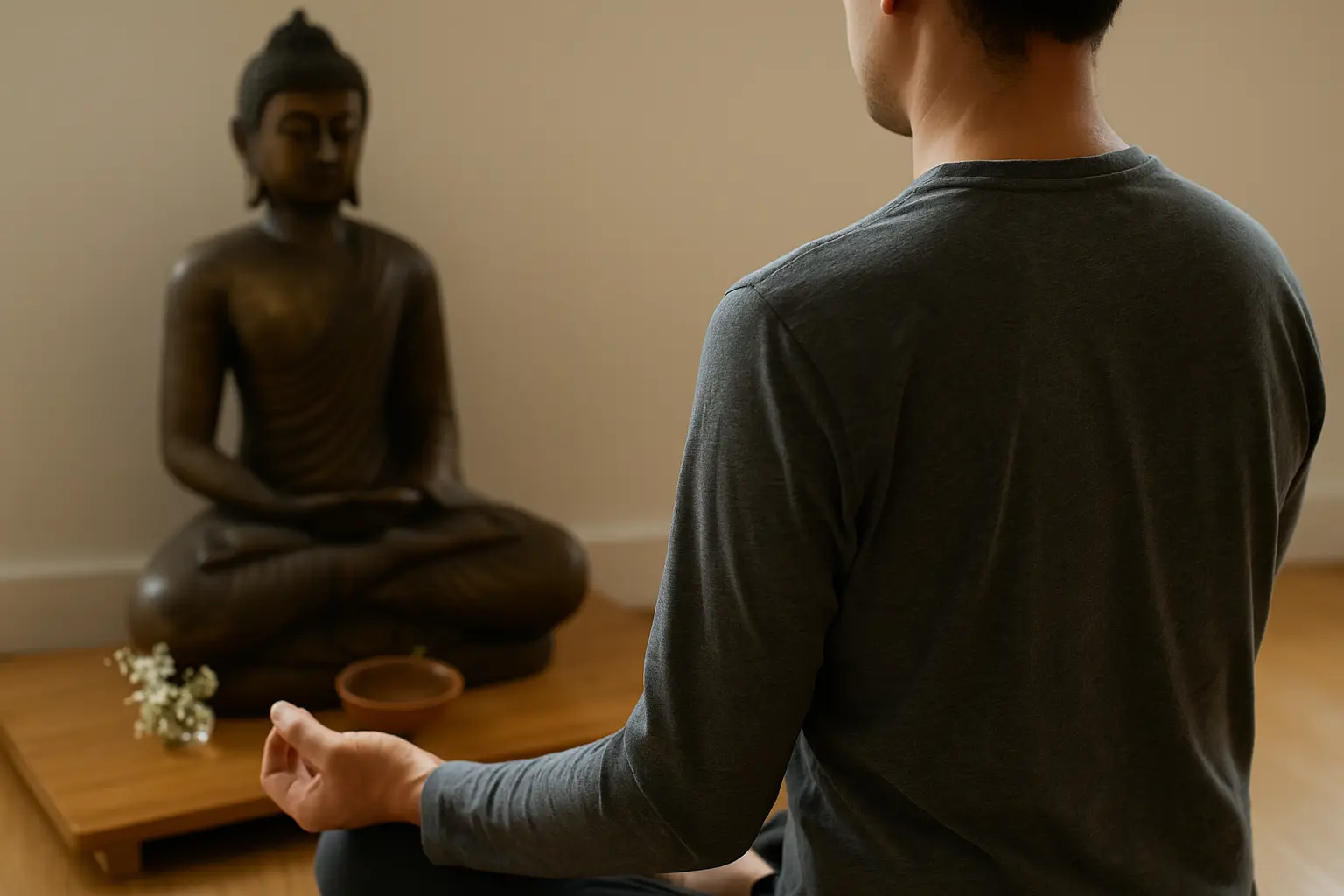
Many people begin by simply sitting. Breathing. Observing their mind. This is already a practice.
The Foundations: Four Noble Truths and the Eightfold Path
All schools of Buddhism begin with the Four Noble Truths. They are not commandments, but insights drawn from observation of life:
1. Life contains suffering (dukkha), not always agony, but a quiet unease, craving, or dissatisfaction
2. This suffering has mainly caused craving, clinging, and misperception
3. There is a way to end this sufferingliberation is possible
4. That way is the Eightfold Path
The Eightfold Path is not linear, but a set of interwoven practices:
Right View
• Right Intention
• Right Speech
• Right Action
• Right Livelihood
• Right Effort
• Right Mindfulness
• Right Concentration
Don’t feel overwhelmed. Many begin by simply becoming more aware of their speech, or sitting quietly for ten minutes. That alone plants seeds.
Begin With Meditation: Sitting, Breathing, Noticing
The most accessible gateway to Buddhist practice is meditation. You don’t need robes or a cushion. You need a quiet space, an upright posture, and attention to your breath.
Start with a few minutes a day. Focus on the in-breath, then the out-breath. When the mind wanders and it will gently return. That act of returning is the heart of meditation.
In Theravāda practice, samatha meditation helps calm the mind. Vipassana, or insight meditation, allows one to see clearly into the nature of thoughts, emotions, and impermanence.
Buddhist meditation is not for performance. It’s a mirror. A place to meet yourself.
If you want a practical, modern introduction, Buddha Net offers free guided meditations and reading lists for beginners.
Living the Dharma in Daily Life
You don’t need to retreat to the mountains to live the Dharma. It begins in the way you treat others, speak to yourself, and move through the day.
Buddhism teaches the Five Precepts as ethical guidelines for laypeople:
• Refrain from harming living beings
• Refrain from taking what is not freely given
• Refrain from sexual misconduct
• Refrain from false speech
• Refrain from intoxicants that cloud the mind
These are not sins, but reminders to create space for clarity and compassion.
Even more simply, practicing Buddhism might look like:
• Pausing before reacting
• Listening fully to someone in pain
• Walking mindfully instead of rushing
• Speaking kindly, especially when it’s difficult
Learn From the Teachings, the Teachers, and the Temples
There’s a quiet joy in discovering the Dharma. You can begin with timeless books like:
• What the Buddha Taught by Walpola Rahula
• The Heart of the Buddha’s Teaching by Thich Nhat Hanh
• In the Buddha’s Words, edited by Bhikkhu Bodhi
Or visit a local temple, monastery, or stupa to worship, but to sit, observe, and feel the atmosphere. In Nepal, the early morning kora around Boudhanath Stupa is a living teaching. The sound of prayer wheels, the hush of incense, the slow rhythm of devotion teach presence without a single word.
You can also explore online communities like Tricycle, which offers teachings across all traditions for modern practitioners.
Start Where You Are, with What You Have
You don’t need to change your clothes, name, or location to begin this path. The most powerful Buddhist practices begin right where you are.
One breath. One moment of stillness. One kind act. That’s it.
You may read a passage and feel nothing for weeks. Then one day, it opens something. You may sit in meditation and only feel restlessness. Then suddenly, peace arrives. Or not. Buddhism teaches us not to chase states, but to be fully present with whatever is here.
And in that presence, everything begins to shift.
Final Thoughts: It Begins With a Breath
Starting to practice Buddhism is less about joining a group and more about remembering what’s already within you. Clarity. Compassion. Stillness. Awareness.
It’s a path that doesn’t begin with belief. It begins with seeing. With a single, honest breath. With bowing not to a statue, but to the possibility of waking up even just a little.
No matter where you are in the world, the first step of the Buddhist path is always the same: stop, breathe, and see clearly.
And you’ve already taken it.
A Place to Begin in Boudha
If you’re traveling to Nepal to begin or deepen your practice, staying close to sacred sites can help ground your journey. At Boudha Mandala Hotel, we offer a peaceful space just seconds from the stupa, where the air carries mantras and the mornings begin in silence.
If you’re looking for a peaceful boutique stay in Boudhanath, or simply a quiet place to reflect, this is a space where your inner journey is honored.
Visit Boudha Mandala Hotel – the best stupa view hotel in Boudha