
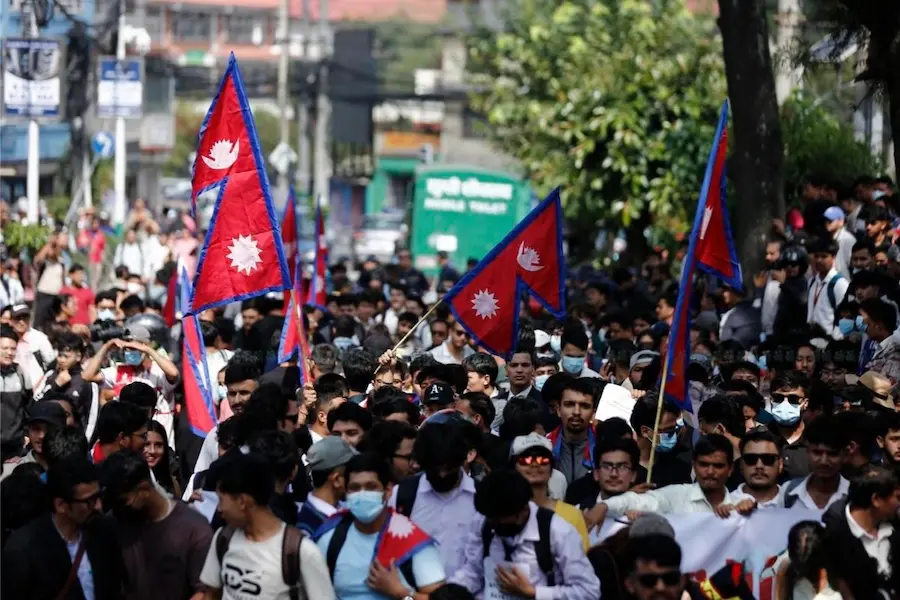
Nepal is safe now.
That’s the answer for anyone wondering whether to book a flight to Kathmandu. Tourism has resumed. Trekking permits are being issued and daily life has returned to its rhythm across the country.
But the full answer requires understanding what happened in September 2025 and why, despite the protest, Nepal emerged with functioning institutions and a path forward. What the world witnessed wasn’t just another protest. It was the Discord Revolution: the first time in history a prime minister was chosen via social media online vote, and a generation’s announcement that democracy could be reimagined in real time.
From Prague to Kathmandu- A New Kind of Change
In 1989, students in Prague stood in Wenceslas Square and jangled their keys. That metallic chorus meant: time’s up, unlock the door, let us through. Within a week, Czechoslovakia’s government stepped aside. They called it the Velvet Revolution because change arrived softly but irreversibly.
Thirty-five years later, Nepal’s Gen-Z didn’t have keys to jangle. They had Discord, Instagram, and other social media platforms. They also had frustration that had been building for years: youth unemployment at 22.7 percent and corruption cases involving billions of rupees.
When the government banned 26 social media platforms on September 4, 2025, including WhatsApp, Facebook, Instagram, Twitter, Reddit, and YouTube claiming it needed to regulate content, young Nepalis saw it as an attempt to silence the #NepoBaby campaign that had been highlighting the gap between politicians’ children and ordinary youth. The ban became the spark.
The Discord Revolution: How it Unfolded
September 6-8: From Online to the Streets
Activist Sudan Gurung, founder of the NGO Hami Nepal, put out a call on Instagram on September 6: “Do not stay silent. Do not stay home. Bring your friends, your family, your courage, and your voice” . On September 8, he announced the Discord channel “Youths Against Corruption” as the central communication system for the protest.
Thousands of young people, many in school and college uniforms, gathered in Kathmandu and other cities. They carried placards. Some skateboarded alongside the crowd. Leaders announced they wouldn’t destroy property or leave trash behind . One of their symbols was the Jolly Roger flag from the manga One Piece, representing resistance against oppression .
Then chaos erupted. Some protesters stormed Parliament. Security forces responded with tear gas, water cannons, rubber bullets, and eventually live ammunition. By nightfall, 19 protesters were dead across the country, most under the age of thirty .
September 9: The Breaking Point
The deaths on September 8 sparked widespread anger. On September 9, violent incidents occurred across Nepal, with government buildings, political party offices, and other structures destroyed in multiple cities. The scale of the unrest included the Prime Minister’s Office, Parliament, the Supreme Court, and numerous provincial and municipal facilities.
Prime Minister K.P. Sharma Oli resigned on September 9. By September 10, the Army assumed responsibility for security as the nation faced a significant institutional crisis.
September 10-12: Discord Revolution Democracy Reimagined
On the evening of September 10, something unprecedented happened. As chaos threatened to engulf Kathmandu, 7,586 young Nepalis voted on the Discord channel “Youths Against Corruption” for their candidate to lead an interim government. The vote was livestreamed on YouTube, TikTok, and Facebook.
Former Chief Justice Sushila Karki won. It was perhaps the first time in history that a prime minister had been chosen via an online vote. On September 12, President Ram Chandra Poudel invoked the “doctrine of necessity” to appoint her as Nepal’s first woman prime minister, tasked with overseeing elections within six months and subsequently dissolved Parliament.
The total toll: at least 72 deaths, including 19 young students and one child as young as 12. Over 200 were hospitalized. The government lifted the social media ban and launched investigations into both the violence and police actions.
Why “Discord Revolution” Captures What Happened
The term isn’t official. No organization claims it. But it’s emerged as the most accurate way to describe what occurred in Nepal in September 2025.
According to analysis by the Wilson Center, “Nepal’s political landscape has undergone an extraordinary and rapid change. The protests revealed a force the traditional political parties had long ignored: the youth. The Discord Revolution represents both the tool (the app) and the outcome (institutional transformation through digital democracy).
Like the Velvet Revolution in Prague, the Orange Revolution in Ukraine, or the Arab Spring across the Middle East, the Discord Revolution has become shorthand for a specific moment when a generation demanded change. The difference is the method: this was democracy reimagined in real time, on anonymous online forums rather than in newspapers or TV studios.
Nepal’s Discord Revolution in the Global Context
Nepal’s protests were part of a broader pattern in 2025. Gen-Z Youth-led movements emerged in Indonesia, Madagascar, and Morocco, all challenging corruption and demanding reforms through digitally coordinated action.
The most striking evidence of Nepal’s influence came in October 2025, when thousands of youths in Tbilisi, Georgia, surrounded the presidential palace demanding sweeping political reforms. The outlet quoted a demonstrator as saying the Georgian government had “put itself into the Nepalese scenario”, a direct reference to Nepal’s recent Discord Revolution that led to the fall of its previous government.
Lonely Planet’s 2025 travel safety update notes that “Nepal’s period of civic unrest resolved with a government transition and commitment to elections, with tourism infrastructure recovering rapidly.
Nepal Now- Safe, Stable, and Moving Forward
Today, Nepal is functioning normally. Tribhuvan International Airport processes international arrivals on schedule. Trekking permits are issued without delay. Hotels across Kathmandu, Pokhara, and mountain regions are filling with travelers.
The U.S. Department of State’s Nepal travel advisory maintains its Level 2 rating (Exercise Increased Caution), the same classification it held before September, primarily due to terrain and infrastructure considerations common to mountain regions, not political instability. The interim government under Prime Minister Sushila Karki has focused on three priorities: investigating the September violence, addressing corruption cases that sparked the protests, and preparing for elections within six months.
Her cabinet reflects a technocratic approach, with ministers appointed based on merit and specialization rather than political loyalty. Electoral rolls are being revised to ensure young people can register to vote. The rhythms of Nepal haven’t changed. The country you’ve been reading about, the one with the Himalayas, the prayer flags, the impossibly kind people, is still here.
What the Discord Revolution Means Beyond Nepal
Nepal did something difficult in September: it absorbed a crisis, transitioned peacefully (despite the violence), and emerged with institutions intact.
According to the Wilson Center analysis, “Any future discussions around government formation and constitutional amendments must ensure the participation of younger marginalized voices, especially from nonurban Nepal”. The Discord Revolution has raised questions about how democracy functions in the digital age.
India and the United States have both emphasized support for democratic principles as Nepal regroups. The international community recognizes that what happened in Nepal, despite its chaos, ultimately strengthened rather than weakened democratic institutions.
Frequently Asked Questions
Is Nepal safe for tourists now?
Yes. Nepal is safe for tourists after the Gen Z protest. Tourism infrastructure operates normally. An interim government is in place with elections scheduled within six months. Daily life has returned to normal across the country.
What was the Discord Revolution?
The Discord Revolution refers to Nepal’s September 2025 youth-led movement that resulted in the first-ever prime minister chosen via online vote. On September 10, 7,586 young Nepalis voted on Discord for former Chief Justice Sushila Karki to lead an interim government. The term captures both the digital nature of the organizing (Discord app) and the rapid institutional transformation.
Is Boudha a safe neighborhood?
Yes. Boudhanath remained calm throughout September and continues to be one of Kathmandu’s most peaceful areas. The spiritual center maintained its tranquil atmosphere even during the peak of unrest elsewhere in the city.
How does this compare to other recent movements?
Nepal’s Discord Revolution was part of a wave of youth-led uprisings in Asia during 2025, including in Indonesia, Madagascar, and Morocco. It shares similarities with Bangladesh (2024) and Sri Lanka (2022) in terms of youth-driven change, but differs in its rapid resolution and the unprecedented use of an online vote to choose leadership.
The Revolution That Rewrote Democracy
On September 10, 2025, as Nepal faced a significant institutional crisis, 7,586 young Nepalis participated in an online vote via Discord to select a candidate for interim leadership. Former Chief Justice Sushila Karki emerged as their choice. The vote was livestreamed on YouTube, TikTok, and Facebook, a reflection of how democracy was being reimagined in real time through digital platforms rather than traditional political channels.
The Discord Revolution demonstrated that digitally connected generations can organize rapid institutional change. Nepal’s youth, frustrated by corruption and economic challenges, used the very tools banned by the government to coordinate their movement and ultimately participate in selecting leadership. This represented a significant shift in how civic engagement operates in the social media age.
The Discord Revolution entered the global lexicon as a reminder that democracy’s next chapter may be written through digital coordination as much as traditional political processes and that small countries can set precedents that resonate globally when a generation demands accountability and change.
Experience the Peace That Endured
The Stupa’s eyes still watch over Boudha. Prayer wheels still turn. And in the courtyards of a peaceful hotel near Boudha, travelers gather each evening to share stories.
Book your room today and discover why, even after its hardest moment, this corner of Kathmandu remains a sanctuary just steps from the Stupa.