
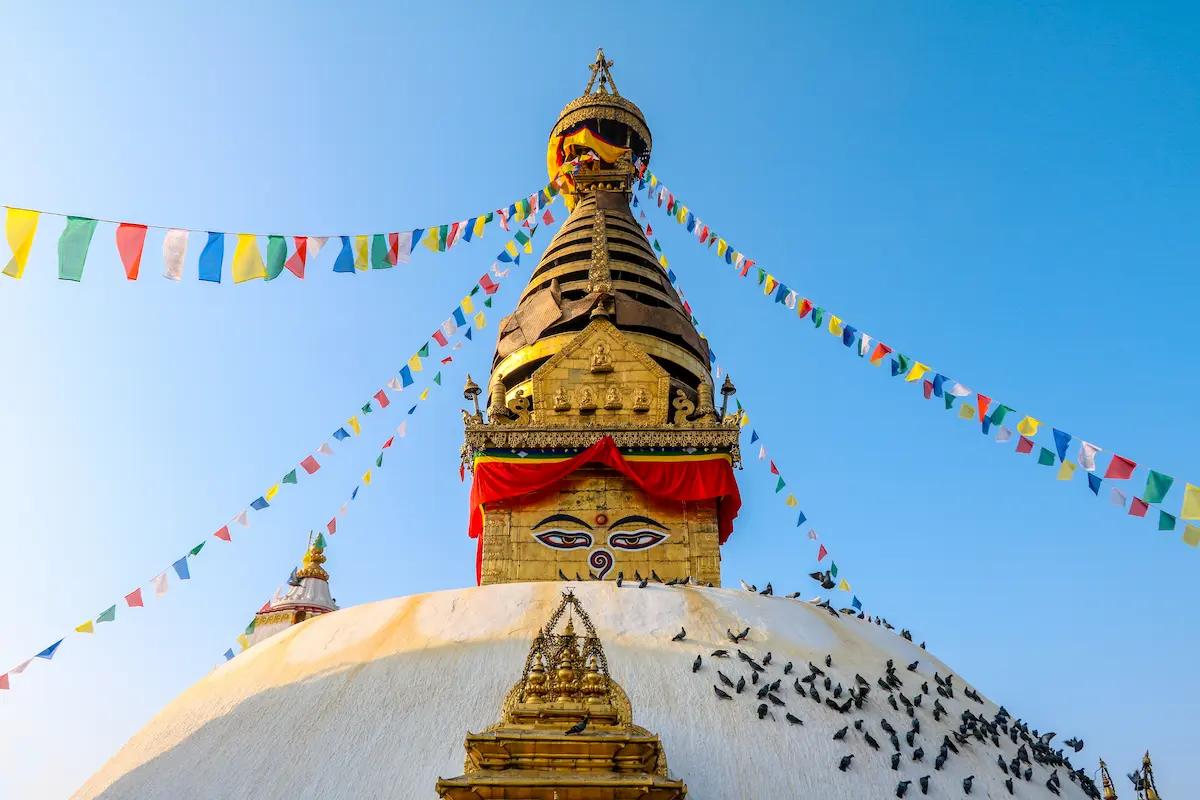
Key Takeaways
• A stupa is a sacred Buddhist monument that represents the mind of the Buddha, often containing relics or sacred objects
• Originally burial mounds in ancient India, stupas evolved into profound symbols of awakening and impermanence
• Their architecture mirrors the path to enlightenment, incorporating elemental and spiritual symbolism
• Walking around a stupa (circumambulation) is a meditative practice to generate merit, mindfulness, and devotion
• Stupas like Boudhanath, Sanchi, and Shwedagon are living pilgrimage sites that continue to inspire seekers across traditions
What Is a Stupa in Buddhism?
When you first stand before a stupa, there’s a stillness that meets you before thought. A silence that isn’t empty, but full. In Buddhist cultures, stupas are not mere monuments, they are beings. Silent teachers.
Historically, stupas began as mounds built over the ashes or relics of great sages and the Buddha himself. In early India, they were places of veneration, not only for memory, but for awakening. Over time, the structure of the stupa was refined, not just in form, but in meaning.
In Theravāda traditions, stupas house relics of the Buddha or his disciples. In Vajrayāna Buddhism, they also embody sacred geometry and symbolic blueprints of the awakened mind. Wherever they appear, they serve one purpose, to awaken something deep and still within us.
The Symbolism Within the Stupa’s Structure
A stupa is not designed randomly. Every shape, every layer, carries meaning. It’s a map of enlightenment, expressed in stone and space.
• The square base represents the earth element and mindfulness, the grounded beginning of the path
• The dome or anda represents water and the open, spacious nature of mind
• The spire (harmika and yasti) symbolizes fire, transformation, and insight
• The canopy and top relate to air and space, culminating in wisdom beyond concept
In Vajrayāna Buddhism, eight kinds of stupas mark eight major events in the Buddha’s life, from his birth to his final liberation (parinirvana). These include the Enlightenment Stupa, the Dharma Wheel Stupa, and the Parinirvana Stupa.
To walk around the stupa is to journey the path symbolically, with every step, you turn ignorance into understanding, agitation into calm, and confusion into clarity.
How Stupas Are Used in Buddhist Practice
In Boudha, I’ve seen an 80-year-old Tibetan grandmother doing kora (circumambulation) in slippers at 4 a.m., whispering mantras with each step. I’ve seen exhausted travelers sit in silence before the stupa, crying without knowing why. That is the power of a stupa.
Practices connected to stupas include:
• Circumambulation (walking clockwise) while reciting mantras or prayers.
• Offering butter lamps, incense, and flowers.
• Sitting silently, allowing the form of the stupa to quiet the mind.
• Chanting or reading texts, using the stupa as a center of reflection.
These rituals are not performances. They are gestures of sincerity, offerings to the Buddha, and reminders to the self.
Stupas are often built in monasteries, hills, crossroads, and sacred lands to bless the environment, purify negative energy, and act as a focal point for community devotion.
Sacred Stupas Across the Buddhist World
Each stupa is rooted in its land, culture, and people. But they all reflect the same sky, liberation.
• Sanchi Stupa (India)
One of the oldest surviving Buddhist monuments, built by Emperor Ashoka in the 3rd century BCE. A UNESCO World Heritage site, it reflects the early blossoming of Buddhist architecture. UNESCO Source
• Boudhanath Stupa (Nepal)
A living center of Tibetan Buddhist life outside Tibet. Walk around at dawn, and you’ll hear mantras, smell juniper smoke, and feel centuries of devotion under your feet. It is not a ruin, it is alive.
• Shwedagon Pagoda (Myanmar)
Towering at 112 meters and plated with gold, this stupa is said to enshrine relics of four Buddhas. At sunset, the light off its dome feels otherworldly.
• Ruwanwelisaya (Sri Lanka)
A key site in Theravāda Buddhism, built in the 2nd century BCE. Revered for its classical form and sacred power.
These stupas are not just tourist destinations. They are pilgrimage sites, where seekers come to walk, to bow, to ask nothing, and yet, receive something beyond language.
Why Stupas Still Matter in Our Time
In a world that moves too fast, stupas remain. They don’t ask us to believe. They ask us to slow down. To circle. To bow.
Whether in the Himalayas or the plains of Sri Lanka, they remind us that awakening is possible, not far away, but here. Not later, but now. The stupa is a pause that reveals presence.
In this way, stupas are not just ancient structures. They are invitations, to stillness, to remembrance, and to return to what matters.
As Thich Nhat Hanh once wrote, “Peace is every step.” So is every step around a stupa.
FAQs
What does a stupa represent in Buddhism?
A stupa symbolizes the enlightened mind of the Buddha and the path to awakening. It also contains relics or sacred texts, serving as a focal point for meditation and devotion.
Can anyone visit a stupa?
Yes. Stupas are open to all, regardless of background. They welcome those who come with sincerity, whether in silence, prayer, or simple presence.
What is the purpose of walking around a stupa?
Circumambulation is a meditative act that symbolizes walking the path of Dharma. It is often done mindfully, with a mantra or prayer, to purify negative karma and generate merit.
Are there different kinds of stupas?
Yes. Especially in Vajrayāna Buddhism, there are eight symbolic stupas representing events in the Buddha’s life, as well as regional variations in form and meaning.
Can I meditate at a stupa even if I’m not Buddhist?
Absolutely. The stupa doesn’t require identity, it invites intention. Many non-Buddhists find peace and insight simply sitting quietly beside one.
Want to Stay Near One of the Most Sacred Stupas in the World?
If you’ve ever dreamed of waking up to the sound of prayer wheels and walking to the stupa before sunrise, Boudha is where that dream becomes real.
Just 10 seconds from the great Boudhanath Stupa, Boudha Mandala Hotel offers a peaceful retreat space for pilgrims, meditators, and spiritual travelers. Whether you’re journaling after circumambulation or meditating in your balcony room, the stupa is always near.