Buddhism Religion Symbol: The Meaning Behind the Dharma Wheel

Key Takeaways

• The Dharma Wheel (Dharmachakra) is the official and most widely recognized religious symbol of Buddhism, representing the Buddha’s teachings

• Its eight spokes reflect the Noble Eightfold Path, guiding principles for liberation

• Other major Buddhist symbols include the lotus flower, Bodhi tree, stupa, and Ashtamangala (Eight Auspicious Symbols)

• Buddhist symbols are deeply woven into monastic life, temple architecture, and visual arts throughout Asia

• The Dharma Wheel is not just an image, it is a daily reminder to live ethically, mindfully, and with compassion

What Is the Main Religious Symbol of Buddhism?

If you had to choose one symbol to represent the entire Buddhist path, it would be the Dharma Wheel, also known as the Dharmachakra. It is an ancient symbol, a wheel with eight spokes, a circular hub, and sometimes intricate rims. This wheel represents the cycle of life and rebirth, but more importantly, the Buddha’s teaching that helps liberate us from it.

The turning of the Dharma Wheel is a metaphor the Buddha used when he first began to teach. With his first discourse in Sarnath, he said he had “set the wheel of Dharma in motion.”

Each spoke stands for a path:
• Right view
• Right intention
• Right speech
• Right action
• Right livelihood
• Right effort
• Right mindfulness
• Right concentration

This is the Noble Eightfold Path, the heart of Buddhist ethics and meditation. The Dharma Wheel reminds practitioners that each moment offers the chance to take one step on this path.

As noted in Britannica, the wheel is also found on temple gates, statues, prayer wheels, and even on national emblems like India’s Ashoka Chakra.

The Eightfold Path and the Spokes of Liberation

The symbolism of the Dharma Wheel is not abstract. It is deeply practical. Every spoke corresponds to a domain of practice. The right view and intention cultivate clarity. Right speech and action encourage ethical living. Right effort and mindfulness train the heart-mind. And right concentration anchors the awareness.

So, when you see a Dharma Wheel carved above a temple door or painted on a monastery wall, it’s not merely art. It’s a roadmap for liberation.

This is what makes it the most universal symbol of Buddhism as a religion: it contains the path, the purpose, and the perspective.

Other Important Symbols in Buddhism

While the Dharma Wheel is the official emblem, Buddhist symbolism is richly layered. Other symbols deepen and complement the meaning of the Wheel:

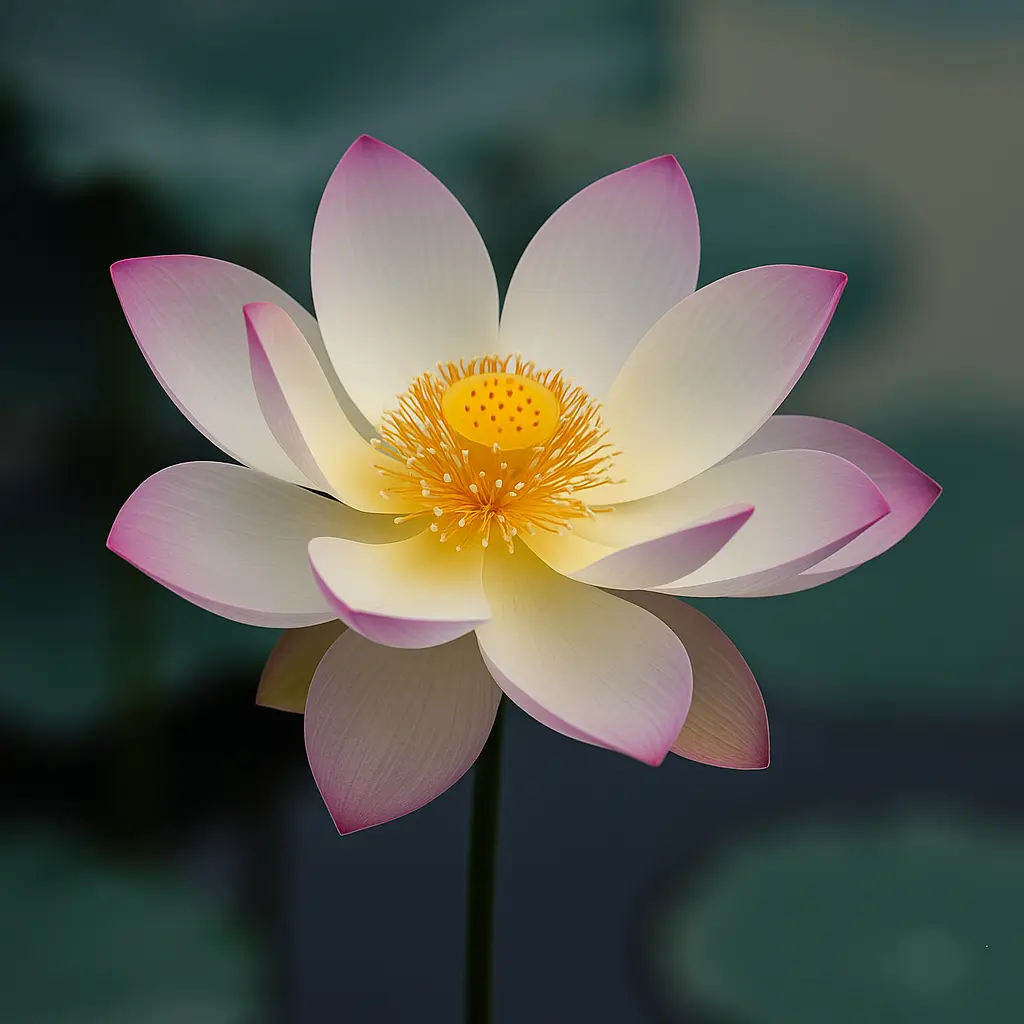
• Lotus Flower: Symbolizes purity and awakening. It grows from mud but remains unstained, just like our ability to awaken despite the challenges of samsara.

• Bodhi Tree: Under this tree, Siddhartha attained enlightenment. A living symbol of the possibility of realization.

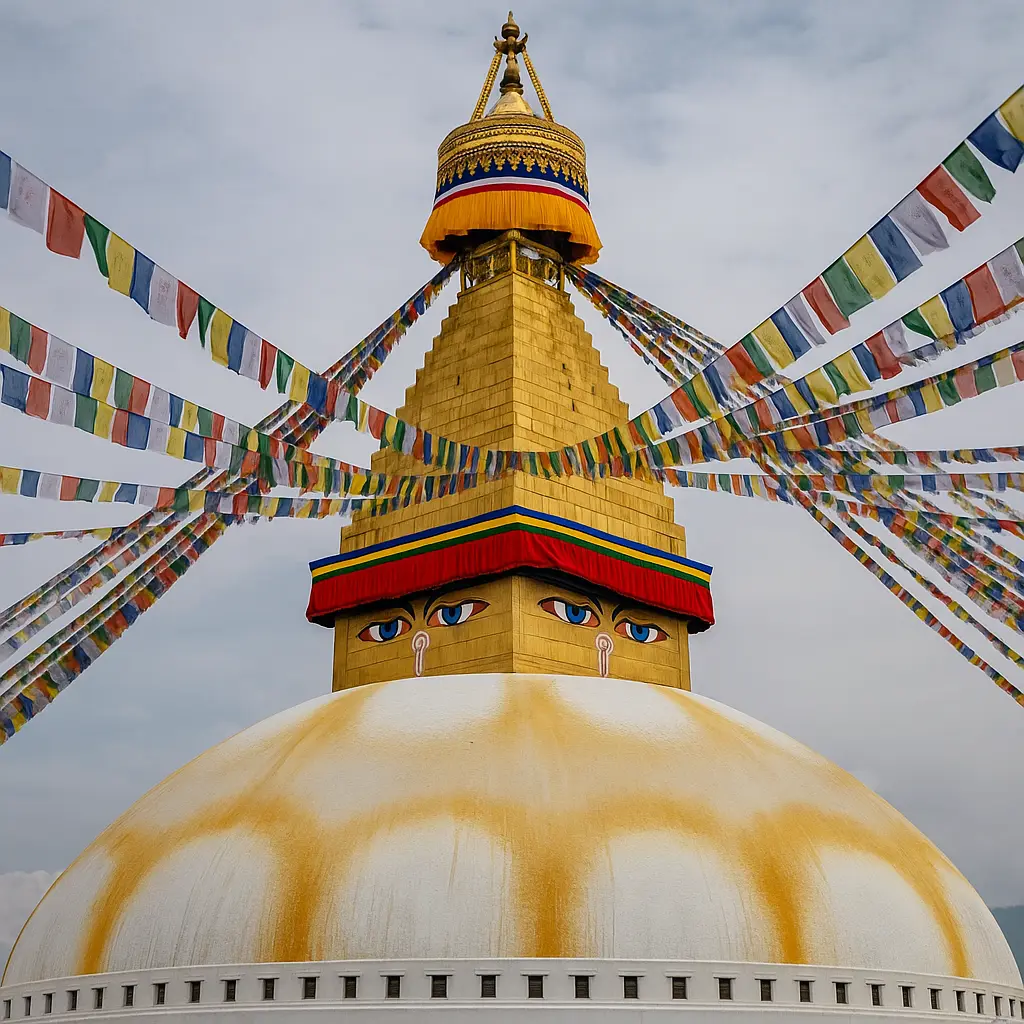
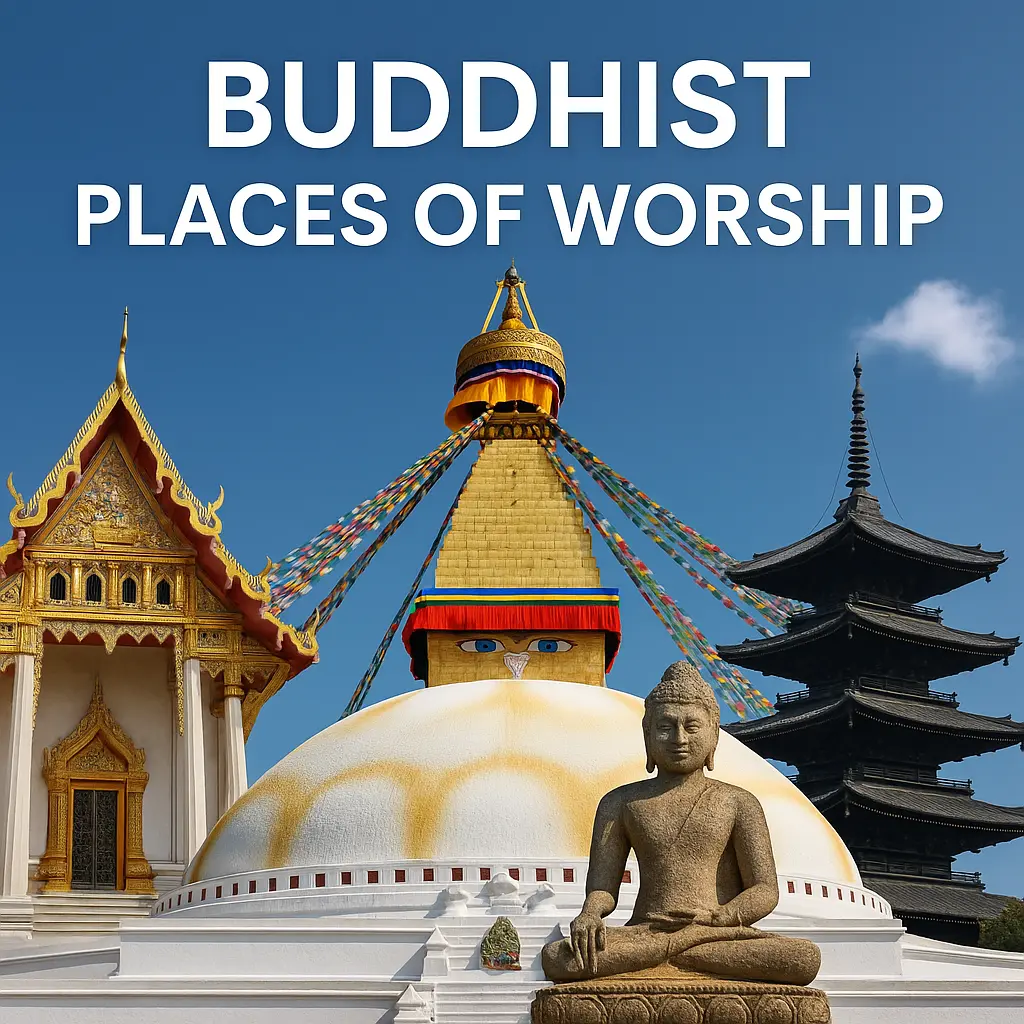
• Stupa: A dome-shaped structure holding relics or symbolizing the Buddha’s awakened mind. It represents both remembrance and refuge.

• Ashtamangala: The Eight Auspicious Symbols used especially in Vajrayāna Buddhism:
– Parasol (protection)
– Golden fish (freedom)
– Treasure vase (spiritual wealth)
– Lotus (purity)
– Conch shell (proclamation)
– Endless knot (interdependence)
– Victory banner (overcoming obstacles)
– Wheel (Dharma)

According to Oxford Reference, these symbols are found in temple murals, ritual implements, and monastic offerings.

Where You’ll See These Symbols Today
Across Nepal, Tibet, Bhutan, and beyond, these symbols are living elements of the Buddhist cultural landscape.

• The gates of Boudhanath Stupa feature the Dharma Wheel flanked by two deer, symbolizing the Deer Park where the Buddha first taught

• The lotus appears on altars, murals, and in every monastery garden

• The Eight Auspicious Symbols are printed on prayer flags, engraved on bronze bowls, and painted across Tibetan thangkas

They are not decorations. They are reminders. Each one pulls the mind back to the path.

Why Symbols Matter on the Inner Path

Buddhism often warns against clinging to form. But it also embraces the power of symbolic form to transmit timeless truths.

These symbols act as bridges between visible and invisible realities. You may forget a teaching, but a symbol stays with you. A wheel over a temple door may call you to pause. A lotus beside a stupa may help you breathe through difficulty.They are the quiet language of awakening, available without words.

The Eightfold Path and the Spokes of Liberation

The wheel keeps turning. Not because we chase it, but because the path of Dharma continues in each breath, step, and choice.

You don’t need to wear the Dharma Wheel to live its meaning. Just take one step. Choose one spoke. Live it sincerely. And the wheel turns. If you’re walking the path, the symbols will meet you wherever you are.

Stay Near the Dharma Wheel Itself. There’s no better place to reflect on Buddhist symbols than Boudha, one of the most sacred pilgrimage sites in the world.

Just steps from the great stupa, you’ll find a peaceful retreat where the wheel turns quietly.

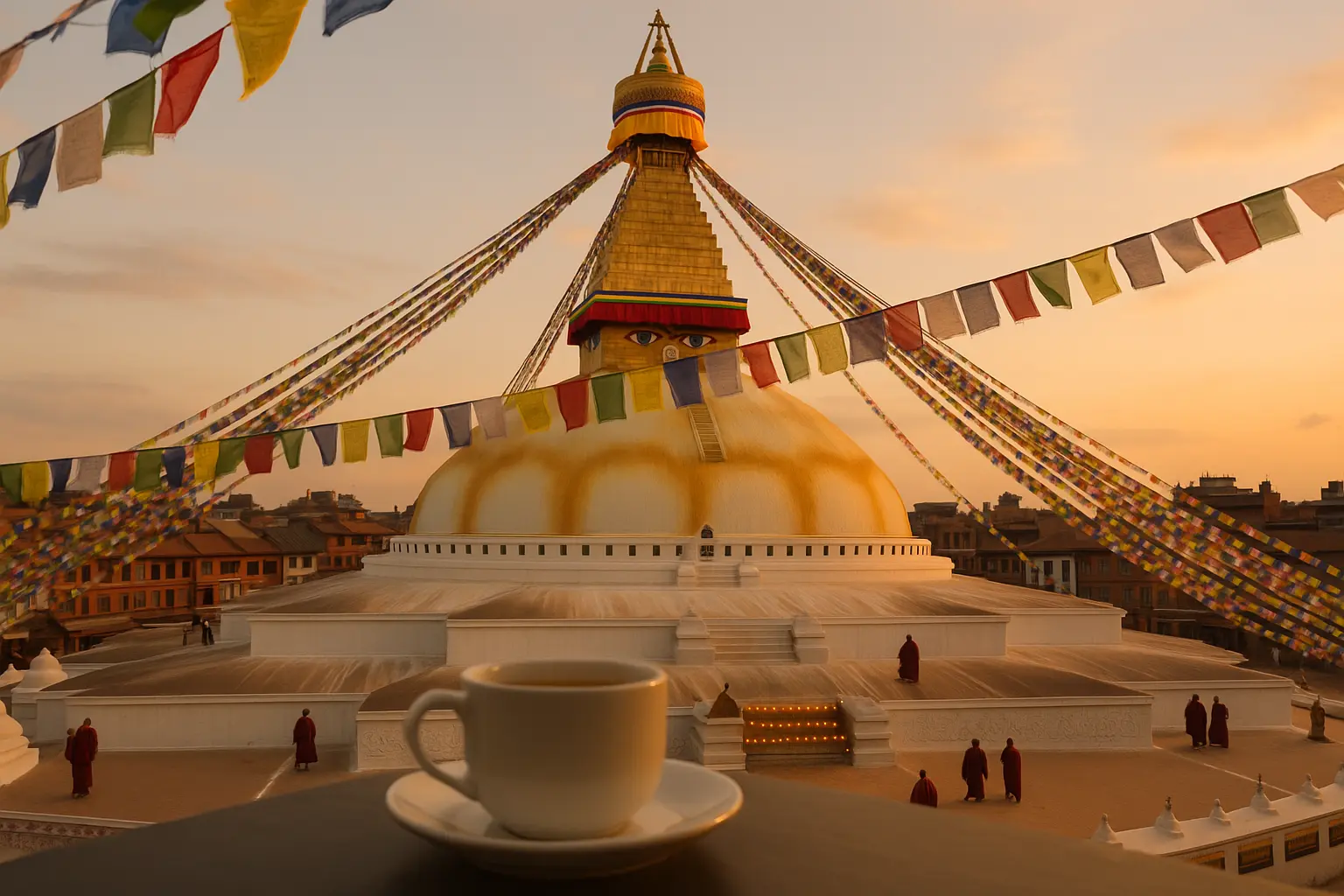
At Boudha Mandala Hotel, you can wake to the chants of monks, sip tea while gazing at the stupa, and feel surrounded by the same symbols that have guided seekers for centuries.

If you’re looking for a peaceful boutique hotel in Boudha, our space is designed to support your inner and outer journey.

Thangka Painting in Boudha: Where to See, Learn, and Buy

Key Takeaways:
Boudha is more than a stupa. It’s a living mandala of devotion, where the walls breathe prayer and the alleys hum with sacred color. One of its quiet treasures is the presence of Thangka painting, sacred scroll art that tells the stories of the Buddha, bodhisattvas, and protectors through intricate brushwork, devotion, and lineage.

This guide walks you through where to witness, learn, and support authentic Thangka art in Boudha, with a special spotlight on the Himalayan Art Council, a guardian of this sacred heritage.

Why Thangka Painting Matters in Boudha.

If you’ve walked the kora around Boudhanath Stupa, you’ve likely passed Thangka shops glowing with reds, golds, and blues. But these aren’t just souvenirs. A true Thangka is a meditation in paint,a visual scripture born of sacred geometry, iconographic precision, and often months of devotion.

Originally used as aids for meditation or teaching, Thangkas are part of a deeper ritual life in Vajrayana Buddhism. They must be painted with care, following exact proportions handed down through the centuries. And Boudha remains one of the rare places on earth where this tradition is still alive, not just preserved, but practiced.

Where to See Masterpieces Up Close

Himalayan Art Council: A Living Archive of Himalayan Art

If you want to understand Himalayan painting beyond its surface beauty, this is where you begin.

The Himalayan Art Council is more than a gallery. It’s a cultural institution rooted in preservation, education, and living practice. Their collection spans ancient paubhas, rare deity Thangkas, and modern interpretations from contemporary Himalayan artists.

Step inside and you’ll find:
• Rarely-seen pieces from private collections and remote monasteries
• Exhibitions that connect traditional art with modern expressions
• Guided insights into the symbolism, technique, and lineage behind each work

The Council also protects artistic integrity through digital provenance systems, allowing artists to certify their original work and ensure it’s not lost to imitation or overseas commodification.

Visit the Himalayan Art Council to explore current exhibits, artist residencies, or join a guided tour.

Where to Learn the Sacred Craft

Local Thangka Studios and Workshops

For travelers who want to go beyond looking and begin creating, Boudha offers several studios where you can take short or long-term Thangka painting courses.

1. The Norling Art School

Tucked down a quiet alley near Shechen Monastery, Norling offers traditional training under lineage artists. They focus on authentic technique: gold detailing, brush prep, hand-ground pigments, and iconometric drawing.

• Great for: Serious learners or those staying in Boudha for a few weeks
• Tip: They often host beginner workshops during Losar or special retreats

2. Tibetan Thanka Art School
A family-run space that’s open to walk-ins. Students can observe painters in process or join half-day sketching sessions.
• Great for: Curious travelers with little background
• Bonus: Their master painter has done commissions for local monasteries

Before signing up, always ask whether the teacher has direct training under a lama or certified art lineage, this ensures the practice is spiritually rooted, not just decorative.

Where to Buy Authentic Thangka Paintings in Boudha

Buying a Thangka is like adopting a sacred mirror. If done respectfully, it becomes a blessing in your home or altar.

Here’s how to do it mindfully:
• Avoid tourist traps with factory-made copies
• Ask about the artist. Where did they train? Which lineage? What deity or symbolism is depicted?
• Visit verified spaces like the Himalayan Art Council, where pieces are certified, ethically sourced, and accompanied by artist bios

Most reputable shops in Boudha will wrap your Thangka carefully and explain how to treat it with respect (don’t place it on the ground, avoid display in bathrooms or casual spaces).

Why the Himalayan Art Council Matters Now More Than Ever

In a world where sacred art is often commercialized or stripped of context, the Himalayan Art Council acts as a cultural shield. Their mission is to protect Himalayan art as a living national treasure, not just relics in glass cases.

They preserve endangered paubhas, support new artists, and use AI and private blockchain to ensure artwork remains authentic, traceable, and connected to its source culture.

Every certified Thangka in their collection is:
• Digitally recorded for provenance
• Connected to the artist’s lineage and method
• Part of a larger public archive for future generations

When you buy or support art through the Council, you’re not just collecting,you’re participating in the protection of Himalayan identity, history, and spiritual integrity.

Explore available artworks or artist collaborations at the Himalayan Art Council

Final Reflection

To truly understand Thangka painting, you don’t need a textbook. You need to slow down.

Sit inside a quiet atelier. Watch the steady hand lay gold leaf on a Bodhisattva’s crown. Ask the artist why they chose that particular shade of blue. Feel how reverence travels from hand to brush to canvas.
And maybe, as you carry your own Thangka home, you’ll realize it’s not just pigment and cloth. Its presence.

A reminder that in Boudha, art is not decoration. It’s devotion, made visible.

Planning to Explore Sacred Art in Boudha?

If you’re staying in Boudha to explore its artistic and spiritual depth, Boudha Mandala Hotel offers long-stay apartments and peaceful stupa-view rooms just steps away from workshops, studios, and galleries.

Our staff can help you connect with local artists or visit current Himalayan Art Council exhibitions.

Buddhist Food Restrictions: Mindful Eating and Spiritual Discipline

Food in Buddhism goes beyond mere nourishment. It’s an essential part of spiritual practice, mindfulness, and ethical living. Buddhist dietary practices are influenced by teachings around compassion, non-attachment, and respect for life.

This guide explores Buddhist food restrictions, why they exist, and how mindful eating is a core part of spiritual growth for Buddhists and mindful travelers alike.

Core Principles Behind Buddhist Food Restrictions

Buddhist food guidelines aren’t just rules; they reflect deeper spiritual values:

• Ahimsa (Non-Harming): Avoiding harm to living beings, leading many Buddhists to adopt vegetarianism or veganism.

• Mindfulness and Moderation: Eating to nourish the body rather than indulging desire.

• Non-Attachment: Food is viewed as sustenance, not pleasure or indulgence.

These principles guide dietary choices and everyday eating habits.

Vegetarianism and Veganism in Buddhism

While not all Buddhists are vegetarians, many choose vegetarian or vegan diets as an expression of compassion and non-harming. Mahayana Buddhists are more likely to follow strict vegetarianism, believing that abstaining from meat reduces suffering in the world.

Monks and nuns in many Buddhist traditions also follow vegetarian or vegan diets as part of their monastic discipline.

Foods Typically Avoided in Buddhism

Certain foods are traditionally avoided by many practicing Buddhists, especially monastics:

• Meat and Fish: Especially avoided during important religious observances or by stricter practitioners.

• Alcohol and Intoxicants: Alcohol and mind-altering substances are usually prohibited as they impair mindfulness.

• Garlic, Onion, and Strongly Flavored Foods: These are often avoided, particularly in Mahayana monasteries, due to their perceived impact on spiritual balance and meditation.

Mindful Eating: How Buddhists Approach Meals

Eating mindfully is central in Buddhism. It involves:

• Eating slowly and consciously, fully appreciating each bite.
• Being aware of where the food comes from and expressing gratitude.
• Consuming just enough to nourish the body without excess or waste.

This mindfulness transforms a simple act into a spiritual practice.

Buddhist Food Practices Around Boudhanath

If you’re exploring spiritual life around Boudhanath, you’ll find many restaurants and cafes offering meals aligned with Buddhist food guidelines:

1. Boudha Cafe De Mandala

Located within the Boudha Mandala Hotel, it offers vegetarian and vegan options, mindful dishes prepared with local ingredients, ideal for travelers who appreciate food as spiritual nourishment.

2. Ananda Treehouse

Known for its organic vegan and vegetarian options, this rooftop café provides mindful, flavorful meals suited to spiritual and health-conscious travelers.

3. Zen Bistro

Offers a variety of vegetarian dishes without onion or garlic, catering specifically to Buddhist dietary principles.

Incorporating Buddhist Food Practices at Home

Whether you’re traveling or staying in Boudha long-term, you can incorporate Buddhist principles into your meals:

• Choose vegetarian or vegan meals several times a week.
• Practice mindful eating by eating slowly, without distraction.
• Reflect on the source of your food, fostering gratitude and awareness.

You can find local ingredients at Boudha’s fresh market, enhancing your mindfulness practice through cooking and meal preparation.

Why Buddhist Dietary Restrictions Matter

Understanding Buddhist food restrictions isn’t just about rules; it’s about adopting a mindful approach to life. Eating becomes a practice of compassion, ethical living, and spiritual discipline.
For travelers staying near Boudhanath, embracing these practices enriches the travel experience, aligning daily meals with spiritual intentions and cultural respect.

Final Reflection: Food as a Path to Awakening

Food in Buddhism is more than sustenance. It’s a pathway to awakening. By observing food restrictions and mindful eating practices, you nourish not only your body but your spirit.

Next time you sit down to eat near Boudha, pause. Feel grateful for the food before you. Remember, every meal is an opportunity for mindfulness and spiritual growth.

Boudhanath Stupa Guide 2026: History, Rituals, Visit

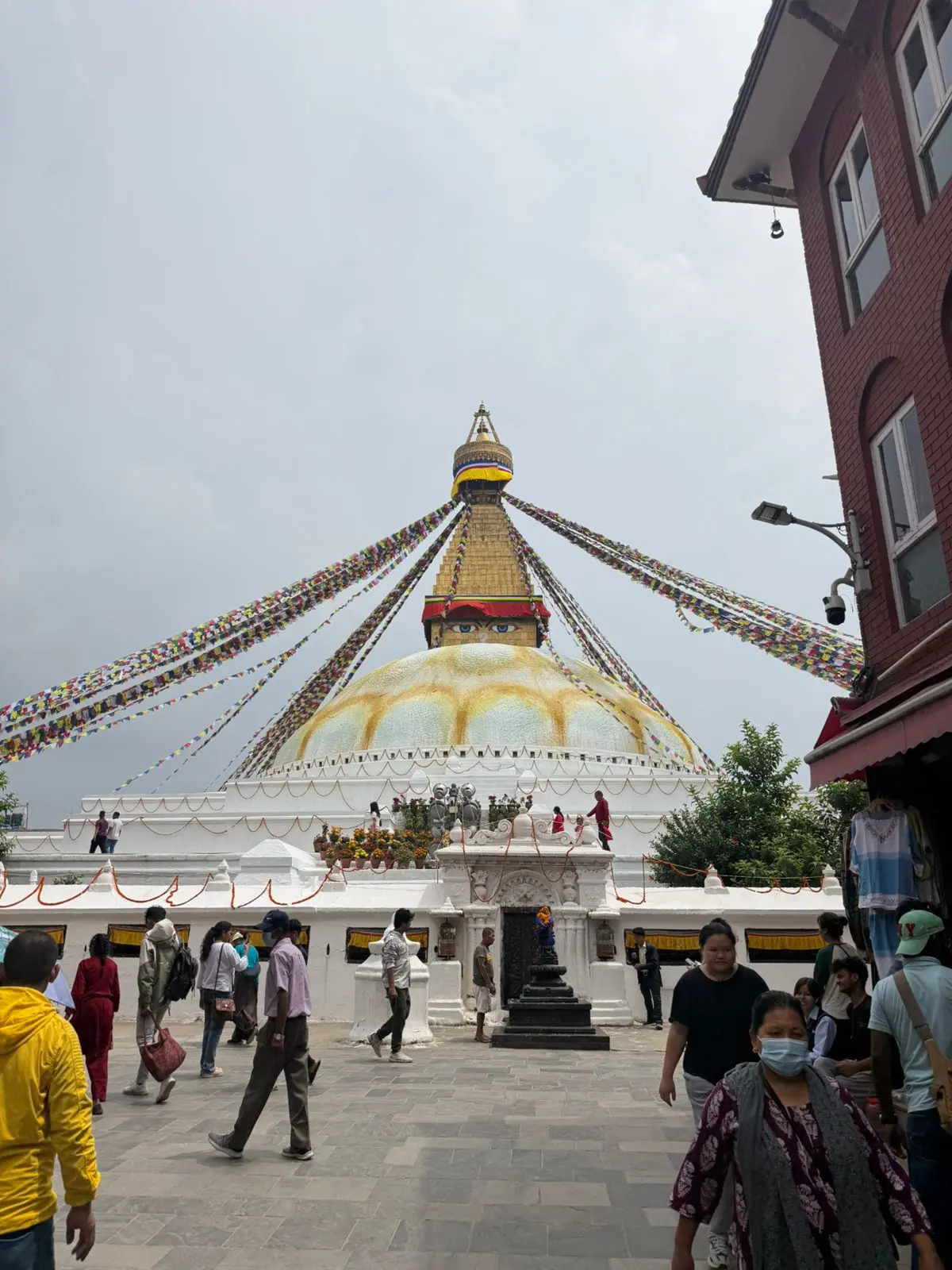
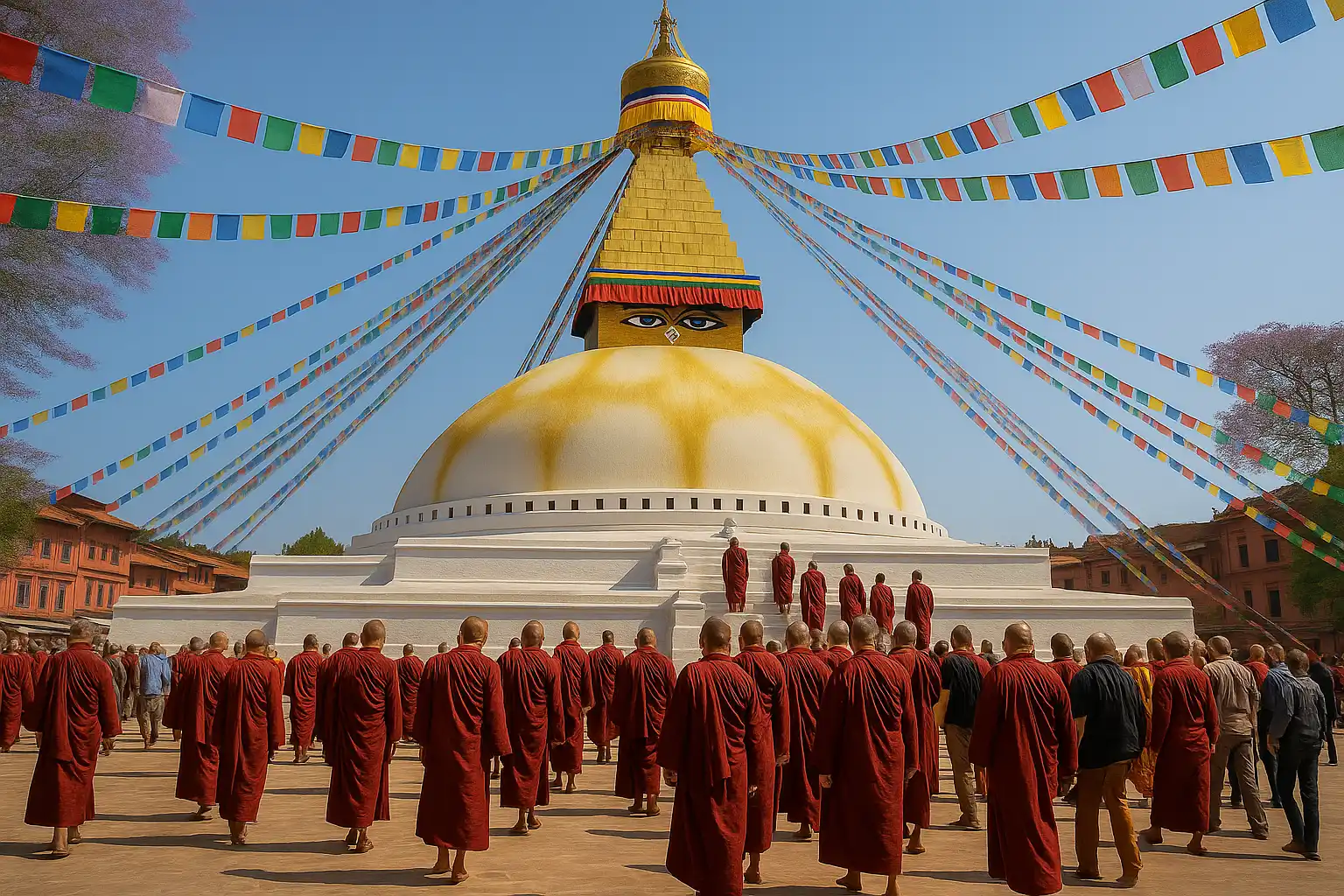
You don’t need a religious background to feel the pull of Boudhanath Stupa. You just need to arrive at the right hour. When the first light slips over the dome and the prayer flags start catching wind, you notice a simple truth: this place runs on devotion, not display. People come here to practice, to remember, to walk. Visitors are welcome but the stupa asks you to enter its rhythm correctly.

This guide is for first-time visitors who want clarity without being overwhelmed: the history that matters, what the symbolism actually means, how to do kora respectfully, and how to plan a day around Boudha’s living schedule.

A short, clear history & UNESCO status

Boudhanath (often called “Boudha”) is among Nepal’s largest and most important stupas, with roots tied to the Licchavi period (roughly 5th to 7th century CE). Over centuries, it has been restored and expanded by kings, local communities, and monastic traditions, which is why it still feels alive rather than frozen in time.

What matters for first-time visitors is its role today: Boudhanath is the spiritual center of Tibetan Buddhism in Nepal. After 1959, waves of Tibetan refugees settled around the stupa, establishing monasteries and a cultural economy that continues to shape the neighborhood’s identity.

UNESCO recognized the stupa as part of the Kathmandu Valley World Heritage listing in 1979.

So when you visit, you are stepping into a heritage site that is also someone’s daily spiritual home. Both truths coexist.

What the stupa’s symbolism means (eyes, dome, kora, prayer flags)

If you understand the stupa’s symbolic language, your visit becomes more than watching others perform rituals.

The white dome

The dome represents the vast world and the mind’s potential for awakening. Its smooth curve is deliberate: a reminder that realization isn’t angular or forced to it’s spacious, gradual, and inclusive.

The all-seeing eyes

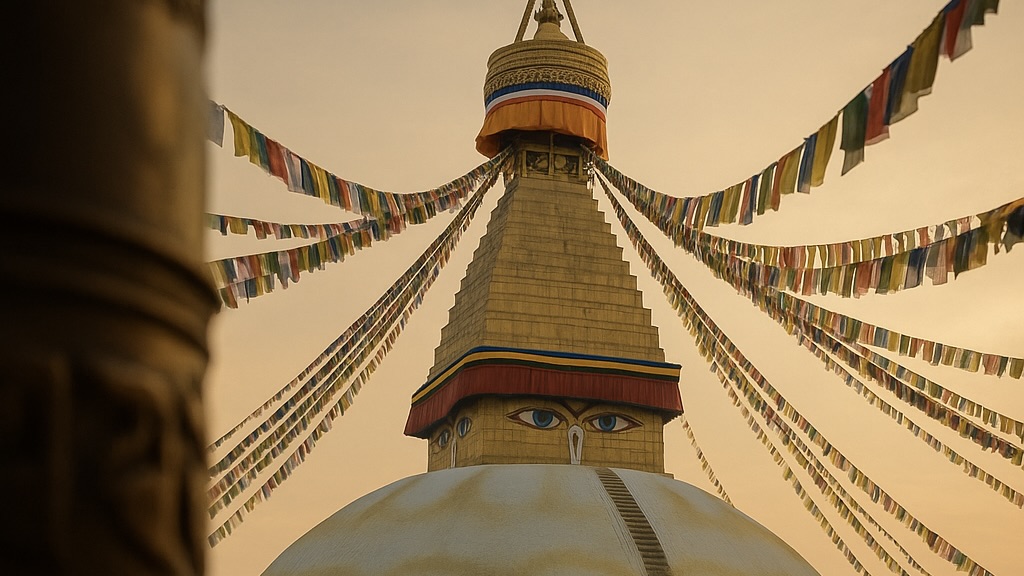
The Buddha eyes painted on the harmika (square tower above the dome) symbolize wisdom and compassion looking in all directions. They are not meant as surveillance. They are meant as awareness: calm, present, non-judging.

The kora path

The circular walkway around the stupa embodies the Buddhist path as a lived practice. You circle because the transformation is cyclicaltoone round deepens the next. This is why locals do multiple circuits, not just one.

Prayer flags

The flags carry mantras and blessings outward through wind. You’ll see newer bright flags and older faded ones; both belong. Their fading is part of the lesson: practice continues even as cloth frays.

Once these elements make sense, the stupa reads like a map of practice, not just architecture where in buddhist meditation digs deeper and bridges first time friendly into meditation culture.

The daily rhythm you’ll witness around the stupa

Boudhanath is best understood through its daily cycle.

Early morning (around 5:00to7:30 AM)

The plaza is devotional and quiet. Elderly locals, pilgrims, and monastics do koras steadily. Prayer wheels click. Soft chants rise. The air is cooler and cleaner.

Midday (10:00 AMto3:00 PM)

The ring becomes social and commercial. Shops open fully. Visitors increase. Monasteries hold routine activities. If you want coffee, shopping, or monastery interiors, this is your window.

Dusk (4:30to6:30 PM)

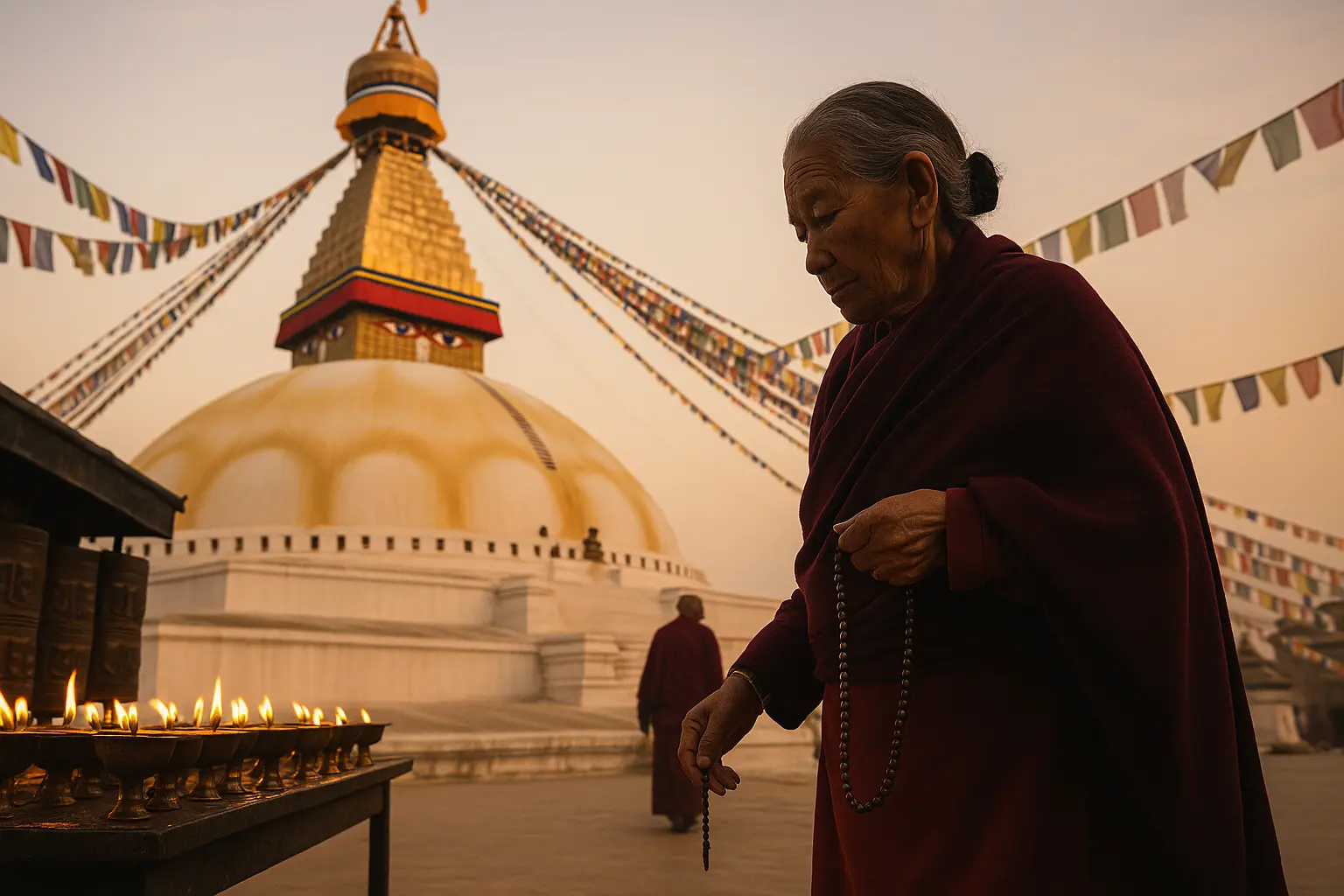
The most emotionally charged time. The dome warms under golden light. Butter lamps appear in long rows. The kora current thickens again.

Evening (after 7:00 PM)

The crowd softens. Lights glow. The stupa feels contemplative again, especially on clear nights.

This rhythm is stable across seasons. If your itinerary matches it, your experience becomes naturally smoother.For a grounded way to watch these everyday rhythms without turning them into a “tour.”

Best times of day to visit (sunrise, dusk, full-moon nights)

First-time visitors often ask “When is Boudha at its best?” The honest answer: it depends on what you want to feel.

Sunrise

This gives you the calmest, most practice-filled atmosphere. If you want a genuine sunrise at Boudha experience, come early, walk a full clockwise circuit, and then sit on the outer ring for ten quiet minutes.

Dusk

Come if you want to witness devotion as shared energy: butter lamps, chanting clusters, a steady flow of koras. The light is also ideal for photography.

Full-moon nights

Many Buddhist observances fall on full-moon days, so the plaza often carries a stronger devotional presence, with more lamps and evening circumambulation.

If you can only pick one time, pick sunrise. If you can pick two, sunrise and dusk together form a complete arc.

How to do kora respectfully (direction, pace, behavior)

Kora is not a performance. It’s a moving meditation. To join respectfully:

  • Walk clockwise.
  • Always keep the stupa to your right. If you accidentally go the other way, you’ll feel the mismatch instantly.
  • Blend into the flow.
  • Don’t stop suddenly in the middle of the path. Step to the outer edge if you need to pause.
  • Keep your voice low.
  • Treat the ring as a sanctuary even when shops are busy.
  • Respect elders and monastics.
  • Give way. Let their pace lead the current.
  • You may spin prayer wheels gently.
  • If you do, spin them in the direction they naturally turn (clockwise).

Even one round done properly teaches more than five rounds done distractedly.

What to wear and photography etiquette

What to wear

Boudha is tolerant, but monasteries and devotional spaces still expect modesty.

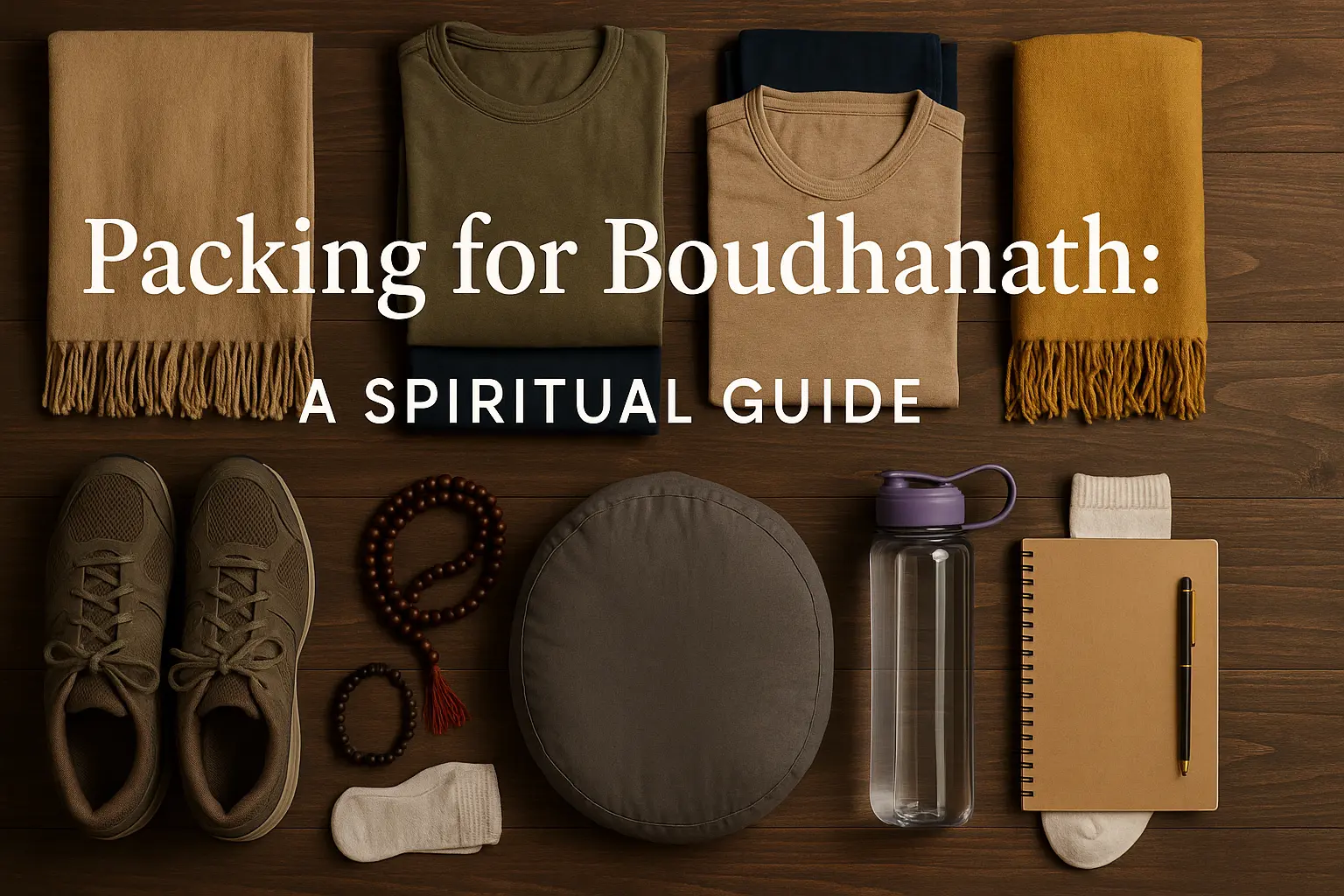
    • Covered shoulders and knees are safest.
    • Light layers help: mornings in winter can be cold; midday warms quickly.

Photography etiquette

    • Do not photograph monks or elders close-up without asking.
    • Avoid flash during rituals.
    • Some monastery interiors prohibit photos entirely to follow signs or staff guidance.
    • If you want portraits, ask first, smile, and accept a no gracefully.

It’s fine to document your visit. It’s not fine to interrupt someone else’s practice to do it.

Tibetan Buddhist presence around Boudha, simply explained

Boudhanath is a Tibetan Buddhist hub because it became a refuge and spiritual center after Tibet’s mid-20th-century upheavals. Tibetan communities settled around Boudha, creating monasteries, schools, and artisan traditions that preserved their lineages in exile.

That’s why you see:

    • Monks and nuns from multiple Tibetan traditions.
    • Thangka studios and ritual-item shops.
    • Tibetan-language signage and cafés serving thukpa and butter tea.

For visitors, the takeaway is simple: you are witnessing a living diaspora culture grounded in religion and community, not a staged attraction.

Key monasteries travelers can visit respectfully

You don’t need to visit many monasteries. Two or three, done slowly, are enough.

Commonly visited, culturally significant options include:

    • Shechen Monastery (Nyingma tradition): known for its art, architecture, and daily rituals.
    • Ka-Nying Shedrub Ling (White Monastery): a major teaching center with a welcoming layout for visitors.
    • Kopan Monastery (nearby hilltop): especially known for meditation courses and retreats.

A good pattern is one large active monastery plus one smaller quiet gompa in the lanes.

Etiquette inside monasteries and during puja

Monasteries are working spiritual institutions. You’re welcome, but your behavior matters.

    • Enter quietly; remove shoes if required.
    • Sit where visitors are directed, often along walls.
    • Don’t walk in front of teachers or prayer groups during puja.
    • Keep phones silent; no calls in courtyards.
    • If an offering bowl is present, you may contribute a small note respectfully.

If you’re uncertain, watch what locals do and follow.

Festivals and special days at Boudhanath

Festivals are when Boudha shifts from steady devotion to collective celebration. If your trip overlaps with one, you’re in for something unforgettable.

Major observances include:

    • Losar (Tibetan New Year, Jan to Feb): prayer gatherings, mask dances, special offerings, festive atmosphere around the stupa.
    • Buddha Jayanti / Vesak (April to May full moon): commemorates Buddha’s birth, enlightenment, and passing; the stupa is lit and crowded with candle processions.
    • Lhabab Düchen (Oct to Nov, Tibetan lunar calendar): special prayers and merit-making ceremonies, often with intensified monastery activity.

Festival days are crowded but deeply alive. Go early and keep expectations flexible.

Annual festival calendar for Boudha and nearby temples

Here’s a simplified annual view for travelers (actual lunar dates shift year to year):

    • Jan Feb: Losar (Tibetan New Year)
    • April May: Buddha Jayanti / Vesak (full moon)
    • Oct Nov: Lhabab Düchen + major autumn pilgrimage season

Nearby Kathmandu Valley temples and heritage sites also host seasonal festivals in the same windows, so autumn and late spring are the most culturally dense travel periods.

Best viewpoints and quiet corners

First-time visitors often stay glued to the ring. That’s understandable but the best perspective is sometimes one step away.

Rooftop cafés

These give broad mandala views and let you observe the ring without being inside it. Morning and dusk are best for light and atmosphere.

Side alleys

Walk outward a few lanes from the ring and you find quiet studios, smaller shrines, and less crowded prayer-wheel corners. These alleys are great for photography without blocking kora flow.

Quiet corners on the outer ring

There are subtle sitting spots along the edge where locals rest between rounds. Sit there for ten minutes. Watch the movement. Let it sink in. You’ll understand Boudha better than if you rushed another attraction.

How to join meditation sessions or teachings respectfully

Many monasteries and centers around Boudha offer public teachings or meditation sessions, especially in peak pilgrimage seasons.

If you want to join:

    • Ask your hotel or a monastery staff member about schedules.
    • Arrive early, dress modestly, and sit where directed.
    • Keep your phone off.
    • If a donation is customary, contribute quietly at the end.

Kopan Monastery, in particular, is known for structured retreats and short courses that welcome international visitors.

The key is humility: enter as a learner, not a consumer.

A practical first-timer itinerary (2 to 6 hours)

This is a realistic plan that respects the stupa’s rhythm.

2-hour “first contact” visit

    • Enter the plaza and orient yourself.
    • Do one full clockwise kora.
    • Pause at prayer wheels, spin gently if you wish.
    • Sit on the outer ring for ten quiet minutes.
    • Finish with tea at a rooftop café.

Half-day “cultural immersion” visit

    • Sunrise or dusk kora.
    • Visit one major monastery.
    • Walk artisan lanes for thangka studios and craft shops.
    • Rooftop lunch or coffee.
    • Return for a second short kora before leaving.

If you stay near the stupa, you can split this across morning and evening rather than compressing it into one stretch.

Conclusion

Boudhanath Stupa meets you at whatever depth you’re ready for. You arrive as a first-time visitor, but the place doesn’t treat you like one; it simply invites you into a living rhythm that has been repeating for centuries. When you understand the essential history, read the symbolism with clear eyes, and move through kora in the right direction and spirit, the stupa stops being “a site” and becomes a teacher of pace, attention, and shared practice. You notice how the day turns herequiet sunrise rounds, midday market hum, dusk lamps and chants, full-moon gatherings and you start planning your hours around that pulse rather than forcing your own. Visit fewer monasteries but stay longer in each. Take your photos without interrupting devotion. Sit in a quiet corner and watch a thousand tiny acts of faith happen without announcement. If you do that, your first Boudhanath visit in 2026 won’t feel like sightseeing. It will feel like participation in something stable, human, and still unfolding.

Walk slowly, circle clockwise, come at sunrise or dusk, and let the mandala do what it has always done: draw you into presence.

FAQs

What is Boudhanath Stupa and why is it important?

Boudhanath is one of Nepal’s largest stupas and the main center of Tibetan Buddhist pilgrimage in Kathmandu. It has been a UNESCO World Heritage Site since 1979.

What do the Buddha eyes on the stupa mean?

They symbolize wisdom and compassion looking in all directionstoawareness rather than judgment.

What is the best time to visit Boudhanath Stupa?

Sunrise is calmest and most devotional; dusk is most alive with lamps and chanting. Full-moon nights are special during Buddhist observances.

How do you do kora at Boudhanath respectfully?

Walk clockwise with the stupa on your right, blend into the flow, keep voices low, step aside to pause, and respect elders and monks.

What should you wear to visit Boudhanath and nearby monasteries?

Modest clothing that covers shoulders and knees is best. Bring layers for cold mornings and cool evenings.

Which monasteries near Boudhanath can tourists visit?

Shechen Monastery, Ka-Nying Shedrub Ling (White Monastery), and Kopan Monastery (nearby) are key visitor-friendly options when approached respectfully.

What festivals happen at Boudhanath Stupa?

Losar (Tibetan New Year), Buddha Jayanti/Vesak, and Lhabab Düchen are major annual observances with heightened rituals and crowds.

If you are staying at Boudha Mandala Hotel, you are already in the best position to experience Boudha gently and correctly steps from the ring, but with quiet to return to. When you are ready, you can book through Boudha Mandala Hotel

Buddhist Meditation: Returning to the Stillness Within

TL;DR
• Buddhist meditation is a way of seeing, not escaping

• It begins with the breath, but leads to compassion, clarity, and liberation

• Practices like Vipassanā, Samatha, and Metta reveal the truth of impermanence and the nature of self

• You don’t need robes or rituals to begin, just sincerity and presence

• Meditation is the heart of Buddhism, because it shows us how to suffer less, and love more

A Practice Older Than the Dust on Pilgrim Paths

To understand Buddhist meditation, you have to begin not with technique, but with the reason.

Why do we sit? Why do monks rise before dawn, why do pilgrims walk in circles around stupas, beads in hand, breath quiet?

Not to chase peace. Not to block out the world. But to remember something we forget, again and again.

That the mind is not the enemy. That silence is not empty. That in stillness, we can hear what’s true.

The Buddha, after years of extremes, sat beneath the Bodhi tree with no expectation. Just breath, body, and unwavering attention. What he saw there wasn’t supernatural, it was ordinary, seen clearly. That everything changes, that clinging brings suffering, and that freedom is possible.

Three Paths, One Heart

Though the lineages vary across countries and centuries, the essence of Buddhist meditation rests on three pillars. These are not categories to master, but companions that unfold together, like breath, body, and sky.

Vipassanā, Seeing Things As They Are

In the Theravāda tradition, this is often the first formal training. Vipassanā, or insight meditation, invites you to observe the body, thoughts, and emotions without decorating them, without editing.

What happens when you simply watch the breath, or a rising feeling, without judgment?

You start to notice: this moment is moving. Sensations rise, pass. Thought loops dissolve when you don’t feed them. Self becomes more like a story than a solid fact.

The insight doesn’t come from believing. It comes from looking.

“Just as footprints follow the ox that pulls the cart, so too does suffering follow the untrained mind,” said the Buddha.
This practice is the training.

For foundational texts on this, explore Access to Insight’s guide to Vipassana.

Samatha , Calming the Waters

Before the mind can see clearly, it often needs to settle. That’s where Samatha, or calm-abiding meditation, comes in.

Focus on the breath, not to force it, but to soften the mind’s grip on distraction. Over time, the mental static quiets. You begin to rest, not in sleep, but in awareness.

This isn’t sedation. It’s alert stillness. The kind that monks describe as “resting like a bird on a branch”, light, unshaken.

Samatha is not the goal, but it’s the ground from which insight blooms.

Metta , A Soft Heart in a Harsh World

In this practice, we turn toward the heart. Metta, or loving-kindness meditation, begins with a simple wish: May I be well. May I be safe. May I live with ease.

Then it expands: to a loved one, to a stranger, to someone who hurt you, and finally, to all beings.

It may feel mechanical at first. But something shifts. You begin to meet your own wounds with gentleness. You begin to see others, not as threats, but as fellow travelers.

Learn more about this heart-centered practice through Lion’s Roar’s explanation of Metta.

Meditation Is Not Perfection. It’s Presence.

In Boudhanath, I’ve seen travelers from every corner of the world try to sit. Some try to stop their thoughts. Others try to float in bliss. But true practice begins when we drop the trying.
Meditation is not a performance. It’s not about achieving anything.

It’s a way of being honest, with the breath, with the ache in the knees, with the mess of the mind. And in that honesty, something opens. A tenderness. A truth. A peace that doesn’t depend on things going right.

Where to Begin (Even If You’re Not in a Monastery)

You don’t need a mountain hut to meditate. You don’t need to chant in Pali or light incense.

Start with what you have:
• A quiet space

• A posture that’s steady, not stiff

• A few minutes of watching the breath, just rising, falling

• When the mind wanders (and it will), gently return

In Boudha, Meditation Is in the Air

I’ve lived near the stupa for years. Here, meditation isn’t separate from life. You feel it in the rhythm of prayer wheels, the murmur of monks before dawn, the scent of incense mixing with the morning fog.

It’s a place where silence speaks.

At Boudha Mandala Hotel, guests often come for quiet, but they find something deeper: presence. We are not a monastery, but we offer stillness. A room with light. A balcony that sees the stupa. A place to breathe, reflect, and begin again.

If you’re looking for a peaceful hotel near Boudha, not just to stay, but to reconnect, you’ll be welcome here.

FAQs on Buddhist Meditation

Q1: Do I need to become a Buddhist to meditate this way?

No. The practice is open to anyone with sincerity. You don’t have to believe in anything, just be willing to look.

Q2: What if I can’t sit still or feel restless?

That’s normal. Restlessness is part of the path. The practice is not about stopping it, but seeing it clearly and gently staying.

Q3: Can I walk or move during meditation?

Yes. Walking meditation is common, especially in monasteries. In Boudha, you’ll often see pilgrims circumambulating the stupa mindfully.

Q4: How do I know if I’m doing it right?

If you’re being honest, kind, and returning when you wander, you’re practicing. There’s no perfect form, only sincere presence.

Q5: How long before I feel peaceful?

Sometimes moments. Sometimes months. The goal is not to feel peaceful, but to see clearly. Peace follows naturally.

Why Artists, Poets, and Monks Come to Boudha for Inspiration

Where Silence Sparks Creation

There are places that sing to the soul, and then there are places that hum. Boudhanath is the latter.

If you’ve ever stood quietly before the stupa as the sun rises, you’ve felt it, that gentle vibration that settles the mind and stirs something deeper. The scent of juniper, the soft murmur of chants, the slow turning of prayer wheels, it’s not noise, it’s rhythm. And in that rhythm, many have found their voice.

Over the years, Boudha has become more than a pilgrimage site. It’s a quiet refuge for creators, a sanctuary where inspiration arrives not through intensity, but through presence.

The Spiritual Atmosphere of Boudhanath

Boudhanath Stupa isn’t just a monument. It’s a living, breathing mandala. Every day from before sunrise, monks, nuns, elders, and pilgrims begin their kora, walking clockwise around the stupa with prayer beads in hand.

There is a field of stillness here that seems to expand the moment you arrive. You slow down, not because you’re told to, but because the energy invites you to.

The chants from nearby monasteries create a low, continuous current in the air. Prayer flags snap gently in the wind. Pigeons take flight and land without panic. Even the light here feels like it filters down through layers of prayer.

It’s no wonder artists find themselves reaching for their sketchbooks, poets for their notebooks, and monks for their bells.

Why Artists Come to Boudha

Walk around the stupa mid-morning and you’ll see it: someone sitting cross-legged near Tamang Gompa sketching the dome, a painter under a rooftop umbrella blending oils into a golden sky, a photographer waiting quietly for the perfect light on a butter lamp altar.

It’s not just the visual beauty. It’s the way Boudha makes space for contemplation. The textures of carved wood, the movement of robes, the interplay of shadow and incense, these things speak in a language artists understand.

One of the best places to explore this artistic spirit is the Himalayan Art Council. Here, traditional thangka painting, paubha scrolls, and contemporary Himalayan art come together. It’s a platform that honors artist creativity as a living tradition, not a relic of the past.

Explore the Himalayan Art Council

Whether you’re an artist looking to study form or a traveler simply seeking soulful visual beauty, this platform opens a rare doorway into both ancient craftsmanship and modern expression.

A Home for Poets and Writers

The rhythm of Boudha is perfect for writing. The turning of wheels, the chanting, the soft footsteps, it all becomes a kind of metronome for thought.

Many writers come here to finish manuscripts, begin memoirs, or simply keep a quiet journal of their inner journey. There’s no pressure to produce, just a subtle invitation to pay attention. That’s where poetry begins.

Rooftop cafés like Garden Kitchen or Boudha Café de Mandala (the in-house café at Boudha Mandala Hotel) are favorite spots for early-morning writing. With a pot of Tibetan tea and the stupa glowing in front of you, words tend to arrive without being forced.

Some say Boudha gives language back its silence. The kind of silence where meaning grows.

Monks and the Art of Mindful Living

Creativity doesn’t always take the form of a brush or pen. In Boudha, some of the most profound artists are the monks.

Watch a monk arrange butter lamps, each flame lit with care. Or a nun sweeping the courtyard, her movement steady and unrushed. Or the precise symmetry of a thangka painter dipping a brush into pigment ground from stone.

In these acts, there is rhythm. There is precision. There is presence. And that is the essence of art.

The architecture itself is a canvas: vivid murals, carved dragons above doorways, multicolored banners dancing in the wind. Everywhere you look, you see the imprint of spiritual creativity.

Staying in Boudha as a Creative

To truly enter the flow of this place, you need to stay nearby. When you can walk out of your room and be at the stupa in ten seconds, you stop chasing moments,you live inside them.

Boudha Mandala Hotel offers just that. Stupa-view balconies, a calm rooftop for morning writing, and a peaceful café below where monks and travelers alike gather. For long-stay artists or digital nomads working on slow creative projects, the hotel feels like a retreat center without the formality.

The staff understands pilgrimage. They understand silence. And they’ll help you find incense, art supplies, or even the nearest monastery workshop, without hesitation.

Final Reflection

You won’t find fast Wi-Fi on every rooftop here, and that’s the point. Boudha doesn’t invite distraction. It invites you to notice.
The way a monk walks. The flutter of a robe. The color of dusk. The echo of a bell long after it’s been rung.

This is where creation begins, not from pressure, but from quiet.
So if you’re a poet in search of stillness, a painter waiting for color to return, or simply someone who’s forgotten how to listen to silence, come to Boudha.

Walk slowly. Look closely. The inspiration is already here.

If you’re seeking a peaceful stay just steps from the stupa, Boudha Mandala Hotel offers long-stay options, a rooftop café, and a warm welcome rooted in the spirit of presence.

Famous People Who Visited Boudha: The Sacred Draw of Kathmandu’s Spiritual Heart

Key Takeaways:

Boudhanath Stupa isn’t just sacred ground for locals; its peaceful energy and spiritual magnetism have drawn famous visitors, from globally revered spiritual leaders to Hollywood actors and renowned writers. Their journeys reflect the universal appeal of Boudha’s quiet stillness and spiritual depth.

Introduction

If you’ve ever walked the quiet morning kora around Boudhanath Stupa, you understand why people travel from around the world to experience its sacred peace. But you might not realize just how many well-known spiritual leaders, Hollywood stars, and renowned thinkers have quietly walked this same path.

Boudha doesn’t shout about its famous visitors. Instead, it quietly draws them in. Here, celebrity status fades away; the stupa sees all equally, through the compassionate eyes of the Buddha painted on its golden spire.

Let’s explore the stories behind some of the most famous people who have quietly found their way here.

His Holiness the 14th Dalai Lama: Spiritual Influence in Boudha

While the Dalai Lama himself rarely visits Nepal due to political sensitivities, his spiritual influence deeply permeates Boudhanath.

Many monasteries surrounding the stupa follow his teachings closely, and several prominent disciples have taught here regularly. The essence of compassion he embodies resonates throughout Boudhanath.

In a sense, even without frequent physical visits, the Dalai Lama’s spirit is ever-present in Boudha, making the stupa feel like an extension of his compassionate heart.

Richard Gere: Actor Turned Devotee

Hollywood star Richard Gere is known not just for his acting but for his profound dedication to Tibetan Buddhism. Gere has visited Nepal multiple times, quietly spending time around Boudhanath’s circle, engaging in meditation, and learning from prominent Tibetan teachers in the area.

He once mentioned in an interview that places like Boudha provide the grounding necessary for true spiritual reflection. For Gere, the stupa isn’t a tourist attraction; it’s a refuge of presence.

Keanu Reeves and “Little Buddha”: The Hollywood Connection

Many visitors to Kathmandu know about the film Little Buddha, directed by Bernardo Bertolucci, starring Keanu Reeves as Siddhartha. While filming in Nepal, Reeves reportedly spent quiet moments near Boudhanath, drawn by its peaceful aura.

Though Reeves hasn’t spoken extensively about his personal spiritual beliefs, locals remember his visit fondly. His respectful demeanor and genuine interest in Nepal’s spiritual heritage left a positive impression around Boudha.

Renowned Tibetan Buddhist Masters: Chökyi Nyima and Tsoknyi Rinpoche

While perhaps not household names everywhere, teachers like Chökyi Nyima Rinpoche and Tsoknyi Rinpoche are revered globally among spiritual seekers. Their frequent teachings and meditation retreats at monasteries surrounding Boudha attract international artists, writers, and practitioners who seek depth, wisdom, and creative inspiration.

When you walk around Boudha, you might be sitting next to students who have traveled thousands of miles simply to learn from these masters. The quiet presence of these spiritual leaders makes Boudha a true global spiritual destination.

Spiritual Writers and Thinkers: Matthieu Ricard, Robert Thurman, Lama Surya Das

World-renowned Buddhist writer Matthieu Ricard has often spoken of Boudha as a place of profound inner silence, conducive to meditation and compassion. Similarly, Tibetan scholar Robert Thurman and popular author Lama Surya Das have visited and referenced the stupa’s sacred environment in their teachings and writings.

These thinkers have helped popularize Buddhism’s deep stillness and its capacity for spiritual renewal, making it a key pilgrimage point for intellectual and spiritual exploration.

What Brings Them to Boudha?

You might wonder: Why do these accomplished, globally recognized individuals choose Boudhanath? The answer is simple yet profound; it offers something rare in today’s noisy world: true silence, meaningful connection, and spiritual clarity.

Artists come for creative renewal. Actors for authenticity beyond the spotlight. Writers for uninterrupted thought. And monks for genuine spiritual practice.

Here, everyone, famous or not, arrives seeking something deeper.

Staying Near the Stupa: How You Can Walk in Their Footsteps

If you’re drawn to Boudha’s spiritual and creative energy, staying close makes all the difference. Boudha Mandala Hotel is not only steps away from the stupa, it’s perfectly aligned with Boudha’s atmosphere of quiet introspection.

From its rooftop, you can watch the same sunrise that inspired artists and spiritual leaders before you. In its peaceful rooms, you find rest that deepens your practice. And as you walk the early morning kora, you’ll join footsteps left by seekers, saints, and even stars.

Conclusion

Fame might bring people here, but it doesn’t matter much once they arrive. Boudha sees all visitors the same,as pilgrims, seekers, or travelers finding their own quiet path. Whether it’s the Dalai Lama’s teachings resonating in monasteries, Gere’s quiet reverence, or writers’ poetic reflections, the truth is clear:

Boudha isn’t famous because of who visits. It’s beloved because of what it inspires.

Come see for yourself why people from all walks of life, known or unknown, journey here. Perhaps you’ll discover your own quiet inspiration waiting silently beneath prayer flags, among spinning wheels, or in the eyes of strangers circling slowly around the stupa.

Planning your visit to Boudha?

Stay just steps from the sacred stupa at Boudha Mandala Hotel. With peaceful rooms, stupa views, and warm local hospitality, you can experience the same tranquility that’s drawn artists, monks, and famous travelers from across the world.

The History of Boudha: A Sacred Center of Tibetan Buddhism in Kathmandu

Key Takeaways
Boudhanath Stupa in Kathmandu is one of the holiest Buddhist sites in the world and the heart of Tibetan Buddhism in Nepal. Rooted in ancient legends and built during the Licchavi period, it has grown from a simple act of devotion to a sacred monument that holds relics, prayers, and generations of seekers.

After the 1959 Tibetan diaspora, Boudha became a refuge and spiritual center, now surrounded by dozens of monasteries. More than history, Boudha is a living shrine of resilience, faith, and inner peace.

Introduction
When you walk through the narrow lanes of Boudha and suddenly emerge into the vast circle of sky and stupa, something shifts. The pace of life slows. The air smells like juniper and melted butter. Prayer wheels spin in sync with ancient mantras. And at the center, like a spiritual compass, stands the towering white dome of Boudhanath Stupa.

This isn’t just a monument. It’s a witness to centuries. A sacred pulse in the middle of Kathmandu. Its story is woven with myth, migration, ritual, and quiet resilience. To know Boudha is to understand why the spiritual heartbeat of Tibetan Buddhism continues to echo from this place.

The Legend of a Poultry Keeper: The Mythical Origin

According to Buddhist legend, Boudhanath was built by a humble poultry-keeping woman and her four sons. Moved by faith, she petitioned the king for a small piece of land to build a shrine for the relics of Kassapa Buddha. The king granted her wish, and with love, devotion, and the help of her sons, she constructed what became one of the greatest stupas of the Buddhist world.

This legend continues to live in the local consciousness, a reminder that deep faith, even from someone seen as ordinary, can create something timeless and holy. The stupa is more than a structure; it’s a monument to the power of intention.

Historical Foundations: Licchavi Period and Early Buddhism

Beyond the myth, historical evidence places the construction of Boudhanath during the Licchavi era, around the 5th to 6th century CE. In ancient texts, the stupa was known as Khasti Chaitya , with “Khasti” meaning “dew.” During a long drought, locals are said to have cultivated the land with collected dew to support the construction.

This was a time when Nepal was a vital center of Buddhist learning and trade between India and Tibet. Boudhanath became a sacred stop on early pilgrimage routes. It was, and remains, a powerful representation of the dharma in stone.

A New Chapter: The Tibetan Refugee Era Post-1959

The year 1959 marked a profound transformation for Boudha. After the Chinese invasion of Tibet, thousands of Tibetan refugees crossed the Himalayas and settled in the Boudha area. The stupa, already sacred, became a new spiritual home for a displaced people.

Dozens of Tibetan Buddhist monasteries, including Shechen Monastery, Ka-Nying Shedrub Ling, and Thrangu Tashi Yangtse, were built around the stupa. Each lineage, from Nyingma to Gelug, found space here. The stupa became more than a historical site. It became a living monastery, a center for ritual, community, and the continuation of a threatened tradition.

Even today, Boudha is one of the only places outside Tibet where Tibetan Buddhism thrives so openly and fully.

Boudhanath as a UNESCO World Heritage Site

In 1979, UNESCO declared Boudhanath a World Heritage Site, not just for its architecture, but for its cultural and spiritual value. The stupa is one of the largest spherical stupas in the world. Its design follows a mandala pattern, representing the universe, with the dome symbolizing emptiness, and the 13 spires representing stages toward enlightenment.

After the 2015 earthquake, the stupa suffered significant damage. But the restoration that followed, funded by local monasteries and global Buddhist communities, became a symbol of collective healing and resilience.

Spiritual Importance in Tibetan Vajrayana Practice

Boudhanath isn’t just sacred because of history , it is sacred because of what happens there every single day.

– Circumambulation (kora): Devotees walk clockwise around the stupa while reciting mantras.

– Butter lamp offerings: Symbolic acts of light and wisdom

– Prayer flags: Sending compassion to all directions

– Prostrations: Practiced with full-body devotion, especially during dawn and dusk

It’s believed that walking the kora mindfully purifies lifetimes of karma. For Vajrayana practitioners, Boudha is a place where the veil between seen and unseen feels especially thin.

Festivals and Ritual Rhythms at the Stupa

Some of the most powerful experiences at Boudha come during major Tibetan and Buddhist festivals:

– Losar: Tibetan New Year marked with music, prayer, and color

– Buddha Jayanti: Celebrating the Buddha’s birth, enlightenment, and passing

– Lhabab Duchen: Honoring the Buddha’s return from heavenly realms

These aren’t tourist events. They are living rituals, participated in by monks, nuns, and families. Butter lamps line the base of the stupa. Chanting fills the air. It is devotion in motion.

A Living Pilgrimage Site: Why Boudha Still Matters

In a fast-moving world, Boudhanath remains a place where the sacred slows you down. For many Tibetans and Himalayan Buddhists, visiting Boudha at least once is a lifetime goal. For others, it becomes a daily rhythm , a morning kora, an evening lamp.
The stupa radiates peace not only because of its design, but because of the countless acts of devotion offered here for over 1500 years. It is a center of collective consciousness, a space for refuge, remembrance, and recommitment to the path.

Reflection: The Wisdom Hidden in the Stones

I remember sitting on a rooftop café one dusky evening, sipping salt-butter tea while watching hundreds of butter lamps flicker around the stupa. An old monk passed by below, spinning a prayer wheel slowly. Children chased pigeons. Somewhere, a bell rang.

In that moment, I felt what many before me have felt: Boudha is not just a place you visit. It is a place that visits something inside you.

Conclusion
The history of Boudha is not written in dry records; it is carried in footsteps, lit in butter lamps, and whispered through mantras. From the humble prayer of a poultry keeper to the resilience of an exiled community, Boudha teaches us that the sacred is not fixed in stone, but renewed with every offering.

To walk around Boudhanath is to walk with history, with spirit, and with generations of hope.

If you wish to stay immersed in the peaceful rhythm of this sacred place, Boudha Mandala Hotel offers spiritually aligned rooms just 10 seconds from the stupa, a perfect base for slow travel, retreat, and reflection.

How to Experience Authentic Local Culture in Boudha: A Mindful Traveler’s Guide

Key Takeaways

If you’re looking to experience the real Boudha, not just see it, immerse yourself in local life. Walk the morning kora alongside Tibetan grandmothers. Light a butter lamp with intention. Taste fresh thukpa made by families who’ve lived here for generations. True cultural immersion in Boudha begins when you slow down, listen deeply, and let the stupa’s rhythm shape your days.

Arriving in Boudha: First Impressions That Stay With You

The first time I stepped into Boudha, it wasn’t the scale of the stupa that struck me. It was the sound. The deep, low hum of mantras swirling in the air, carried by pilgrims circling clockwise in quiet devotion. Prayer wheels turned with well-worn palms. Butter lamps flickered along the stupa’s base. Something about it all, so ordinary, so sacred, made me want to stay.

Unlike Thamel’s tourist energy, Boudha feels slower, rooted, and protective. It’s not performative culture; it’s lived culture. To truly experience it, you have to meet Boudha on its terms.

1. Start with the Kora: The Spiritual Pulse of Boudha

Every morning and evening, the local community walks the kora, the clockwise circuit around the stupa. Some carry prayer beads, others walk in silence. Some whisper mantras, others listen.

Join them, not as a spectator, but as a fellow traveler. Walk slowly. Notice the rhythm. Spin the prayer wheels if it feels right. Don’t rush. This isn’t a performance, it’s a spiritual practice, and being part of it, even quietly, is the first step toward understanding Boudha.

Tip: Arrive around 6:00 AM. The first light over the stupa, mixed with soft chanting and the smell of incense, is unforgettable.

2. Visit the Monasteries, But Stay for the Moments

Boudha is home to dozens of monasteries representing different schools of Tibetan Buddhism. You can visit the grand Shechen Monastery with its vivid murals or the tucked-away Ka-Nying Shedrub Ling Monastery near the east gate.

But the real moments? They’re often unplanned:

– Sitting quietly during a prayer session and feeling the chants resonate through your chest.

– Watching young monks laugh as they sweep the courtyard.

– Lighting a butter lamp in memory of someone you love.

You don’t need to understand the rituals. Just be present.

3. Eat Where the Locals Eat: A Taste of Tibetan-Nepali Life

Food is a powerful entry point into any culture, and in Boudha, it’s deeply comforting. Skip the Western cafés (though there are good ones) and try the spots hidden in alleyways where aunties serve steaming bowls of thukpa and hand-folded momos.

Some favorites:

– Tsangpo Restaurant – homestyle Tibetan dishes in a no-frills setting.

– La Casita de Boudhanath – rooftop views with a mix of Nepali and Spanish-inspired dishes.

– Stupa View Cafe – a peaceful spot for butter tea or lemon ginger honey.

Groceries are also a cultural experience here. Walk through Boudha’s Saturday organic market to find local honey, buckwheat, or handmade incense.

4. Learn the Language of Butter Lamps and Prayer Flags

Culture in Boudha isn’t always spoken. It’s symbolized through offerings, color, gesture, and ritual.

– Butter lamps: Lighting one is an act of remembrance, aspiration, or prayer. You can do this yourself for a small donation at most temples.

– Prayer flags: Each color and mantra has meaning. When strung across rooftops, they bless the winds and the beings they touch.

– Mala beads: Often seen in the hands of older Tibetans walking kora, they aren’t jewelry; they’re spiritual tools.

Ask before photographing these moments. Better yet, participate when appropriate.

5. Shop Mindfully: Support Local Artisans and Keep the Culture Alive

Boudha has its share of souvenir stalls, but look deeper. There are families who’ve painted thangkas for generations, young women learning metalwork from their grandfathers, and shopkeepers who can tell you the story behind each piece.

When you:

– Buy a hand-painted thangka

– Commission a custom mala

– Support an NGO-run handicraft store

…you’re not just shopping. You’re sustaining a living tradition.

Ask how things are made. Be curious. Choose handmade over mass-produced.

6. Participate in a Local Festival or Puja

If you’re in Boudha during Losar (Tibetan New Year) or Buddha Jayanti, don’t just watch, participate. You’ll witness:

– Giant sand mandalas being created, then ritually dissolved.

– Monks chanting for days in preparation.

– Community feasts where you may be warmly invited to sit and eat.

These festivals are vibrant, sacred, and grounded in devotion. Bring an open heart, dress modestly, and ask your host or hotel how to participate respectfully.

7. Stay in a Place That Reflects the Spirit of Boudha

Where you stay shapes how you experience a place. In Boudha, staying at a mindful hotel like Boudha Mandala Hotel means waking up to the stupa’s morning chants, sipping tea on a stupa-view balcony, and being cared for by staff who understand why you came.

The hotel is just 10 seconds from the stupa, close enough to feel its energy, but tucked away enough to offer peace. With multilingual staff, spiritual travelers in mind, and long-stay rooms for remote workers or sabbatical-goers, it supports your inner journey too.

It’s not just a hotel, it’s a gentle space to arrive and belong.

8. Let Boudha Change Your Rhythm

Perhaps the biggest shift when you truly engage with Boudha’s culture is not what you do, but how you do it.
You learn to:

– Walk slower

– Listen more

– Eat without multitasking

– Sit in silence without filling it

Local culture isn’t something to “check off.” It’s something that seeps in when you let go of rushing and lean into presence. Boudha teaches that without words.

Final Reflection

I came to Boudha thinking I’d stay a few days. I stayed three months. Not because there was a checklist of things to do, but because it felt like home in a way few places ever have.

To experience the authentic culture of Boudha, don’t try to consume it. Instead, be in a relationship with it. Walk the stupa path every morning. Make friends with a momo vendor. Sit quietly in a monastery courtyard. Let the prayer flags do their work above you.

If you’re looking for the best stupa view hotel in Boudha, Boudha Mandala offers more than a room; it offers a welcome into the spirit of this place.
Why People Circle the Boudhanath Stupa: Ritual, Meaning & the Power of Kora

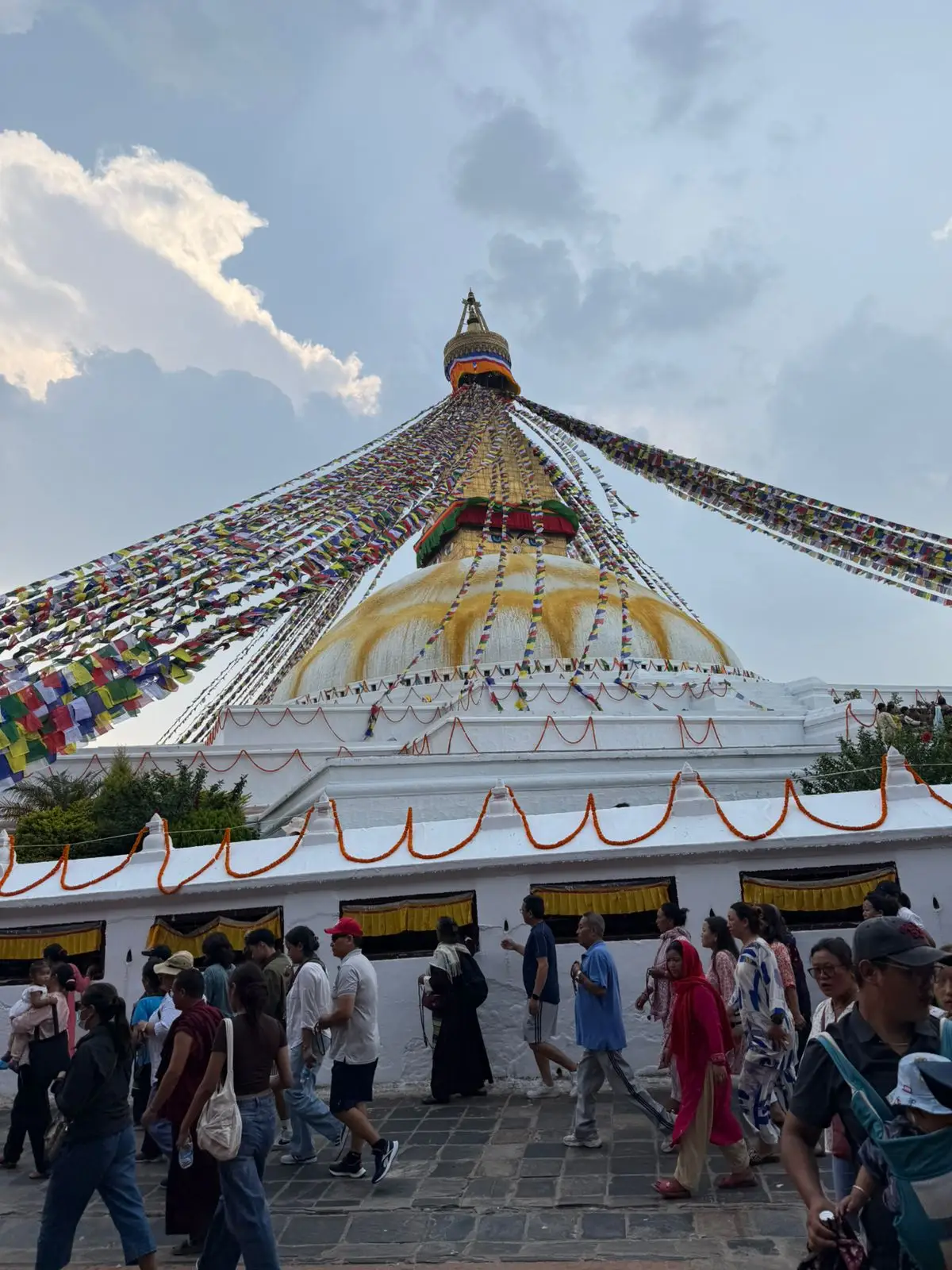
Every morning and evening, the path around Boudhanath Stupa in Kathmandu comes alive with the gentle shuffle of footsteps, the soft hum of mantras, and the rhythmic spin of prayer wheels.

Locals, monks, pilgrims, and spiritual travelers walk clockwise around the stupa in a centuries-old ritual known as Kora. But why do people circle the Boudhanath Stupa, and what does it mean and what is it’s significance?

Kora is a meditation, devotion, purification, and connection. Here’s why this practice holds a deep significance in the heart of Tibetan Buddhism and the lives of those who come here.

What Is Kora? Understanding the Ritual of Circumambulation

Kora (also spelled “korra”) is the act of walking clockwise around a Buddhist sacred site. In Tibetan Buddhism, it’s a powerful form of moving meditation that channels focus, reverence, and spiritual merit. At Boudhanath, kora happens daily around one of the most sacred stupas outside of Tibet.
Pilgrims often recite the mantra “Om Mani Padme Hum” as they walk, some spinning prayer wheels embedded into the stupa’s base. Each step is a prayer, each lap a small act of transformation.

Accumulating Merit & Purifying Karma

One of the main reasons people circle the Boudhanath Stupa is to accumulate merit and purify past karma. In Buddhism, merit is the positive spiritual energy generated through good deeds, and kora is seen as one of the most effective ways to cultivate it.

Boudhanath is lined with 147 prayer wheels. Each wheel contains scrolls inscribed with mantras, spinning one is believed to have the same effect as reciting the mantra aloud thousands of times. One full lap around the stupa is said to generate the equivalent of over 1.6 million prayers, amplifying one’s karmic benefit.
In a world full of distractions, this simple act becomes a path to inner clarity.

Meditation in Motion

Kora also serves as a deeply grounding meditation practice. Instead of sitting still, practitioners move mindfully around the stupa, synchronizing breath, chant and movement.

This ritual quiets mental chatter and cultivates present-moment awareness. You might hear murmured chants of “Om Mani Padme Hum,” feel the cool brass of the wheels, or watch monks robed in maroon robes walk slowly, step by sacred step.

Even for non -buddhists, the experience offers a rare stillness. Many travelers describe a sense of deep calm, like being inside a living prayer.

Respect and Devotion to the Buddha

Circling the stupa is devotional. In Buddhist tradition, walking clockwise around a sacred object is called pradakshina, a practice that symbolizes honoring the enlightened mind of the Buddha.

Boudhanath itself represents different aspects of Buddhist cosmology: the dome symbolizes the Buddha’s enlightened consciousness, the all-seeing eyes signify omnipresent compassion, and the spire connects heaven and earth.

By walking around it, pilgrims offer their respect, devotion, and aspirations for awakening.

Feeling the Energy of a Sacred Space

Boudhanath is a living and breathing sacred space. Designated a UNESCO World Heritage Site in 1979, the stupa is surrounded by more than 50 Tibetan monasteries.

Many describe feeling an unexplainable energy in the courtyard: a magnetic pull toward stillness, reflection, or even tears. It’s believed that this spot lies on a powerful energy line, making it especially potent for spiritual practice.

Community, Resilience & Cultural Continuity

Kora also connects people to each other and to their heritage. Locals gather here daily: elders with malas, young monks in training, Tibetans in traditional dress, and curious visitors.

After the 2015 earthquake, when the stupa was partially damaged, the community came together to restore it. And with that, the daily practice of kora continued uninterrupted, an act of resilience and unity in motion.

Joining the Kora: What to Know as a Visitor

You’re welcome to join.
Just walk slowly, clockwise, and respectfully. Refrain from loud conversations, dress modestly, and try spinning the prayer wheels with intention.
Best times to go?

Early morning (around 6–7 am) or at dusk, when butter lamps flicker and the stupa glows gold. Whether you walk one lap or many, the experience can be deeply grounding.

Final Thought

So why do people circle the Boudhanath Stupa?

Because it brings them closer to peace, to presence, to the Buddha, and to a spiritual community that transcends borders.
If you’re looking for a peaceful hotel just steps from the stupa, Boudha Mandala Hotel offers stupa-view rooms and long-stay options. You’ll be close enough to hear the morning chants and join the kora yourself.