Famous People Who Visited Boudha: The Sacred Draw of Kathmandu’s Spiritual Heart

Key Takeaways:

Boudhanath Stupa isn’t just sacred ground for locals; its peaceful energy and spiritual magnetism have drawn famous visitors, from globally revered spiritual leaders to Hollywood actors and renowned writers. Their journeys reflect the universal appeal of Boudha’s quiet stillness and spiritual depth.

Introduction

If you’ve ever walked the quiet morning kora around Boudhanath Stupa, you understand why people travel from around the world to experience its sacred peace. But you might not realize just how many well-known spiritual leaders, Hollywood stars, and renowned thinkers have quietly walked this same path.

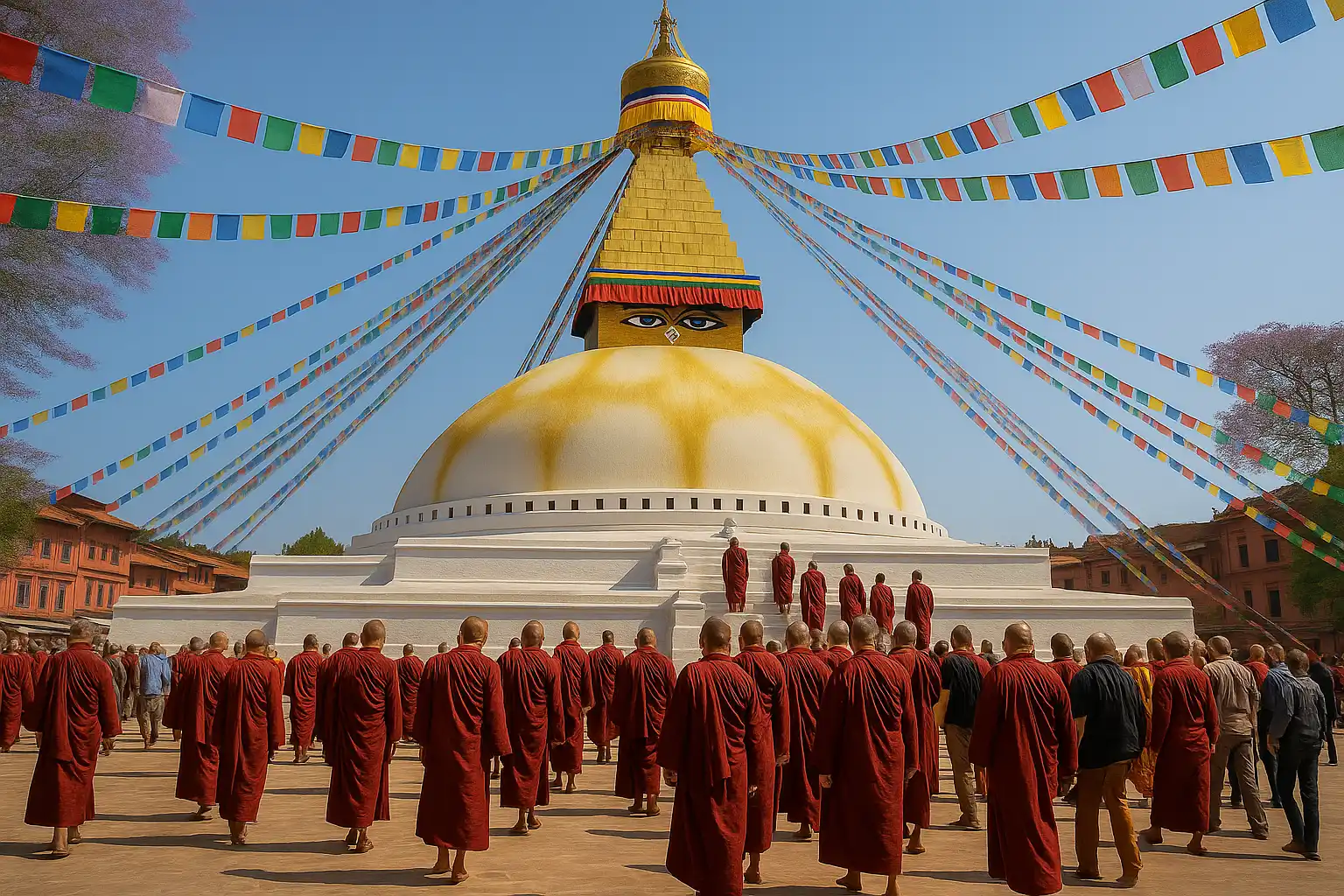
Boudha doesn’t shout about its famous visitors. Instead, it quietly draws them in. Here, celebrity status fades away; the stupa sees all equally, through the compassionate eyes of the Buddha painted on its golden spire.

Let’s explore the stories behind some of the most famous people who have quietly found their way here.

His Holiness the 14th Dalai Lama: Spiritual Influence in Boudha

While the Dalai Lama himself rarely visits Nepal due to political sensitivities, his spiritual influence deeply permeates Boudhanath.

Many monasteries surrounding the stupa follow his teachings closely, and several prominent disciples have taught here regularly. The essence of compassion he embodies resonates throughout Boudhanath.

In a sense, even without frequent physical visits, the Dalai Lama’s spirit is ever-present in Boudha, making the stupa feel like an extension of his compassionate heart.

Richard Gere: Actor Turned Devotee

Hollywood star Richard Gere is known not just for his acting but for his profound dedication to Tibetan Buddhism. Gere has visited Nepal multiple times, quietly spending time around Boudhanath’s circle, engaging in meditation, and learning from prominent Tibetan teachers in the area.

He once mentioned in an interview that places like Boudha provide the grounding necessary for true spiritual reflection. For Gere, the stupa isn’t a tourist attraction; it’s a refuge of presence.

Keanu Reeves and “Little Buddha”: The Hollywood Connection

Many visitors to Kathmandu know about the film Little Buddha, directed by Bernardo Bertolucci, starring Keanu Reeves as Siddhartha. While filming in Nepal, Reeves reportedly spent quiet moments near Boudhanath, drawn by its peaceful aura.

Though Reeves hasn’t spoken extensively about his personal spiritual beliefs, locals remember his visit fondly. His respectful demeanor and genuine interest in Nepal’s spiritual heritage left a positive impression around Boudha.

Renowned Tibetan Buddhist Masters: Chökyi Nyima and Tsoknyi Rinpoche

While perhaps not household names everywhere, teachers like Chökyi Nyima Rinpoche and Tsoknyi Rinpoche are revered globally among spiritual seekers. Their frequent teachings and meditation retreats at monasteries surrounding Boudha attract international artists, writers, and practitioners who seek depth, wisdom, and creative inspiration.

When you walk around Boudha, you might be sitting next to students who have traveled thousands of miles simply to learn from these masters. The quiet presence of these spiritual leaders makes Boudha a true global spiritual destination.

Spiritual Writers and Thinkers: Matthieu Ricard, Robert Thurman, Lama Surya Das

World-renowned Buddhist writer Matthieu Ricard has often spoken of Boudha as a place of profound inner silence, conducive to meditation and compassion. Similarly, Tibetan scholar Robert Thurman and popular author Lama Surya Das have visited and referenced the stupa’s sacred environment in their teachings and writings.

These thinkers have helped popularize Buddhism’s deep stillness and its capacity for spiritual renewal, making it a key pilgrimage point for intellectual and spiritual exploration.

What Brings Them to Boudha?

You might wonder: Why do these accomplished, globally recognized individuals choose Boudhanath? The answer is simple yet profound; it offers something rare in today’s noisy world: true silence, meaningful connection, and spiritual clarity.

Artists come for creative renewal. Actors for authenticity beyond the spotlight. Writers for uninterrupted thought. And monks for genuine spiritual practice.

Here, everyone, famous or not, arrives seeking something deeper.

Staying Near the Stupa: How You Can Walk in Their Footsteps

If you’re drawn to Boudha’s spiritual and creative energy, staying close makes all the difference. Boudha Mandala Hotel is not only steps away from the stupa, it’s perfectly aligned with Boudha’s atmosphere of quiet introspection.

From its rooftop, you can watch the same sunrise that inspired artists and spiritual leaders before you. In its peaceful rooms, you find rest that deepens your practice. And as you walk the early morning kora, you’ll join footsteps left by seekers, saints, and even stars.

Conclusion

Fame might bring people here, but it doesn’t matter much once they arrive. Boudha sees all visitors the same,as pilgrims, seekers, or travelers finding their own quiet path. Whether it’s the Dalai Lama’s teachings resonating in monasteries, Gere’s quiet reverence, or writers’ poetic reflections, the truth is clear:

Boudha isn’t famous because of who visits. It’s beloved because of what it inspires.

Come see for yourself why people from all walks of life, known or unknown, journey here. Perhaps you’ll discover your own quiet inspiration waiting silently beneath prayer flags, among spinning wheels, or in the eyes of strangers circling slowly around the stupa.

Planning your visit to Boudha?

Stay just steps from the sacred stupa at Boudha Mandala Hotel. With peaceful rooms, stupa views, and warm local hospitality, you can experience the same tranquility that’s drawn artists, monks, and famous travelers from across the world.

The History of Boudha: A Sacred Center of Tibetan Buddhism in Kathmandu

Key Takeaways
Boudhanath Stupa in Kathmandu is one of the holiest Buddhist sites in the world and the heart of Tibetan Buddhism in Nepal. Rooted in ancient legends and built during the Licchavi period, it has grown from a simple act of devotion to a sacred monument that holds relics, prayers, and generations of seekers.

After the 1959 Tibetan diaspora, Boudha became a refuge and spiritual center, now surrounded by dozens of monasteries. More than history, Boudha is a living shrine of resilience, faith, and inner peace.

Introduction
When you walk through the narrow lanes of Boudha and suddenly emerge into the vast circle of sky and stupa, something shifts. The pace of life slows. The air smells like juniper and melted butter. Prayer wheels spin in sync with ancient mantras. And at the center, like a spiritual compass, stands the towering white dome of Boudhanath Stupa.

This isn’t just a monument. It’s a witness to centuries. A sacred pulse in the middle of Kathmandu. Its story is woven with myth, migration, ritual, and quiet resilience. To know Boudha is to understand why the spiritual heartbeat of Tibetan Buddhism continues to echo from this place.

The Legend of a Poultry Keeper: The Mythical Origin

According to Buddhist legend, Boudhanath was built by a humble poultry-keeping woman and her four sons. Moved by faith, she petitioned the king for a small piece of land to build a shrine for the relics of Kassapa Buddha. The king granted her wish, and with love, devotion, and the help of her sons, she constructed what became one of the greatest stupas of the Buddhist world.

This legend continues to live in the local consciousness, a reminder that deep faith, even from someone seen as ordinary, can create something timeless and holy. The stupa is more than a structure; it’s a monument to the power of intention.

Historical Foundations: Licchavi Period and Early Buddhism

Beyond the myth, historical evidence places the construction of Boudhanath during the Licchavi era, around the 5th to 6th century CE. In ancient texts, the stupa was known as Khasti Chaitya , with “Khasti” meaning “dew.” During a long drought, locals are said to have cultivated the land with collected dew to support the construction.

This was a time when Nepal was a vital center of Buddhist learning and trade between India and Tibet. Boudhanath became a sacred stop on early pilgrimage routes. It was, and remains, a powerful representation of the dharma in stone.

A New Chapter: The Tibetan Refugee Era Post-1959

The year 1959 marked a profound transformation for Boudha. After the Chinese invasion of Tibet, thousands of Tibetan refugees crossed the Himalayas and settled in the Boudha area. The stupa, already sacred, became a new spiritual home for a displaced people.

Dozens of Tibetan Buddhist monasteries, including Shechen Monastery, Ka-Nying Shedrub Ling, and Thrangu Tashi Yangtse, were built around the stupa. Each lineage, from Nyingma to Gelug, found space here. The stupa became more than a historical site. It became a living monastery, a center for ritual, community, and the continuation of a threatened tradition.

Even today, Boudha is one of the only places outside Tibet where Tibetan Buddhism thrives so openly and fully.

Boudhanath as a UNESCO World Heritage Site

In 1979, UNESCO declared Boudhanath a World Heritage Site, not just for its architecture, but for its cultural and spiritual value. The stupa is one of the largest spherical stupas in the world. Its design follows a mandala pattern, representing the universe, with the dome symbolizing emptiness, and the 13 spires representing stages toward enlightenment.

After the 2015 earthquake, the stupa suffered significant damage. But the restoration that followed, funded by local monasteries and global Buddhist communities, became a symbol of collective healing and resilience.

Spiritual Importance in Tibetan Vajrayana Practice

Boudhanath isn’t just sacred because of history , it is sacred because of what happens there every single day.

– Circumambulation (kora): Devotees walk clockwise around the stupa while reciting mantras.

– Butter lamp offerings: Symbolic acts of light and wisdom

– Prayer flags: Sending compassion to all directions

– Prostrations: Practiced with full-body devotion, especially during dawn and dusk

It’s believed that walking the kora mindfully purifies lifetimes of karma. For Vajrayana practitioners, Boudha is a place where the veil between seen and unseen feels especially thin.

Festivals and Ritual Rhythms at the Stupa

Some of the most powerful experiences at Boudha come during major Tibetan and Buddhist festivals:

– Losar: Tibetan New Year marked with music, prayer, and color

– Buddha Jayanti: Celebrating the Buddha’s birth, enlightenment, and passing

– Lhabab Duchen: Honoring the Buddha’s return from heavenly realms

These aren’t tourist events. They are living rituals, participated in by monks, nuns, and families. Butter lamps line the base of the stupa. Chanting fills the air. It is devotion in motion.

A Living Pilgrimage Site: Why Boudha Still Matters

In a fast-moving world, Boudhanath remains a place where the sacred slows you down. For many Tibetans and Himalayan Buddhists, visiting Boudha at least once is a lifetime goal. For others, it becomes a daily rhythm , a morning kora, an evening lamp.
The stupa radiates peace not only because of its design, but because of the countless acts of devotion offered here for over 1500 years. It is a center of collective consciousness, a space for refuge, remembrance, and recommitment to the path.

Reflection: The Wisdom Hidden in the Stones

I remember sitting on a rooftop café one dusky evening, sipping salt-butter tea while watching hundreds of butter lamps flicker around the stupa. An old monk passed by below, spinning a prayer wheel slowly. Children chased pigeons. Somewhere, a bell rang.

In that moment, I felt what many before me have felt: Boudha is not just a place you visit. It is a place that visits something inside you.

Conclusion
The history of Boudha is not written in dry records; it is carried in footsteps, lit in butter lamps, and whispered through mantras. From the humble prayer of a poultry keeper to the resilience of an exiled community, Boudha teaches us that the sacred is not fixed in stone, but renewed with every offering.

To walk around Boudhanath is to walk with history, with spirit, and with generations of hope.

If you wish to stay immersed in the peaceful rhythm of this sacred place, Boudha Mandala Hotel offers spiritually aligned rooms just 10 seconds from the stupa, a perfect base for slow travel, retreat, and reflection.

How to Experience Authentic Local Culture in Boudha: A Mindful Traveler’s Guide

Key Takeaways

If you’re looking to experience the real Boudha, not just see it, immerse yourself in local life. Walk the morning kora alongside Tibetan grandmothers. Light a butter lamp with intention. Taste fresh thukpa made by families who’ve lived here for generations. True cultural immersion in Boudha begins when you slow down, listen deeply, and let the stupa’s rhythm shape your days.

Arriving in Boudha: First Impressions That Stay With You

The first time I stepped into Boudha, it wasn’t the scale of the stupa that struck me. It was the sound. The deep, low hum of mantras swirling in the air, carried by pilgrims circling clockwise in quiet devotion. Prayer wheels turned with well-worn palms. Butter lamps flickered along the stupa’s base. Something about it all, so ordinary, so sacred, made me want to stay.

Unlike Thamel’s tourist energy, Boudha feels slower, rooted, and protective. It’s not performative culture; it’s lived culture. To truly experience it, you have to meet Boudha on its terms.

1. Start with the Kora: The Spiritual Pulse of Boudha

Every morning and evening, the local community walks the kora, the clockwise circuit around the stupa. Some carry prayer beads, others walk in silence. Some whisper mantras, others listen.

Join them, not as a spectator, but as a fellow traveler. Walk slowly. Notice the rhythm. Spin the prayer wheels if it feels right. Don’t rush. This isn’t a performance, it’s a spiritual practice, and being part of it, even quietly, is the first step toward understanding Boudha.

Tip: Arrive around 6:00 AM. The first light over the stupa, mixed with soft chanting and the smell of incense, is unforgettable.

2. Visit the Monasteries, But Stay for the Moments

Boudha is home to dozens of monasteries representing different schools of Tibetan Buddhism. You can visit the grand Shechen Monastery with its vivid murals or the tucked-away Ka-Nying Shedrub Ling Monastery near the east gate.

But the real moments? They’re often unplanned:

– Sitting quietly during a prayer session and feeling the chants resonate through your chest.

– Watching young monks laugh as they sweep the courtyard.

– Lighting a butter lamp in memory of someone you love.

You don’t need to understand the rituals. Just be present.

3. Eat Where the Locals Eat: A Taste of Tibetan-Nepali Life

Food is a powerful entry point into any culture, and in Boudha, it’s deeply comforting. Skip the Western cafés (though there are good ones) and try the spots hidden in alleyways where aunties serve steaming bowls of thukpa and hand-folded momos.

Some favorites:

– Tsangpo Restaurant – homestyle Tibetan dishes in a no-frills setting.

– La Casita de Boudhanath – rooftop views with a mix of Nepali and Spanish-inspired dishes.

– Stupa View Cafe – a peaceful spot for butter tea or lemon ginger honey.

Groceries are also a cultural experience here. Walk through Boudha’s Saturday organic market to find local honey, buckwheat, or handmade incense.

4. Learn the Language of Butter Lamps and Prayer Flags

Culture in Boudha isn’t always spoken. It’s symbolized through offerings, color, gesture, and ritual.

– Butter lamps: Lighting one is an act of remembrance, aspiration, or prayer. You can do this yourself for a small donation at most temples.

– Prayer flags: Each color and mantra has meaning. When strung across rooftops, they bless the winds and the beings they touch.

– Mala beads: Often seen in the hands of older Tibetans walking kora, they aren’t jewelry; they’re spiritual tools.

Ask before photographing these moments. Better yet, participate when appropriate.

5. Shop Mindfully: Support Local Artisans and Keep the Culture Alive

Boudha has its share of souvenir stalls, but look deeper. There are families who’ve painted thangkas for generations, young women learning metalwork from their grandfathers, and shopkeepers who can tell you the story behind each piece.

When you:

– Buy a hand-painted thangka

– Commission a custom mala

– Support an NGO-run handicraft store

…you’re not just shopping. You’re sustaining a living tradition.

Ask how things are made. Be curious. Choose handmade over mass-produced.

6. Participate in a Local Festival or Puja

If you’re in Boudha during Losar (Tibetan New Year) or Buddha Jayanti, don’t just watch, participate. You’ll witness:

– Giant sand mandalas being created, then ritually dissolved.

– Monks chanting for days in preparation.

– Community feasts where you may be warmly invited to sit and eat.

These festivals are vibrant, sacred, and grounded in devotion. Bring an open heart, dress modestly, and ask your host or hotel how to participate respectfully.

7. Stay in a Place That Reflects the Spirit of Boudha

Where you stay shapes how you experience a place. In Boudha, staying at a mindful hotel like Boudha Mandala Hotel means waking up to the stupa’s morning chants, sipping tea on a stupa-view balcony, and being cared for by staff who understand why you came.

The hotel is just 10 seconds from the stupa, close enough to feel its energy, but tucked away enough to offer peace. With multilingual staff, spiritual travelers in mind, and long-stay rooms for remote workers or sabbatical-goers, it supports your inner journey too.

It’s not just a hotel, it’s a gentle space to arrive and belong.

8. Let Boudha Change Your Rhythm

Perhaps the biggest shift when you truly engage with Boudha’s culture is not what you do, but how you do it.
You learn to:

– Walk slower

– Listen more

– Eat without multitasking

– Sit in silence without filling it

Local culture isn’t something to “check off.” It’s something that seeps in when you let go of rushing and lean into presence. Boudha teaches that without words.

Final Reflection

I came to Boudha thinking I’d stay a few days. I stayed three months. Not because there was a checklist of things to do, but because it felt like home in a way few places ever have.

To experience the authentic culture of Boudha, don’t try to consume it. Instead, be in a relationship with it. Walk the stupa path every morning. Make friends with a momo vendor. Sit quietly in a monastery courtyard. Let the prayer flags do their work above you.

If you’re looking for the best stupa view hotel in Boudha, Boudha Mandala offers more than a room; it offers a welcome into the spirit of this place.