Boudha Stupa (Boudhanath) Visitor Guide: What to Know Before You Go

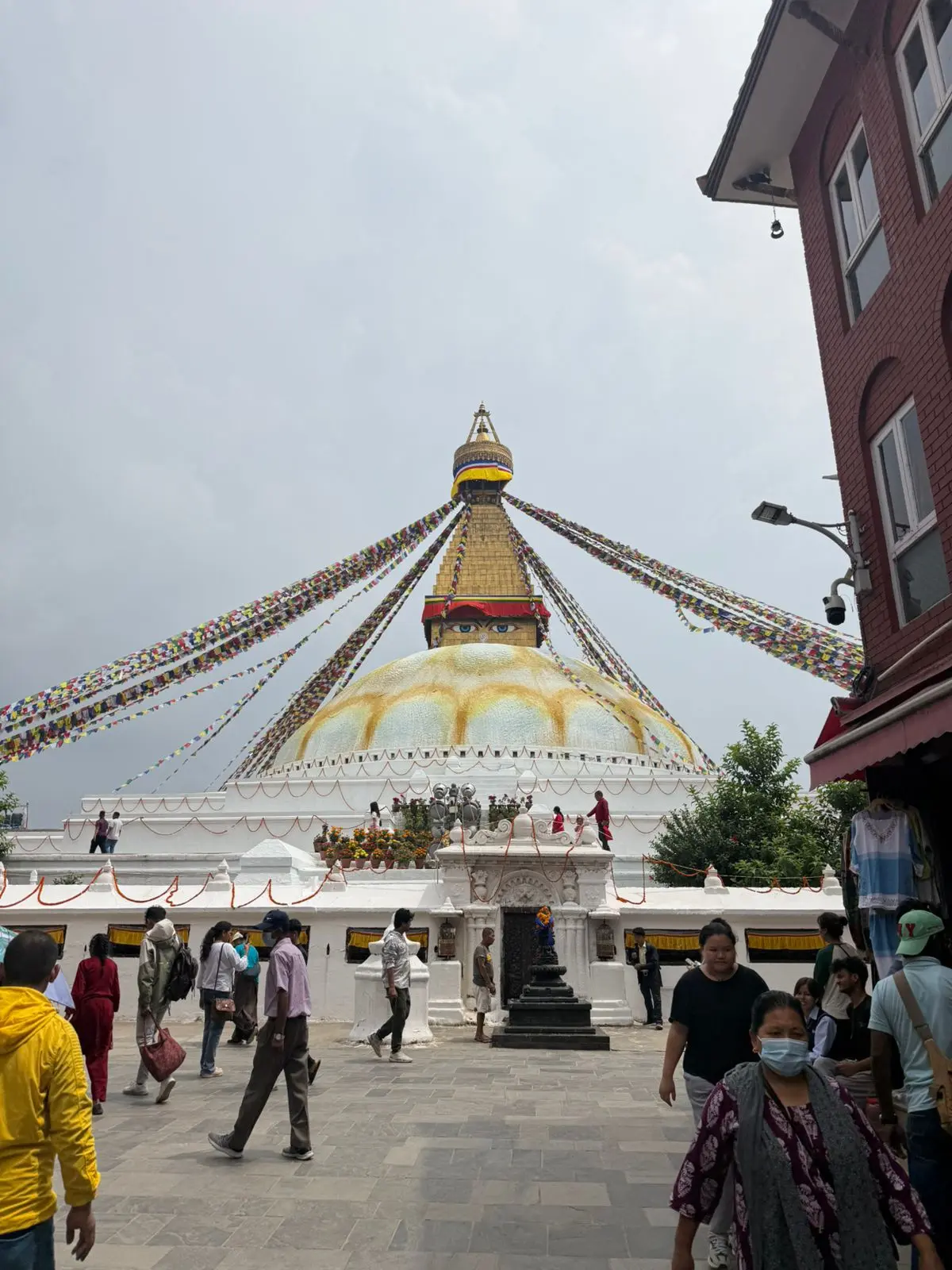
Boudha Stupa is part of the UNESCO-listed Kathmandu Valley World Heritage Site and one of Kathmandu’s most iconic Tibetan Buddhist pilgrimage landmarks. Known for its giant white dome, all-seeing Buddha eyes, prayer wheels, and the daily kora (clockwise circumambulation), Boudhanath is one of the best places in the city for cultural immersion in a powerful spiritual atmosphere, especially outside peak festival times.

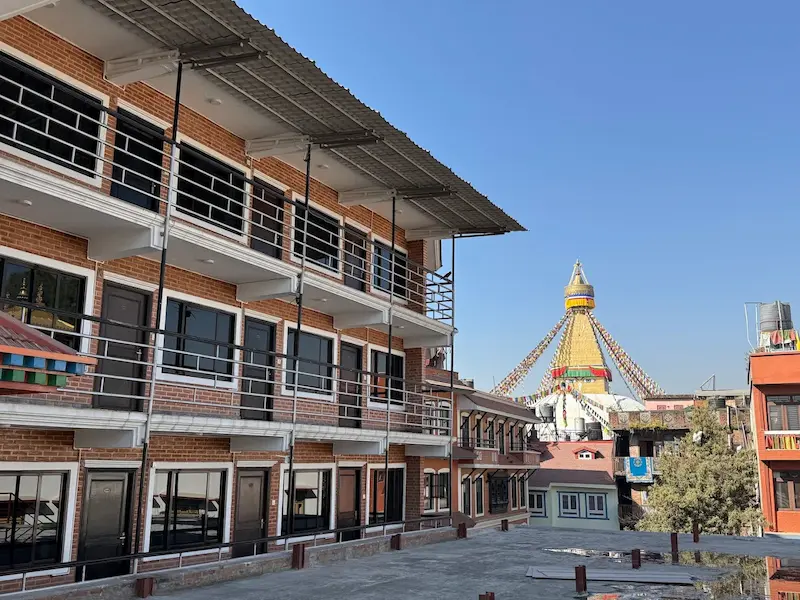
Tip: For an easy sunrise visit, staying in the Boudha neighborhood lets you walk over before the crowds and traffic build. Boudha Mandala Hotel is located near Boudhanath Stupa, making early-morning and evening visits effortless.

Boudhanath Stupa quick visitor essentials

  • Where: Boudha, Kathmandu (near Tribhuvan International Airport)
  • Best time to visit: dawn or sunset
  • What to do: kora (clockwise; keep the stupa on your right), spin prayer wheels, light butter lamps, visit nearby monasteries
  • Ticket: required for non-Nepali visitors (SAARC discounted); Nepalis and children under 10 enter free


1. Boudhanath Stupa at a Glance (Quick Facts for Visitors)

Boudhanath sits in the Boudha neighborhood of Kathmandu, a short ride from Tribhuvan International Airport. It’s among the world’s largest stupas and the spiritual heart of Tibetan Buddhism in Nepal, especially vibrant at dawn and dusk when locals, monks, and visitors circle the stupa with prayer beads and spinning wheels.

Quick facts (visitor-friendly):

  • Location: Boudha, ~6–8 km northeast of central Kathmandu
  • Entry fee: NPR 400 (foreign nationals), NPR 100 (SAARC), free for Nepalis and children under 10
  • Access & hours (important distinction):
  • Stupa area/plaza: often accessible very early and late
  • Ticketed entry points/booths: typically run morning to evening (commonly reported around ~5:00 AM–9:00 PM, but can vary; booths may close earlier)

For the most peaceful experience (and best photos), arrive early before the plaza fills or come near sunset when butter lamps glow and chanting drifts from nearby monasteries.

2. Why Boudhanath Is a UNESCO World Heritage Site

Boudhanath is recognized by UNESCO as one of the seven “Monument Zones” that make up the Kathmandu Valley World Heritage property, inscribed in 1979. In the UNESCO listing, Boudhanath is singled out as the largest stupa in Nepal, an extraordinary religious ensemble that still functions as a living pilgrimage site rather than a museum piece.

UNESCO highlights the Valley’s Outstanding Universal Value through its rare concentration of sacred architecture, exceptional craftsmanship, and continuous cultural life. The Kathmandu Valley inscription is based on criteria (iii), (iv), and (vi) recognizing it as an exceptional testimony to the Valley’s civilization and Newar traditions, an outstanding set of architectural ensembles, and a place deeply tied to rituals, legends, and festivals in Boudha. UNESCO also notes that the integrity of these monument zones is safeguarded within formally defined boundaries (with a boundary modification accepted in 2006).

Boudhanath embodies those values in a single, instantly recognizable landmark: its massive white dome and gilded tower with the all-seeing Buddha eyes express powerful Buddhist symbolism, while the daily rhythm of prayer, circumambulation (kora), and monastic life keeps the heritage actively practiced.

3. History of Boudhanath Stupa (Origins, Legends, and Timeline)

The history of Boudhanath blends verifiable records with powerful sacred storytelling. Many visitor-facing histories date the stupa to around the 5th century CE, during the Licchavi era, when Kathmandu Valley was emerging as a major Buddhist crossroads. Its location mattered: Boudha lay along historic trade and pilgrimage routes linking Tibet and the Kathmandu Valley, making it a natural place for merchants and pilgrims to rest, pray, and exchange culture.

Local and Tibetan traditions add the legends that made Boudhanath unforgettable. One of the best-known stories tells of Jhazima (or Jyazima) a poor widow/poultry keeper who requested land “as big as a buffalo skin,” then cleverly cut it into a long strip to mark out enough space to build the stupa. In Tibetan Buddhism, this origin myth is closely tied to the name Jarung Khashor and the idea that devotion (not wealth) can create a monument of immense merit.

4. Architecture and Symbolism (Dome, Mandala, Buddha Eyes, Prayer Flags)

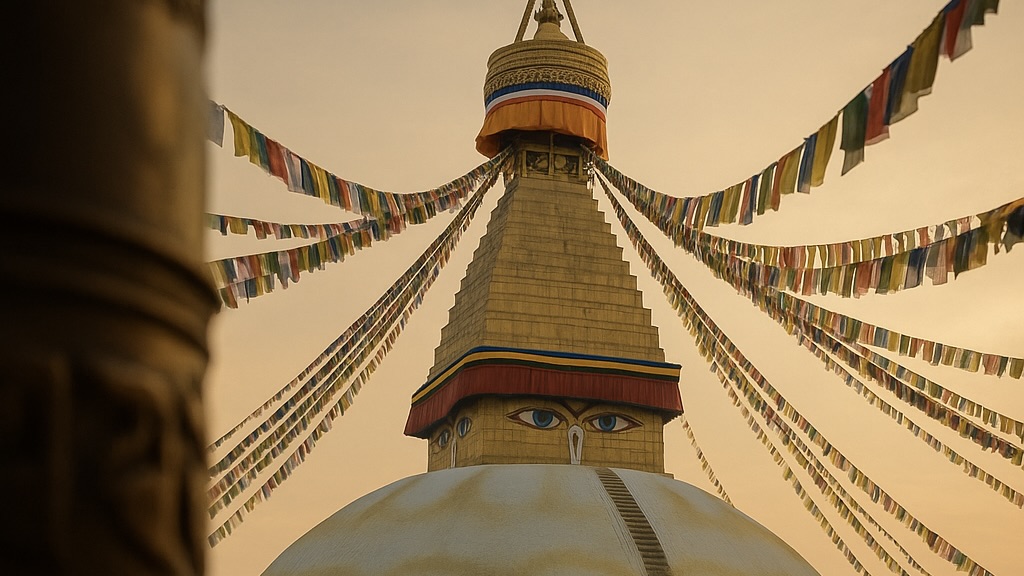
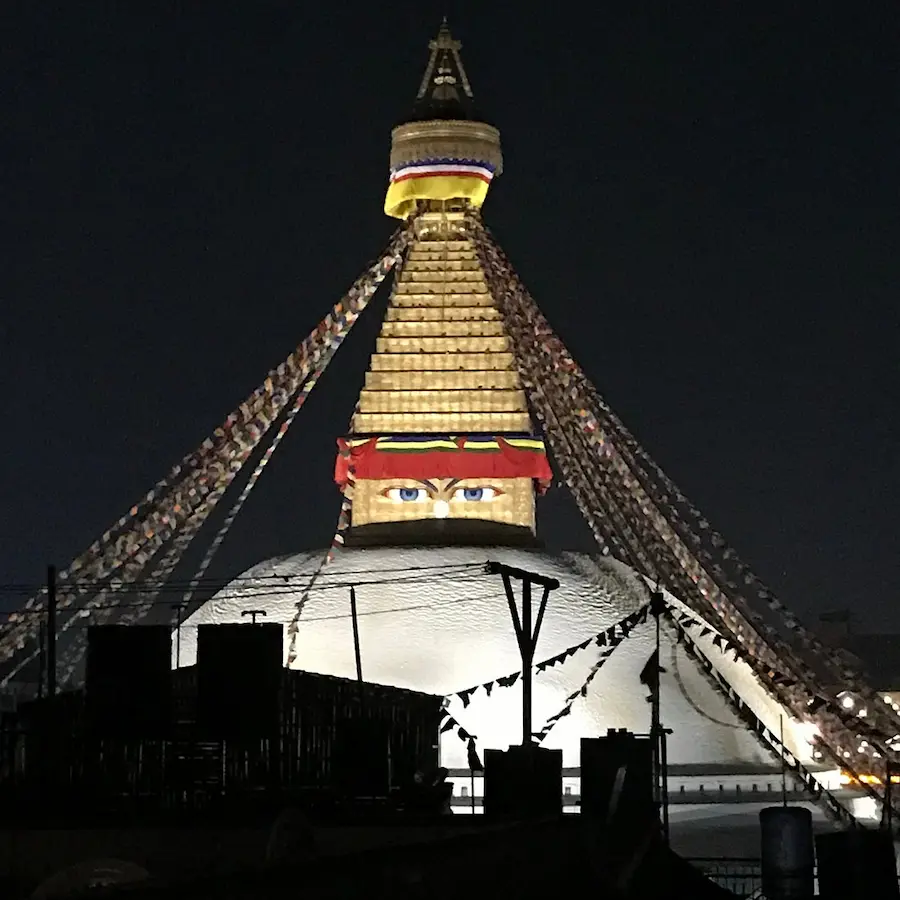
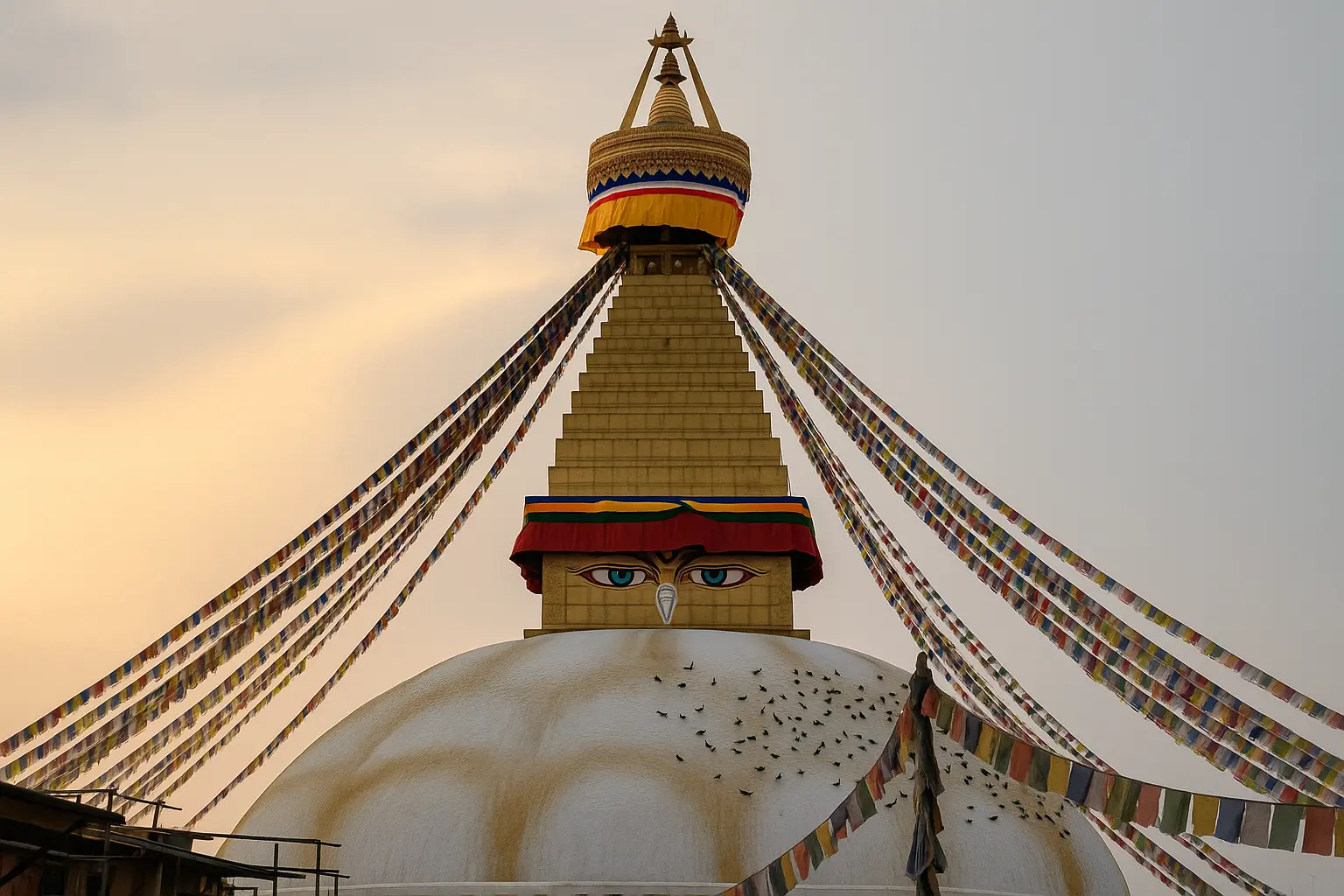
Boudhanath’s design is often described as a three-dimensional mandala, a sacred map of the universe built as a massive white hemispherical dome crowned by a square tower (harmika) and a gilded spire. The harmika, clad in gilded metal, features the Buddha’s all-seeing eyes painted on each side.

Symbolically, every layer reads like a visual teaching. The mandala base represents the ordered cosmos and the spiritual path; the dome is often explained as the universe or a “treasure vase” of blessings; the harmika is the “seat” of enlightened mind; and the 13 steps on the spire are commonly interpreted as progressive stages toward awakening. The famous Buddha Eyes looking out in all directions reinforce the idea of wisdom and awareness that sees beyond appearances.

Prayer flags strung around the stupa flutter as wind-borne prayers Tibetan tradition holds that mantras on the flags spread goodwill on the breeze. The classic five-color set (in order blue, white, red, green, yellow) represents the five elements, which is why you’ll often see them kept together rather than separated.

5. Tibetan Buddhist Culture Around Boudha (Monasteries and Local Life)

Boudha isn’t just a stupa, it’s Kathmandu’s most visible pocket of Tibetan Buddhist life. After the 1959 Tibetan uprising, many Tibetans settled around Boudhanath, and the neighborhood grew into a dense ring of gompas (monasteries), pilgrim hostels, cafés, and artisan shops the kind of place where you’ll see monks, elders, and families doing kora from dawn to nightfall.

Monasteries near Boudha shape the area’s daily rhythm. Shechen Tennyi Dargyeling, reviving the lineage of one of Tibet’s great Nyingma monasteries, was re-established in exile near Boudha under Dilgo Khyentse Rinpoche and remains a major center for teachings and ceremonies. Nearby, Ka-Nying Shedrub Ling (a Kagyu–Nyingma community) became another cornerstone of practice and education in the 1970s.

For visitors, “local life” at Boudhanath is wonderfully tangible: prayer wheels turning clockwise, offerings at shrines, lanes lined with thangkas and ritual items, and rooftop viewpoints where the stupa feels close enough to touch. For a quieter extension of the same culture, Kopan Monastery on the valley’s hills is a well-known Tibetan-tradition monastery welcoming visitors for courses and practice.

6. Things to Do at Boudhanath Stupa (Kora, Rooftops, Markets, Meditation)

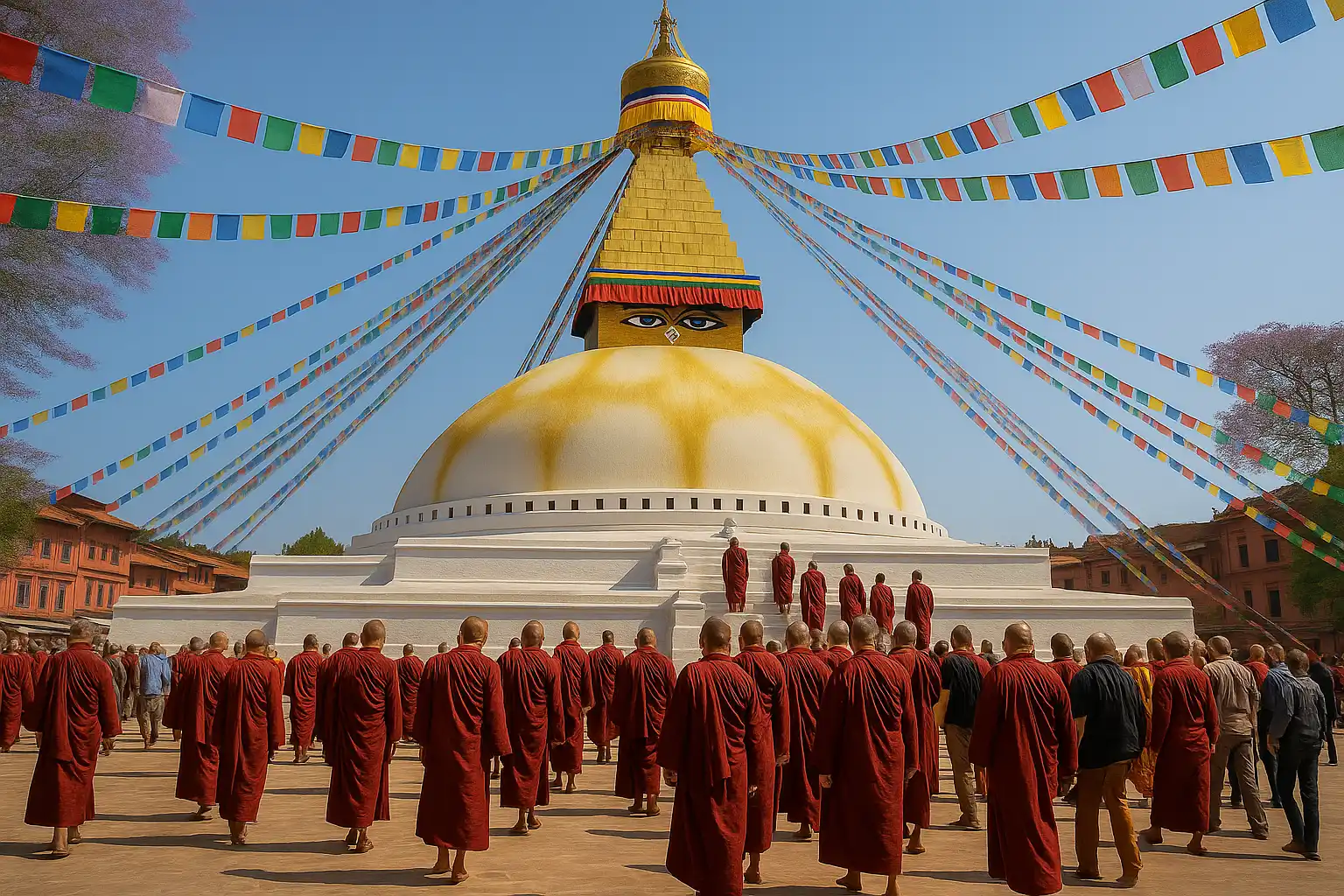
Start with a kora (clockwise circumambulation) the classic Boudhanath experience. Join pilgrims as you circle the stupa clockwise, keeping the stupa on your right, pausing to spin prayer wheels and watch offerings being made at shrines around the square. If you can, come at dawn or dusk when the atmosphere feels most devotional and at night you may see rows of butter lamps/candles glowing around the base.

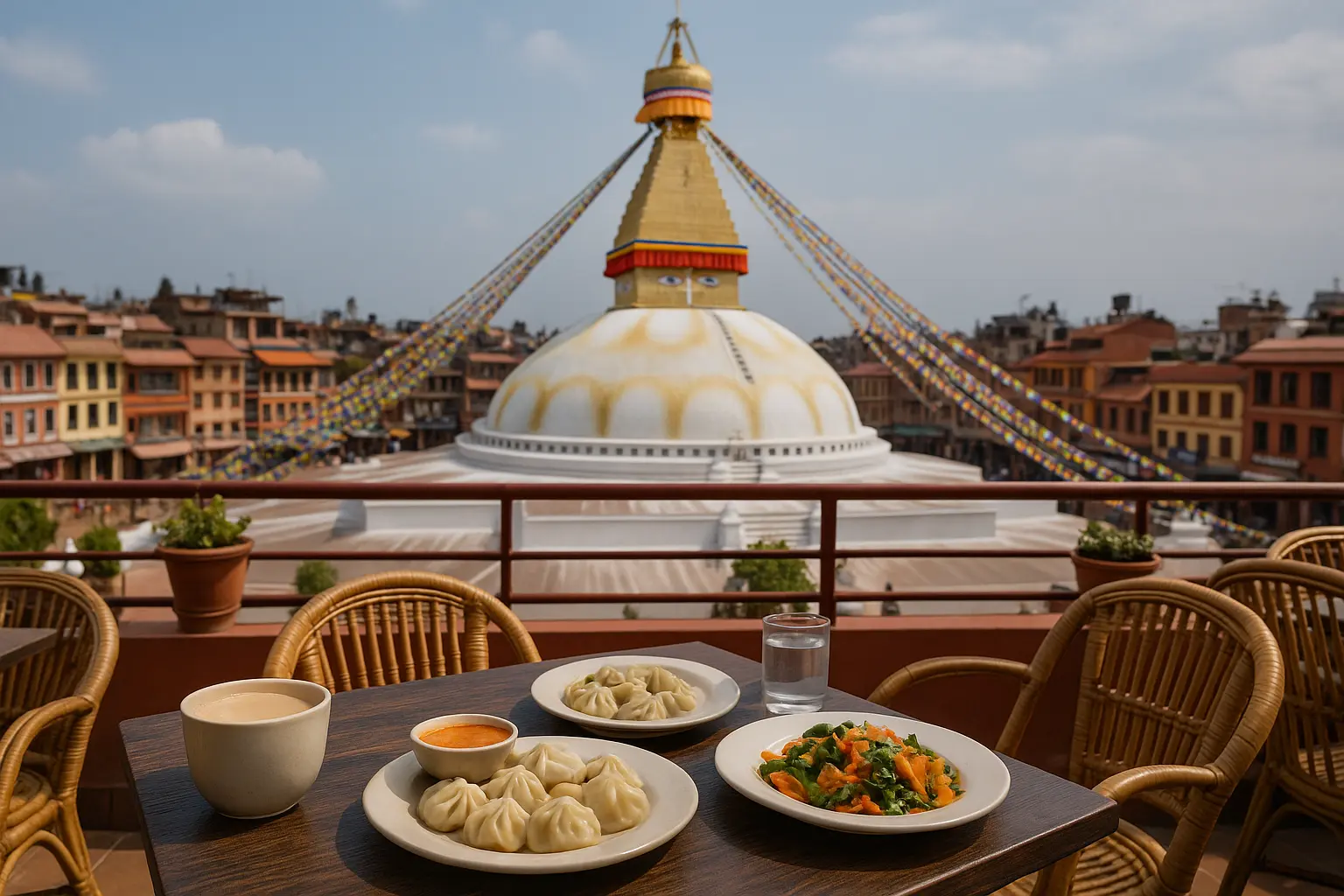
Next, head upstairs: the ring of buildings around the stupa is packed with rooftop cafés and restaurants designed for one thing, stupa views. A slow tea or meal from a rooftop is one of the easiest ways to appreciate the scale of Boudhanath and the constant movement of the kora below.

Finally, explore the markets and mindful corners around the plaza. The lanes are lined with shops selling thangkas, malas, incense, statues, and ritual items, making it a great place for meaningful souvenirs (and people-watching). For a quieter reset, step into nearby gompas respectfully or pair your visit with a dedicated meditation experience at a Tibetan-tradition monastery like Kopan, which welcomes visitors for courses and retreats.

7. Entry Fee and Access Hours (Visitor Info)

For most travelers, Boudhanath entry fees are straightforward: NPR 400 for foreign nationals, NPR 100 for SAARC nationals, and free for Nepali citizens (children under 10 are also free).

On hours, it helps to separate two meanings of “open”:

  • The stupa area/plaza can often be experienced very early and late.
  • Ticket checks/booths and controlled entry points typically follow a more limited daily schedule (commonly reported around ~5:00 AM–9:00 PM, and booths may close earlier).

Pro tip: Buy your ticket at the entry point and keep it handy especially if you plan to step out for a rooftop café and come back in. If anything seems different on the day (holiday, festival, or local adjustments), follow onsite signage.

8. Rules, Etiquette, and Dress Code (What Tourists Should Know)

At Boudhanath, etiquette is simple yet important because the site is both a major tourist destination and an active place of worship. Always walk clockwise (pradakṣiṇa) around the stupa, keeping the stupa to your right and if you spin prayer wheels, do so clockwise as well. Keep the flow moving by avoiding sudden stops in narrow sections, and don’t block the kora path, especially during busy prayer hours.

Dress and behavior should match the sacred setting. Aim for modest clothing (cover shoulders and knees) and keep your voice low; this is one of the easiest ways to show respect to monks, pilgrims, and families doing their daily rounds. If you enter monasteries or prayer halls, remove your shoes and follow any signs or instructions from residents and caretakers.

Photography is generally fine around the stupa, but be mindful: avoid interrupting rituals, and assume you’ll need permission inside gompas/shrines. If someone is praying, chanting, or making offerings, give them space capturing the moment should never come before honoring it.

9. How to Reach Boudhanath (From Thamel, Airport, and Patan)

From Thamel: The easiest option is a taxi/private car, a straightforward cross-city ride, with travel time varying widely by traffic. Public buses/minivans also go to Boudha via the Ring Road (slower, more “local” experience).

From Tribhuvan International Airport (TIA): Boudhanath is one of the closest major landmarks. Many travelers use a taxi, which takes roughly 15–30 minutes, depending on congestion. Pre-arranged pickups through hotels/tour operators can be simplest if you have luggage.

From Patan (Lalitpur), you’ll usually head toward eastern Kathmandu. A taxi or private car is the most direct; public options often involve switching vehicles at busy junctions.

Tip: In Kathmandu, time matters more than distance, plan buffer time during rush hours, and aim for dawn or sunset for the best atmosphere.

10. Earthquake Damage, Repairs, and Restoration (2015 and After)

The 7.8-magnitude Gorkha earthquake on April 25, 2015, shook Boudhanath hard, damaging key parts of the monument most notably the gold spire (pinnacle) while the main white dome was largely spared. Because the stupa is a focal point for daily pilgrimage, the impact was immediate for worship and the wider Boudha community.

Restoration moved forward through a mix of private donations from Buddhist groups and local community support. After about a year and a half of work, the stupa reopened to the public on November 22, 2016, marked by ceremonies and a surge of pilgrims returning to complete their kora.

11. Festivals and Best Time to Visit (Buddha Jayanti, Losar, Quiet Hours)

Boudhanath comes alive during major Buddhist dates, and two big ones to know are Buddha Jayanti (Buddha Purnima/Vesak) and Losar (Tibetan New Year).

  • Buddha Jayanti is observed on the full moon of Vaisakha/Baishakh (usually April–May) and is one of the most atmospheric days to be at Boudhanath except butter lamps, offerings, and devotional crowds into the evening.
  • Losar falls in late winter to early spring, typically February or March, and Boudha becomes a focal point for Tibetan community celebrations, fresh prayer flags, incense, monastery rituals, and families gathering for the new year. Dates shift each year because Losar follows the Tibetan lunisolar calendar.

For the best overall visit, aim for autumn (late September–November) when skies are clearer, and conditions are comfortable. Within a day, the most peaceful quiet hours are early morning and late afternoon to sunset.

12. Nearby Attractions (Pashupatinath, Kopan, and More)

A classic combo with Boudhanath is Pashupatinath Temple, a vast Hindu temple complex on the Bagmati River and, like Boudhanath, one of the key monument zones inside UNESCO’s Kathmandu Valley World Heritage listing. Many travelers visit them back-to-back for two different (but equally powerful) sides of Kathmandu’s sacred life.

For a quieter, panoramic escape, head to Kopan Monastery, set on a hill just north of Boudhanath. Kopan is known for calm grounds, sweeping valley views, and a meditation-friendly atmosphere.

If you want “nearby but less crowded,” look toward Chabahil, home to the Licchavi-era Dhando Chaitya (often cited as among the valley’s oldest stupas), plus the nearby Guhyeshwari Temple, a Shakti shrine associated with the Pashupati area. And if you’re up for another iconic stupa with big views, Swayambhunath (Monkey Temple) is also part of the same UNESCO Kathmandu Valley listing and makes a great half-day add-on.

Tip: Visit Boudha Stupa, experience one of the holiest buddhist pilgrimage sites in the world. Boudha Mandala Hotel is located near Boudhanath Stupa, making early-morning and evening visits effortless allowing you to be at peace with the all seeing eyes of Buddha.

Frequently Asked Questions

1) Where is the Boudha Stupa located in Kathmandu?

Boudha Stupa (Boudhanath Stupa) is in the Boudha/Boudhanath neighborhood in northeastern Kathmandu, close to Tribhuvan International Airport (TIA) and an easy taxi ride from Thamel.
For navigation, search “Boudhanath Stupa” or “Bouddhanath Stupa” on Google Maps (both work). The location is approximately 27.721° N, 85.362° E.

2) How far is Boudha Stupa from Tribhuvan International Airport (TIA), and how long does it take?

Boudha Stupa is very close to Kathmandu airport, typically about 4–6 km by road, depending on the route.
By taxi/private car, it usually takes 15–30 minutes, but traffic in Kathmandu can increase travel time during rush hours.

3) What are the opening hours for Boudha Stupa, and when do ticket counters open/close?

Boudha Stupa is an open public monument zone, so “hours” can mean two things:
Outer area (streets, cafés, outer ring): often accessible early and late
Ticketed monument zone (main stupa plaza/kora area): entry is typically enforced during daytime hours
In practice, many travelers plan around a rough window from early morning to evening (often cited as ~5:00 AM–9:00 PM, though it can vary). Always follow on-site signage and local guidance, especially on festivals/holidays.

4) How much is the Boudha Stupa entry fee?

Boudha Stupa entry fees are usually tiered by nationality. A commonly posted structure is:
Foreign nationals: NPR 400
SAARC nationals: NPR 100
Nepali citizens: free
Children under 10: free
Tickets are purchased at the entry gates. Fees can change, so treat the ticket booth signage as the final word on the day you visit.

5) Is the Boudha Stupa entry ticket valid for same-day re-entry?

Usually, yes. If you plan to step out for a rooftop café or shopping and return, keep your ticket and be ready to show it at the gate.
Tip: snap a quick photo of the ticket as a backup.

6) What is “kora” at Boudha Stupa, and why do people walk clockwise?

Kora means clockwise circumambulation, a devotional walking loop around the Boudha Stupa that serves as both a pilgrimage and a moving meditation.
People walk clockwise as a sign of respect, typically keeping the stupa on their right. Prayer wheels are also spun clockwise.

7) What are the key etiquette rules at Boudha Stupa?

 Boudha Stupa is a living religious site, so small etiquette details matter:
Walk clockwise (stupa on your right) and don’t block the kora flow
Dress modestly (cover shoulders and knees), especially if entering monasteries
In gompas (monasteries): remove shoes (and often hats)
Photography: fine in open areas, but be discreet, avoid interrupting rituals and ask before photographing people up close.
Treat butter lamps/offerings as look, don’t touch.

8) Is Boudha Stupa safe to visit alone, including in the evening?

Generally, yes the main plaza is often active in the evening with pilgrims doing kora and cafés open.
Basic precautions apply: stick to well-lit central areas, watch for pickpocketing, and take a taxi back if it’s late rather than walking quiet side streets. If there are protests/large gatherings, avoid the area and follow local guidance.

9) Is Boudha Stupa wheelchair- and stroller-friendly?

Mostly yes, especially compared to many heritage sites in Kathmandu. The main kora path is generally wide and manageable, but expect:
uneven paving and occasional curbs/short steps
tight spots when crowds are heavy
limited access in many rooftop cafés and older monasteries (stairs are common)
Best tip: visit early morning for fewer crowds and easier movement.
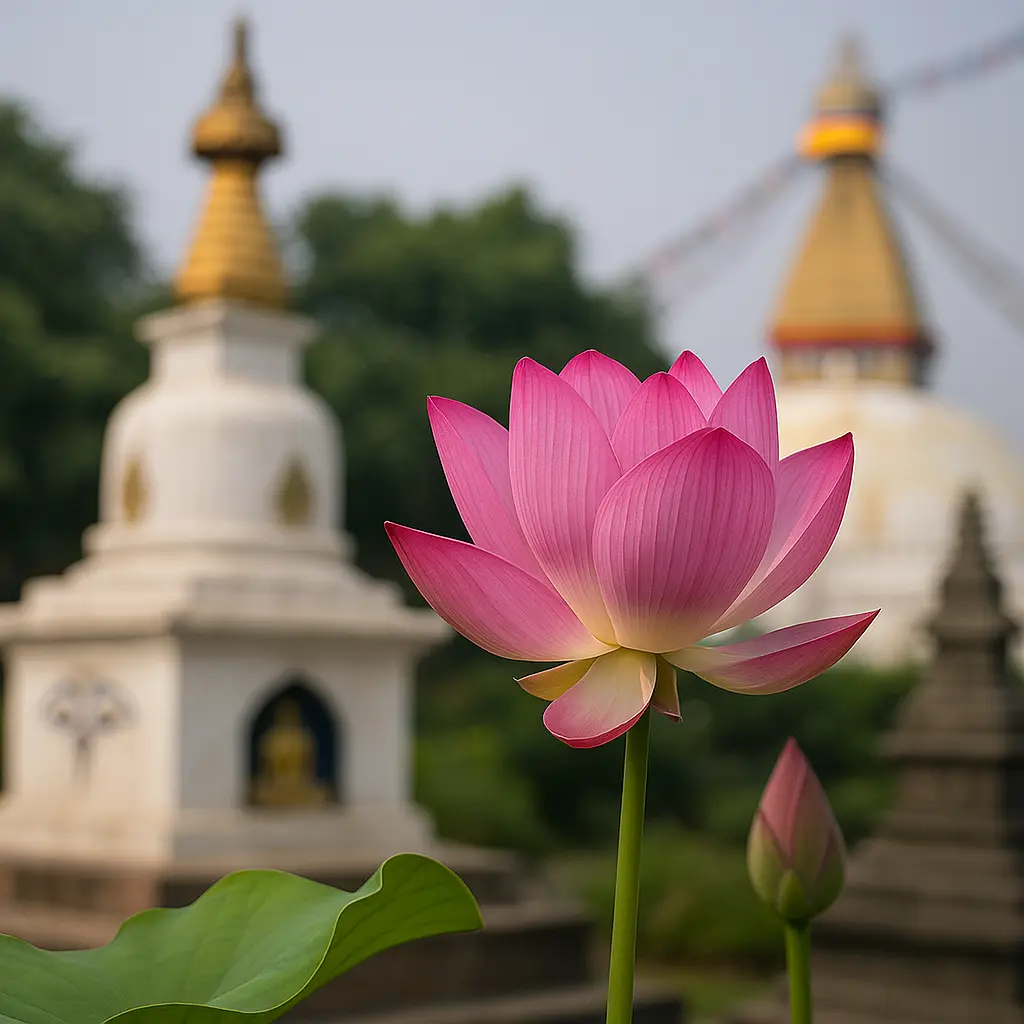
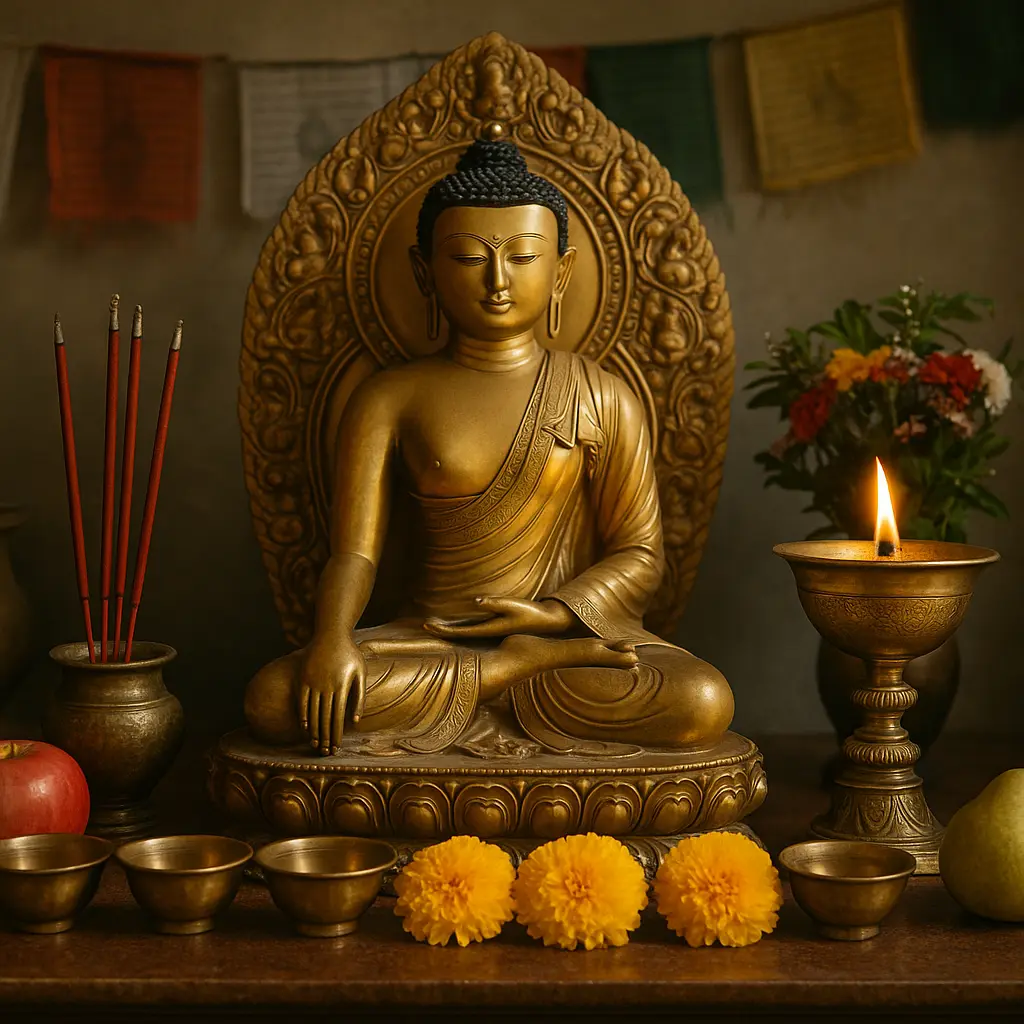
Buddhism Flower: The Meaning and Symbolism Behind Sacred Blooms

Key Takeaways

• In Buddhism, flowers symbolize impermanence, beauty, and spiritual offering.

• The lotus flower is the most iconic Buddhist symbol, representing purity rising from suffering.

• Flowers are offered at temples, stupas and home altars as a gesture of devotion, impermanence, and mindfulness.

• Different flowers, like lotuses, champa, marigolds and blue poppies, carry specific meanings in Buddhist culture.

• The act of offering a flower is more than ritual, it’s a spiritual practice in itself, reminding us of transience and inner clarity.

• Sacred Buddhist sites like Boudhanath Stupa are surrounded by fresh flower stalls and monasteries where floral offerings shape daily life.

Why Flowers Matter in the Buddhist World

Spend a morning walking the kora path around Boudhanath Stupa, and you’ll see something deeply moving: hands, old and young, placing flowers at the feet of Buddha statues. No words. Just intention. A fresh bloom laid with care.

In the Buddhist tradition, a flower is never just a flower. It’s a mirror. A metaphor. A moment of beauty destined to fade, just like everything else in this world.

And yet, it’s precisely this impermanence that makes it sacred.
This is what makes the Buddhism flower not just botanical,but existential. It’s an offering. A teacher. A symbol of both the fleeting and the eternal.

The Lotus: Heart of Buddhist Flower Symbolism

Why the Lotus Is So Sacred

If you ask any Buddhist practitioner, whether in Nepal, Japan, or Tibet ,what flower represents Buddhism, the answer will be unanimous: the lotus.

Here’s why:

• It grows from the mud, yet rises unstained toward the light.

• Its petals unfold in still water, just like mindfulness and awareness in the calm of meditation.

• In Buddhist texts, the Buddha himself is called “The Lotus-Born” ,and many bodhisattvas are depicted seated on lotus thrones.

The lotus isn’t just beautiful, it’s a roadmap to liberation.

To live like the lotus is to rise from suffering with grace, without resentment, without clinging. This is the soul of the Buddhist path.

“Just like a lotus is born in water, grows in water, and rises out of water to stand above it unsoiled, so too does the Buddha rise above the world.”

, The Dhammapada

Flower Offerings in Daily Buddhist Life

The Ritual and Meaning of Offering Flowers

In Buddhism, offering a flower is an act of mindful generosity. It’s not meant to please a deity or bring luck, it’s a symbolic expression of:

• Impermanence: The flower will wilt. Like all things.

• Gratitude: To the Buddha, the Dharma (teachings), and the Sangha (community).

• Inner aspiration: To cultivate beauty, clarity, and presence within oneself.

When a pilgrim lays a single lotus at a shrine in Boudha, they’re not doing it out of habit. They’re saying: “I recognize the passing nature of this life, and I still choose to offer beauty.”

This is Buddhist hospitality at its deepest, not just welcoming the world, but offering it a heart that’s open, fleeting, and sincere.
Other Sacred Flowers in Buddhism (Beyond the Lotus)

While the lotus is the most well-known, many flowers hold symbolic weight across different Buddhist cultures. Here are a few you’ll find across Nepal and the wider Buddhist world:

1. Champa Flower (Plumeria)

Often used in Himalayan monasteries. Symbolizes devotion and fragrance of the heart. You’ll often see it in ritual garlands.

2. Marigold (Tika Phool)

Bright yellow and orange marigolds are common in Nepalese Buddhist ceremonies. They represent light, purification, and joy.

3. Blue Himalayan Poppy

Rare and native to high elevations. In Tibetan Buddhism, it’s sometimes associated with mystical states and visionary insight.

4. White Jasmine

Used in many Southeast Asian Buddhist temples. Represents purity, humility, and peaceful offering.
Each flower tells a story. Not in words, but in scent, texture, and quiet decay.

The Buddhist Lesson Behind Every Bloom: Impermanence

One of the Buddha’s core teachings is anicca, impermanence. Everything is changing, always. Nothing lasts.
The flower embodies this truth more beautifully than any scripture.

• It blossoms.

• It stirs awe.

• It withers.

And in that cycle is a silent teaching: Love what is here, while it is here. Because nothing, not even beauty, is permanent.

At temples across Nepal, from small village shrines to great stupas, you’ll see wilted flowers swept away each evening. Tomorrow, new ones will appear. This is the heartbeat of Buddhist life.

Buddhism, Flowers, and Sacred Spaces: A Living Experience

At Boudha Mandala Hotel, we see this every day.
Guests step out at dawn and walk the stupa path, often returning with fresh flowers bought from nearby stalls. Some leave them on their balcony altar. Others offer them at local monasteries. A few placed them by the hotel’s own small shrine.

They do this not as tourists, but as participants in a living tradition. A flower, in these moments, becomes more than a decoration. It becomes a prayer in form.

And in this small act, they enter the rhythm of Boudha, not just visiting, but belonging.

Final Thoughts

In the quiet act of offering a flower, we are reminded:

• That beauty is brief.

• That intention is everything.

• That even a simple bloom can point us toward enlightenment.

In Buddhism, the flower is not worshipped; it witnesses. It does not demand attention; it gives it freely. It teaches us, without speaking, how to live: openly, briefly, and in full bloom.

So the next time you pass a marigold garland or see a lotus opening in still water, pause. Bow your head. Remember.

“As a flower, beautiful and fragrant, blooms and fades, so too is this life. But from that fading, wisdom grows.”

Stay Where the Flowers Teach You Something

If you are seeking a space in Boudha that honors silence, presence, and small sacred gestures, Boudha Mandala Hotel offers:

• Stupa-view rooms for morning meditations and fresh flower offerings

• A peaceful café with locally sourced flowers and food

• Long-stay apartments for retreat, work, or study

• Warm staff who understand the rhythm of Buddhist life

Just steps from the stupa, yet tucked away in calm, this is a place to offer your own bloom to the shrine, to the moment, to yourself.

What Is a Buddha Shrine? Meaning, Ritual, and Sacred Spaces

A Buddha shrine, sometimes called a Buddhist altar or veneration space, is a sacred place where the presence of the Buddha is honored. Whether found inside temples, monasteries, homes, or tucked into corners of bustling city streets, these shrines serve as spiritual focal points, places for meditation, offerings, and remembrance of the awakened mind.

At its heart, a Buddha shrine is not about religion in the conventional sense. It’s about cultivating presence, gratitude, and mindfulness. Whether you’re a devout practitioner or simply a spiritually curious traveler, standing before a Buddha shrine often evokes a quiet sense of reverence ,like stepping into a moment outside of time.

Elements of a Buddha Shrine: What You’ll See and Why It Matters

No matter where you travel,whether it’s a remote monastery in Nepal or a quiet corner in someone’s home,the essential elements of a Buddha shrine remain surprisingly universal. These include:

• A statue or image of the Buddha, usually seated in meditation or teaching posture

• Offerings such as flowers, incense, butter lamps, fruit, or clean water

• Sacred texts or prayer flags

• A clean, respectful environment, often elevated above daily living spaces

Each element holds meaning. The offerings aren’t to please a god, but to cultivate qualities like generosity, devotion, and awareness. Lighting a butter lamp symbolizes removing ignorance and bringing light to the mind. Even the way the Buddha is seated,legs crossed, eyes lowered,serves as a silent teaching in stillness and equanimity.

Types of Buddha Shrines You’ll Find in Nepal

Temple Shrines

Step into any Buddhist temple in Nepal,whether it’s Boudhanath, Swayambhunath, or a local village monastery,and you’ll encounter grand, elaborately decorated Buddha shrines. These spaces are rich with:

• Thangka paintings of deities and mandalas

• Rows of butter lamps flickering in silence

• Chanting monks or lay practitioners doing circumambulations

At Boudhanath Stupa, for example, the main shrine faces inward from each cardinal direction, radiating blessings like a mandala turned inside out. These aren’t just aesthetic. Each detail is an embodiment of sacred geometry, history, and devotion.

2. Monastic Shrines

Inside Tibetan Buddhist monasteries, shrines often include not just a central Buddha image, but also statues of lineage masters, protector deities, and elaborate offerings arranged with ceremonial precision. These spaces are primarily used for daily pujas (prayer ceremonies) and deeper meditative practices.

If you’re staying near Boudhanath, you can often quietly join morning or evening rituals at monasteries like Shechen, Ka-Nying, or Nagi Gompa (further north in Shivapuri).

3. Home Shrines

Many Nepali and Tibetan families maintain simple home altars, typically located on a high shelf in the main living area. These might include:

• A photo or statue of the Buddha

• A row of small offering bowls filled with water

• Fresh flowers or incense

Even if you’re a traveler or digital nomad living in an apartment, creating a small personal shrine can transform your space into something sacred. A single candle and a peaceful image may be enough.

Why People Visit Buddha Shrines

People come to Buddha shrines not just to pray,but to remember who they are when the noise quiets down. Whether local pilgrims doing prostrations around Boudhanath or solo travelers lighting incense in silence, the reasons include:

• Seeking inner peace or answers

• Expressing gratitude or grief

• Marking the start or end of a journey

• Honoring someone who has passed

• Connecting to a lineage or teaching

Imagine waking up early in Boudha, stepping barefoot onto a balcony, and watching the morning light touch the stupa’s golden pinnacle. Below, an elderly nun offers marigolds to a shrine with a gaze so calm, it stills your thoughts. This is not sightseeing. This is soul-seeing.

How to Behave at a Buddha Shrine: Mindful Etiquette

When visiting a Buddha shrine,especially in Nepal,respect is key. Here are a few gentle reminders:

• Remove your shoes before entering temple areas

• Don’t point your feet toward the shrine or sacred objects

• Walk clockwise around stupas or shrines

• Refrain from loud conversation or selfies

• Don’t touch statues or offerings, unless invited

It’s also common to make a small offering,such as lighting a butter lamp or offering a few rupees for maintenance. But more than anything, your sincerity is the real offering.

Notable Buddha Shrines Around Boudhanath Stupa

If you’re staying at Boudha Mandala Hotel, you’re just seconds away from some of the most spiritually alive Buddha shrines in the world. Here are a few nearby highlights:

• Boudhanath Stupa: The heart of Tibetan Buddhism in Nepal, surrounded by dozens of small shrine rooms and temples

• Guru Lhakhang Monastery: A beautiful courtyard shrine tucked inside a monastery just off the stupa circle

• Samtenling Gompa: A peaceful monastery with a hidden inner shrine visited mostly by locals

• Shechen Monastery: Just a short walk away, with one of the most elaborate shrine halls in Kathmandu

Each of these places invites quiet, patient observation. Don’t rush. Let yourself be affected.

How to Create Your Own Buddha Shrine While Traveling

Even if you’re moving between places, it’s possible to carry a sense of shrine with you. Here’s how:

• Bring a small Buddha statue or image

• Use a scarf or cloth as a sacred base

• Include one or two personal tokens (like a stone from a sacred place or a mala bead)

• Light a candle or incense stick at sunrise or sunset

The goal is not to build something perfect, but something meaningful. Even five minutes in front of your travel altar can anchor you in presence, gratitude, and calm.

Final Thoughts

In an age of speed, distraction, and disconnection, Buddha shrines offer something rare stillness that asks nothing of you. Whether you bow, light a lamp, or simply pause and breathe, these spaces help you return to what matters: the clarity of mind, the depth of heart, and the awareness that peace is possible.

If you’re looking for a peaceful hotel just steps from the stupa, Boudha Mandala offers stupa-view rooms, long-stay options, and a warm local welcome. With calm interiors, nourishing food, and easy access to sacred shrines, it’s the perfect base for travelers seeking meaning, not just movement.

What is Boudhanath Stupa? A Sacred Guide to Kathmandu’s Spiritual Heart

Key Takeaway

Boudhanath Stupa is one of the most sacred Buddhist sites in Nepal, located in Kathmandu. This immense white dome, adorned with the all-seeing eyes of the Buddha, is a pilgrimage site, a spiritual hub, and a place of daily prayer for Tibetan Buddhists and Himalayan communities. It’s where ancient traditions meet modern life, creating a peaceful yet powerful atmosphere of devotion, stillness, and cultural richness.

Introduction

When you first step into Boudha, there is a moment,a hush. The sound of traffic softens. The air feels different. Prayer flags flutter like silent whispers across the sky. And at the center of it all stands the immense white dome of Boudhanath Stupa, like the heart of the valley itself.

For many, Boudhanath isn’t just a sacred site. It’s a place to return to. To walk in circles. To light a lamp. To breathe. It’s where monks chant, pilgrims prostrate, and seekers pause between journeys. Whether you come for peace, practice, or photography, Boudha welcomes you with presence.

What Is Boudhanath Stupa?

Boudhanath Stupa (also spelled Bouddhanath or Boudha) is one of the largest spherical stupas in the world and arguably the most important Tibetan Buddhist site outside of Tibet. Located in Kathmandu, it is both a spiritual magnet and a daily place of practice.

The structure itself is rich with symbolism:

– A massive white dome symbolizing the vastness of the universe

– The harmika and the 13-tiered spire representing the stages of enlightenment

– The Buddha’s eyes painted on all four sides, watching in compassion

– The base ringed with prayer wheels and mandalas, inviting movement and meditation

– It is not just a monument. It is a living, breathing site of devotion.

Historical Origins of Boudhanath

The origins of Boudhanath are wrapped in both legend and historical record. According to local myth, the stupa was built by an old woman who asked the king for permission to construct a shrine to enshrine the relics of Kassapa Buddha. Her devotion was so deep that even the king granted her land.

Historically, the stupa dates back to the Licchavi period, likely built in the 5th century CE. After the 1959 Chinese invasion of Tibet, thousands of Tibetan refugees settled in Boudha, turning it into the epicenter of Tibetan culture in Nepal.

In 1979, UNESCO recognized Boudhanath as a World Heritage Site, cementing its global spiritual and cultural importance.

Spiritual Significance: The Soul of Tibetan Buddhism in Nepal

For Vajrayana Buddhists, Boudhanath holds immense spiritual power.

It is said that circumambulating the stupa with a pure heart accumulates merit and purifies negative karma.

Around the stupa are over 50 Tibetan monasteries, many of them built after the Tibetan diaspora. Monks, nuns, lamas, and lay practitioners all engage in daily rituals:

– Kora (circumambulation): Always done clockwise, often with mala beads

– Offering butter lamps: A symbolic act of lighting the path to wisdom

– Hanging prayer flags: Sending blessings across space and wind

– Prostrations: Seen early in the morning and late in the evening, with deep reverence

Boudhanath is not just about belief,it’s about spiritual practice lived daily.

What to Expect When You Visit

Visiting Boudhanath is an experience that touches all senses:

– Sounds: Tibetan horns, chants, bells, and soft footsteps

– Scents: Incense, juniper, butter lamps

– Sights: Golden spires, maroon-robed monks, spinning prayer wheels

– Feeling: A deep, palpable calm

You can join the kora, sit on a rooftop cafe with a view, or simply observe. Vendors around the stupa sell thangka paintings, prayer beads, butter lamps, and ceremonial items. But unlike many tourist sites, the spiritual atmosphere stays intact.
At dawn and dusk, the stupa glows. Pilgrims arrive in hundreds, walking quietly or whispering mantras. The whole space feels like a mandala in motion.

Best Time to Visit Boudhanath

Time of Day:

– Sunrise: Ideal for quiet photography and observing morning prostrations

– Sunset: When butter lamps light the kora path and chants echo across the dome

Festivals:

– Losar (Tibetan New Year): Colorful, crowded, and deeply devotional

– Buddha Jayanti: Commemorating Buddha’s birth, enlightenment, and parinirvana

– Lhabab Duchen: Celebrating Buddha’s descent from heaven

Each festival fills Boudha with vibrant energy, but also reverent discipline.

How to Visit with Respect and Awareness

– Dress Modestly: Cover shoulders and knees

– Walk Clockwise: When circumambulating the stupa, always go clockwise

– No Loud Talking or Music: It’s a space for reverence

– Photography: Allowed, but not during rituals or too close to monks

– Participate Gently: Light a butter lamp or spin a prayer wheel with intention

Remember, Boudhanath is not a museum. It’s a sacred site still lived in and loved.

Staying Near the Stupa: A Spiritual Base for Slow Travel

Staying in Boudha allows you to experience the rhythm of stupa life:

– Morning kora with locals

– Afternoons reading in peaceful courtyards

– Evenings watching monks light lamps

For long-stay travelers, retreat-goers, or digital nomads seeking peace, it’s an ideal alternative to Thamel. You’ll find vegetarian cafes, organic bakeries, yoga spaces, and hidden gompas just steps away.

If you’re looking for a peaceful, spiritually aligned place to stay, Boudha Mandala Hotel offers stupa-view rooms, a calming rooftop, and long-stay comfort just 10 seconds from the stupa.

Personal Reflections: A Place That Changes You

I came to Boudhanath thinking I would see something. But I left having felt something.

Maybe it was the rhythm of the footsteps around the stupa. Maybe it was the silence inside the monastery. Maybe it was a little old woman, eyes closed, whispering Om Mani Padme Hum like a prayer to the sky.

Conclusion
Boudhanath is more than bricks, more than relics, more than tradition. It is a space of remembering. Of turning inward while walking outward. Of realizing that sometimes, the sacred isn’t something you find, but something you return to.

When you walk around Boudhanath, you don’t walk alone. You walk with centuries of seekers, saints, and silent prayers.
And when you leave, part of you stays.

Make your journey to Boudha deeper by staying close. Boudha Mandala Hotel is a spiritually aligned boutique hotel just steps from the stupa,perfect for retreat, reflection, or mindful work.

What Do Reviews say about Boudha Mandala Hotel?

Key Takeaways
• Guests love the quiet location just a short walk from Boudhanath Stupa, close enough for dawn and dusk koras, calm enough for good sleep.

• Reviews highlight kind, attentive staff and a home-like welcome, from help during tough moments to thoughtful upgrades.

• Many rooms are spacious and clean, some with balconies and stupa views, which guests call unforgettable.

• Long-stay travelers appreciate practical comforts, including kitchenettes, reliable Wi-Fi, and complimentary laundry.

• Cafe de Mandala and easy access to local cafés and monasteries make slow mornings and reflective evenings part of daily life.

• Independent ratings on platforms like Tripadvisor and Booking.com consistently mention peace, location, and staff warmth.

Why listen to the reviews at all

Before you compare room sizes and rate cards, it helps to hear from travelers who have already slept here, prayed here, and watched the stupa glow at sunrise. We read through dozens of recent notes from Google, TripAdvisor, and Booking.com. Together they trace a clear picture, a small hotel that takes hospitality personally, a location that feels close to the sacred rhythm, and a stay that slows the heart.

If you want mornings that begin with soft chants and evening light on the dome, our peaceful hotel near Boudha steps away from the circle, close enough to feel the kora, quiet enough to rest well.

What guests say about the location and quiet

Again and again, guests talk about how easy it is to reach the stupa on foot, and how calm the nights are. One guest wrote that the hotel is “just a short walk to Boudhanath Stupa,” which made morning and evening koras feel natural, not rushed. Another called the apartment view “fantastic,” a line you can almost hear as you picture the early light over prayer flags.

Several reviewers notice a detail we value, near but not too near. Close enough for the bells and the turning wheels, far enough to avoid the late night noise that can echo on the inner circle. For many, that balance is the difference between a good trip and a restorative one.

If you are new to this ritual, you can learn how to walk the kora with respect. Dawn is best, when the air is cool, the alleyways are blue with shadow, and the circle moves like one quiet breath.

Hospitality that feels human

In the reviews, the word that repeats is kindness. A guest from Japan describes staff who were “very friendly,” a simple sentence that carries weight after a long flight and a first night in a new city. Another guest stayed for a month during monsoon and said the team helped her find a more affordable room for the remaining weeks, then welcomed her like family each time she returned.

You will also see the owner’s name in replies. Mark answers with gratitude and small details from the day, an honest note that reminds you the staff know their guests by face and story, not just by room number. That tone shows up in the lobby too, a place where a latte in the morning can become a quiet conversation about where to meditate or which monastery is holding evening puja.

If you want that kind of welcome on your next trip, you can book directly. We keep it simple, and we keep it warm.

Rooms, views, and the feel of the space

Guests describe rooms that are clean, spacious, and restful, with sunlight in the mornings and soft lamps in the evenings. Many mention balconies or windows that frame the white dome, a sight that makes breakfast taste different and evenings slower. One reviewer wrote that the stupa view was “truly unforgettable,” another called the mornings on the rooftop “magical.”

For travelers planning longer stays, practical comforts matter. Several reviews point to kitchenettes, strong Wi-Fi, and complimentary laundry as small things that change a month into a manageable rhythm. A guest who stayed for three months called the hotel quiet and peaceful, the kind of steadiness you need when you are working by day and studying or meditating in the evenings.

You can explore rooms designed for presence, not distraction. Some are simple and bright, some have balconies that catch the early sun, all are set up for rest.

Boudha Cafe de Mandala and nearby cafes

Many reviews mention Boudha Cafe de Mandala for fresh breakfast and a relaxed mood, especially on weekends when live music gives the space a gentle lift. Outside the door, the alleys lead to family kitchens, Tibetan bakeries, and modern coffee bars. It is easy to keep your days simple here, café for an hour, kora for a few circles, a visit to the thangka ateliers, then back to rest.

If you want to plan your first morning well, learn the best time to visit Boudhanath. Dawn gives you the light and the quiet, evening gives you the lamps and the low chant that sits in the chest.

A home for long stays, studies, and work

Boudha draws people who need time, students heading to Kopan for teachings, artists searching for stillness, NGO staff who need a steady base, and remote workers who want reliable internet and a walkable neighborhood.

Reviews from long-stay guests highlight the same three threads, fair pricing for extended stays, staff who make adjustments when life changes, and a space that keeps its calm even when the city is noisy.

When guests write that they will return, it is usually for these reasons, not only the location, but the way the days feel. Quiet mornings, respectful service, and a view that keeps the purpose of travel in sight.

What independent platforms highlight

It helps to check what the wider world says too. On Tripadvisor, recent notes describe the hotel as peaceful and well located, with friendly staff and good value for a quiet stay near the stupa. On Booking.com, travelers use words like quiet, friendly, comfortable, and superb location, and several highlight stupa views from balconies or the upper floors.

These summaries matter because they are written by guests from many countries and travel styles, solo, couple, family, student. Different voices, same pattern, kindness, cleanliness, and calm.

Planning your stay in Boudha

Most guests arrive from Tribhuvan International Airport in about twenty minutes, traffic willing. The walk to the stupa takes just a couple of minutes, easy at dawn when the streets are soft and the bakeries open. Monasteries are close, cafés are many, and shops stay open late enough for a last circle after dinner.

If you want to build a simple day, try this, a slow breakfast, a visit to the art schools, a pause in the garden, then evening kora when the lamps come on. If you are exploring the city, Thamel is around thirty minutes by taxi, and Swayambhunath sits high over the valley, best in the late afternoon when the monkeys are sleepy and the light is long. When you want a day of stillness, remain in the circle and let the rhythm do its work.

You can also discover our local experiences. We keep things close to the ground, simple food, gentle music on weekends, and guidance when you need it.

What the replies reveal

It is easy to scan review scores and miss the conversation beneath. Read the owner’s replies and you will notice something steady, a thank you with specifics from the day, a promise to pass praise to staff by name, a note about ongoing renovations, an honest acknowledgment when something needs fixing. That tone spreads through the building because people work better when they know they are seen.

In time, the reviews become more than ratings. They become a small community of voices that care about the same things, clean rooms, soft mornings, kind service, and a roof that looks toward the stupa.

If you want to feel that for yourself, you can book your stay near the stupa. We will keep a room ready and the coffee warm.

A few guest moments that stayed with us

A traveler wrote that staff waited near the stupa to escort her down the lane because taxis stop before the inner circle. Another said that during a hard week, the team made space for quiet, then moved her to a balcony room so she could breathe easier. A guest who stayed for months said the laundry service and kitchen kept life simple enough to focus on study and practice.
Small gestures add up. In Boudha, they always have.

Practical notes for first-time visitors

Entry to the stupa for foreign visitors is paid at the gate, and the ticket is valid for the day. Dress with shoulders covered when you plan to enter monasteries. Walk clockwise on the kora, spin the wheels with the right hand, and keep your phone on silent in the evening when lamps are lit. If you need an early taxi, reception is twenty-four hours and can help at any time.

When you are ready to rest, sit by the window and watch the circle turn. It is enough.

Conclusion

When different travelers, from different countries and reasons for coming, describe the same feeling, you begin to trust the pattern. Reviews of Boudha Mandala Hotel keep pointing to the same three notes, quiet near the stupa, kindness that feels like family, and rooms that hold their calm. The rest is detail, light on a white dome, a bell at dawn, the soft thread of a mantra in the hall.

If you want your own version of that story, book directly with Boudha Mandala Hotel. We are just a few steps from the stupa, and we keep our welcome simple, sincere, and steady.

You can read recent notes on the Tripadvisor’s page for Boudha Mandala Hotel and the Booking. com review feed.

Best Time to Visit Boudhanath: Festival & Season Guide

If you want to experience the deeper rhythms of life in Kathmandu, visiting Boudhanath during one of its sacred festivals can feel magical. But when exactly should you go?

The answer depends on what kind of experience you’re seeking: quiet reflection, cultural immersion, or high-energy celebration.

This guide is for spiritual travelers, solo seekers, and remote workers who want more than sightseeing. Here’s everything you need to know about the best time to visit Boudhanath for festivals.

Understanding the Spiritual Calendar at Boudhanath

Boudhanath follows both the Tibetan and Nepali lunar calendars, so festival dates shift each year. However, the seasonal rhythm remains predictable. If you time your visit right, you can witness age-old rituals, masked dances, and butter-lamp ceremonies that offer a window into Tibetan Buddhist life.

The most spiritually significant festivals include:

– Losar (Tibetan New Year) – Feb or March

– Buddha Jayanti (Vesak) – Full moon in May

– Mohani/Dashain – Late September to mid-October

– Tihar (Festival of Lights) – October to early November

– Monthly Full Moon Days (Purnima) – All year round

Spring (March to May): Clear Skies & Sacred Celebrations

Spring is arguably the best time to visit Boudhanath. The sky is clear and the stupa pulses with life during Losar and Buddha Jayanti. Flowers bloom along the kora path, monks chant in the courtyards, and the whole area feels vibrantly awake. Days are comfortably warm (15–25 °C), perfect for long, peaceful walks or outdoor rituals.
Ideal for: Spiritual immersion, mild weather, high-energy rituals.

Festivals: Losar (Feb–Mar), Buddha Jayanti (May).

Travel tip: Book accommodation early, monks and pilgrims arrive in waves.

Autumn (Mid-September to November)

Autumn is another best time to visit Boudhanath, especially for culture lovers. Mohani (Newar Dashain) and Tihar light up the stupa with sword dances, butter lamps, and ancestral rituals. The skies are crystal clear, and the weather is cool but pleasant (10–22 °C). It’s the perfect time to blend spiritual depth with rich local culture.

– Ideal for: Cultural travelers, photography, festive atmosphere

– Festivals: Mohani (Sept–Oct), Tihar (Oct–Nov)

– Travel tip: Arrive a few days before Tihar to experience the buildup of lights and energy.

Winter (December to February)

Winter at Boudhanath is quiet and soul-stirring. Cold mornings (as low as 5 °C) give way to bright, clear afternoons ideal for reflection and ritual. Losar often falls at the end of February, bringing the Tibetan New Year energy to life. This is a peaceful time for long-stay travelers or anyone seeking retreat-like calm.

– Ideal for: Meditators, long-stay guests, spiritual solitude.

– Festivals: Full Moon Pujas, Losar (late Feb).

– Travel tip: Book a room with a stupa view to watch morning kora from your balcony.

Monthly Full Moon Days

Every full moon, Boudhanath becomes quietly electric. Devotees circle the stupa at dusk, butter lamps line the base, and the energy shifts. Many locals say this is the most auspicious day to offer prayers.

– Ideal for: Solo travelers, spiritual seekers, retreat guests.
– Vibe: Intimate, candlelit, communal.
– Travel tip: Time your stay to include at least one full moon evening.

Planning Tips for a Festival-Season Visit

– Stay close to the stupa: Being within walking distance makes all the difference. Boudha Mandala Hotel is just 10 seconds from the stupa, offering peaceful rooms and long-stay options.

– Respect the space: Dress modestly, walk clockwise, and avoid photography during ceremonies.

– Book early: Especially in spring and autumn, accommodation near the stupa fills quickly.

– Carry cash: Offerings and local shops around the stupa often prefer it.

The best time to visit Boudhanath depends on the experience you’re seeking. Each season at Boudhanath offers its own rhythm. Whenever you come, come with intention and if you need a peaceful retreat just steps from the stupa, Boudha Mandala Hotel offers long-stay comfort and stupa view rooms with a deeply warm welcome.

Where to Eat in Boudha: Best Restaurants and Cafes Near the Stupa

There’s something sacred about eating in Boudha. Maybe it’s the scent of juniper in the air, the sound of soft mantras drifting from a nearby gompa, or the way time seems to slow down when you’re just a few steps from the great stupa.

Food here isn’t just about filling your belly. It’s about nourishment, presence, and quiet moments in between your journey.

Whether you’re looking for a rooftop cafe to watch the stupa glow at dusk or a hidden garden for morning chai, Boudha welcomes you with meals that feel soulful, not rushed.

What Makes Boudha’s Food Scene Special

Unlike other parts of Kathmandu that cater to fast-moving tourists, Boudha’s cafes and restaurants reflect the rhythm of spiritual life. Here, you’ll find monks sipping tea beside digital nomads with laptops, and long-stay pilgrims sharing vegetarian thalis after a morning of kora.

Many places prioritize clean, mindful eating. Vegetarian and vegan options are abundant. And because of the Tibetan influence, meals are often warm, simple, and made to be savored slowly.

Best Cafes in Boudha for Quiet Moments and Good Coffee

If you’re the kind of traveler who loves writing in a journal over a pot of tea or watching the sky change colors with your espresso, Boudha has the perfect cafe for you.

Boudha Cafe De Mandala: 10 Seconds from the Stupa

This is where guests of Boudha Mandala Hotel and mindful wanderers start their mornings.

Boudha Cafe De Mandala sits quietly just off the stupa’s circle. With its rooftop view, peaceful indoor seating, and a menu that blends local and Western comfort food, it’s the kind of place where you linger without meaning to.

Expect:
• Organic breakfasts with eggs, porridge, or muesli.
• Organic teas and French press coffee.
• Light lunches with fresh greens, momos, and seasonal specials.

The vibe is retreat-like. Monks sometimes pass by below. Writers sip slowly. The staff greet you like an old friend.

Good to know
Free Wi-Fi, long-stay friendly, vegetarian options, and open early for pre-kora tea.

Garden Kitchen Cafe
Tucked near the stupa, this rooftop cafe offers a stunning view of the dome. It’s peaceful, great for digital nomads, and known for its warm banana bread and strong coffee.

Utpala Cafe
Located inside a nunnery compound, this all-vegetarian cafe is a hidden sanctuary. The food is light, affordable, and aligned with Buddhist values. Try the thukpa or the fresh salads.

Roadhouse Cafe Boudha
If you’re missing something a bit more Western, Roadhouse delivers. Their wood-fired pizzas and spacious terrace are perfect for late afternoon meals or group meetups.

Where to Eat for a More Traditional, Heartfelt Meal

After a long walk around the stupa or a morning of meditation, nothing hits like a hot plate of Tibetan food.

Double Dorje Restaurant

Simple seating, rich flavors. Their Tibetan thali includes tingmo bread, dhal, and curried vegetables. Don’t miss the butter tea and hand-folded momos.

Flavors Restaurant

A no-fuss favorite for locals and expats alike. Their rice and curry sets are satisfying, and the quiet atmosphere makes it ideal for slow, mindful eating.

Norling Restaurant
Known for its wholesome soups and stir-fried noodles. Their portions are generous, the prices fair, and the setting calm.

Hidden Gems for eating and reflecting

Sometimes, the best meals aren’t found on a map. They’re discovered while wandering a narrow alley or following the scent of freshly steamed dumplings.

Lhasa Momo
You’ll find it if you follow the locals. Soft, juicy momos with tangy achar in a tiny upstairs room. No frills, just good food and warm energy.

Ananda Treehouse Cafe
A bit off the main road, this garden cafe feels like a retreat within a retreat. Wooden seating, birdsong, and a menu of smoothies and herbal teas.

Stupa View Cafe
Yes, it’s popular. But for good reason. Order a masala tea at sunset and watch the sky blush over the stupa. Worth every rupee.

Eating Respectfully in a Sacred Space

Boudha is home to spiritual practitioners, monks, and retreat centers. Many of the restaurants and cafes are directly connected to these communities. As a visitor, a few quiet gestures of respect go a long way.

• Take off your shoes if eating at a monastery-run cafe
• Avoid loud conversations, especially near shrines or puja halls
• Dress modestly, covering shoulders and knees where possible
• Ask before photographing meals or spaces that feel sacred
• If a place is vegetarian only, honor that choice even if you’re not

Being mindful isn’t just about what’s on your plate, but how you move through the space where you eat.

Staying Nearby Makes Every Meal More Meaningful

One of the best ways to truly enjoy Boudha’s food culture is to stay close. When you’re just steps from the stupa, you don’t need to rush meals or plan your day around long commutes.

Boudha Mandala Hotel offers just that. With its stupa-view rooms and peaceful cafe, you can start your day with a quiet breakfast of oats, fruit, and chai, then return at dusk for lentil soup and herbal tea under prayer flags.

Many long-stay guests say they find their favorite cafes by simply walking, wandering, and letting the energy of the stupa guide them.

A Meal with Meaning
In Boudha, eating is an extension of your presence. Whether you’re sitting on a rooftop watching the sky turn gold or quietly sipping soup in a courtyard surrounded by prayer wheels, food becomes a form of connection.

You’ll remember the meals not just for the taste, but for the stillness you felt between bites.

If you’re looking for somewhere peaceful, nourishing, and deeply rooted in spirit, Boudha is waiting.

And if you want to stay where meals and moments come together effortlessly, Boudha Mandala Hotel is just ten seconds from the stupa gate, and a world away from the noise.

Must Visit Places in Kathmandu: A Local Guide

Kathmandu has a unique way of captivating its visitors, drawing them in with an intoxicating blend of vibrant sounds, aromatic spices, and a variety of experiences that contrast quite a spiritual escape with bustling streets.

In this guide, we’ll help you navigate the city’s rich cultural landscape and pinpoint the must-see attractions so that you can bypass the overwhelming noise and distractions. Discover the hidden gems and iconic landmarks that truly define Kathmandu, making your journey memorable and fulfilling.

What makes Kathmandu worth visiting?

Kathmandu is worth visiting because it blends sacred sites, ancient architecture, and living culture within a few kilometers of each other.
Travelers often expect chaos. They find that, yes. But they also find quiet monasteries, sunrise viewpoints, old royal squares, and food you think about long after you leave. You get layers of history in a compact valley that you can explore without wasting time in long transfers.

Here’s a simple breakdown of what Kathmandu offers:

• Spiritual sites in Boudha, Pashupatinath, and Swayambhu that offer daily rituals, prayer wheels, and temples that feel alive
• Ancient palaces in Kathmandu, Patan, and Bhaktapur Durbar Squares that showcase carvings, courtyards, and centuries-old architecture
• Food and culture in Thamel, Patan, and Boudha with momos, Newari dishes, and Tibetan restaurants
• Relaxing spaces like the Garden of Dreams and cafés in Boudha that give you a breather from traffic
• Viewpoints at Swayambhu with wide views of the entire valley

Boudhanath Stupa

Boudhanath Stupa is a massive white dome featuring watching eyes painted on its tower, serving as a focal point for Tibetan Buddhist life in Kathmandu.

As soon as you enter the circle, the energy of the place envelops you. Locals walk in a clockwise direction around the stupa, while monks in red robes pass by quietly. The flickering of butter lamps and the swarms of pigeons flying around the stupa enhance the atmosphere.

Why it stands out

• Built in the 5th century
• One of the largest spherical stupas in Asia
• A perfect sunrise and sunset spot
• Surrounded by rooftop cafés with warm tea and views
• Safe and walkable at all hours

Distance from Boudha Mandala Hotel:
About 2 minutes on foot. Most guests wander here more than once.

Pashupatinath Temple

Pashupatinath Temple is a sacred Hindu temple complex on the Bagmati River that shows the spiritual side of Nepali life without filters or staging.
It feels raw. Priests chant. Families gather. Rituals happen in real time. You see life and death as part of the same rhythm, something Nepalis understand deeply.

Key points

• UNESCO-listed temple complex
• Known for the evening aarti ritual on the riverbank
• Home to sadhus who sit in painted ash
• A strong cultural experience rather than a sightseeing stop

Distance from Boudha Mandala Hotel:
It’s about 2.2 kilometers. You can take a leisurely walk from Boudha Mandala Hotel to Pasupatinath and experience the vibrant chaos of Kathmandu along the way.

Thamel

Thamel is a busy neighborhood packed with shops, cafés, trekking stores, and live music spots.

Most travelers end up here at least once to pick up warm jackets, handmade crafts, or trekking gear. It’s also the easiest place to find international food if you need a break from dal bhat or momos.

Useful tips:

• Avoid buying the first thing you see. Prices vary a lot.
• Mornings are quieter.
• Roads can feel tight, so walk on the left side and stay alert.

Who enjoys it most

• Shoppers
• Food lovers
• Anyone planning a trek

Distance from the hotel:

Around 5 to 6 kilometers.

Kathmandu Durbar Square

Kathmandu Durbar Square is an old royal palace area filled with carved wooden temples, courtyards, and traditional architecture.

People visit to see the Kumari House (Kumari is a living goddess of the indigenous Newar people of Kathmandu Valley), the former royal palace, and the stacked pagoda temples that survived earthquakes and time.

Best for

• History fans
• Photographers
• Architecture admirers

Distance from the Hotel:

Around 6km.

Swayambunath Stupa ( Monkey Temple )

Swayambhunath is a stupa located on a hilltop at the outskirts of Kathmandu Valley, providing one of the best views of the valley and blending Hindu and Buddhist symbolism.
You meet monkeys on the steps, so keep snacks tucked away. Once you reach the top, the air feels fresh, and prayer flags stretch across the sky.

What stands out:

• A panoramic view of all of Kathmandu
• Prayer wheels around the stupa
• A great sunrise location

Travel distance:
About 7 to 8 kilometers from the Boudha Mandala Hotel.

Patan Durbar Square

Patan Durbar Square is a historic district known for Newari art, stone statues, and temples with incredibly detailed carvings.

It feels calmer than Kathmandu Durbar Square. You find artists working on metal statues, wood carvings, and handmade crafts in the surrounding alleys.

Highlights:

• Krishna Mandir
• Patan Museum
• Traditional courtyards

Many visitors say Patan is their favorite square because it feels more lived-in.

Bhaktapur Durbar Square

Bhaktapur Durbar Square is an old city center filled with medieval architecture, narrow brick lanes, and traditional workshops.

People love Bhaktapur because the streets are clean, the buildings feel timeless, and the city still makes pottery the old way.

Don’t miss:

• Nyatapola Temple
• Pottery Square
• Juju dhau, which is a thick and sweet yogurt

Distance from the hotel:
About 12 kilometers

Garden of Dreams

The Garden of Dreams is a restored neoclassical garden that gives travelers a quiet space to rest, read, or take a break from traffic.

It’s not huge, but it feels peaceful. The pathways, ponds, and small pavilions offer a simple reset.

Good for:

• A slow afternoon
• Sitting with coffee
• Travel recovery days

Located near the entrance of Thamel.

What are the best hidden places near Boudha for travelers staying at Boudha Mandala Hotel?

The best hidden places near Boudha include small monasteries, traditional workshops, and peaceful alleys around the stupa circle.

Guests often enjoy these quiet spots because they feel like small pauses in the day.

Notable stops:

• Shechen Monastery
• Ka-Nying Shedrub Ling Monastery
• Local tea shops with salty butter tea
• Small mandala shops run by Kathmandu artists

These places stay close enough that you can return to the hotel for a break any time.

What travel tips help visitors get the most out of Kathmandu?

Useful travel tips for Kathmandu help visitors save time, avoid common mistakes, and enjoy the city more comfortably.

Here is a list of the essentials:

• Visit during October to December or February to April for comfortable weather
• Use cash because small shops prefer it
• Take taxis, but agree on a rate before starting
• Expect cooler mornings and warmer afternoons
• Wear comfortable walking shoes and bring layers

Why is Boudha Mandala Hotel a good base for exploring Kathmandu?

Boudha Mandala Hotel is a good base because it places travelers within walking distance of Boudhanath Stupa and within a short ride of every major spot in Kathmandu.
Guests appreciate quiet rooms, friendly staff, and the ability to walk to the stupa for sunrise or dinner. After long days, returning to a calm neighborhood helps you recharge faster.

What makes the location comfortable?

• 2-minute walk to Boudhanath Stupa
• Easy taxi access
• Close to cafés, bakeries, monasteries, and shops
• Welcoming atmosphere for both short and long stays

Kathmandu has many corners worth exploring, and staying in Boudha gives you a gentle start and finish to every day.

Best Buddhism Books for Every Stage of the Journey

Key Takeaways

• The best books on Buddhism depend on your path, whether you are just beginning, deepening, or remembering.

• Buddhist books are not merely to be read, but absorbed. They are companions for inner clarity.

• Start with Thich Nhat Hanh, Bhikkhu Bodhi, or Walpola Rahula for grounding.

• As you deepen, Pema Chödrön, Ajahn Chah, and the Dalai Lama become gentle yet radical voices.

• Buddhist scriptures are not reserved for scholars, they’re living texts meant to be lived.

• The most important book is the one that makes you stop, breathe, and soften.

How to Choose a Buddhist Book That Truly Resonates

If you walk into a monastery library, you’ll often see not just rows of texts, but flowers on the shelves. In Buddhism, the right book isn’t just a source of knowledge, it’s an offering. Something sacred. Something that meets the reader exactly where they are.

Some books speak when we’re broken. Others arrive when we’re ready. Your journey matters more than the book list. Ask yourself:

“Do I need to understand? Or do I need to feel held?”

For Beginners: Books That Gently Open the Dharma

When I first came across the Dharma, I was overwhelmed. So many teachings. So many traditions. But the right book felt like a hand on my back.

If you’re beginning, these books are clear, honest, and simple without being simplistic:

• “The Heart of the Buddha’s Teaching” by Thich Nhat Hanh
This is the kind of book that makes the Dharma feel like home. Gentle, poetic, but deeply rooted in core teachings, suffering, mindfulness, compassion.

• “What the Buddha Taught” by Walpola Rahula
Direct and scholarly, yet accessible. A Theravāda classic that lays out the Four Noble Truths and Eightfold Path with no frills or mysticism.

• “In the Buddha’s Words” edited by Bhikkhu Bodhi
A remarkable collection of sutta translations, carefully organized by theme. Bhikkhu Bodhi adds helpful introductions that bring ancient texts to life.

These are not just books for learning Buddhism. They are books for living it.

For Practitioners: Books That Deepen the Path

Once the teachings settle into your bones, you begin to see how real they are, in joy, in grief, in love, in confusion. These are the books that meet you there.

• “When Things Fall Apart” by Pema Chödrön
This is not a comforting book. It’s a truthful one. Pema speaks from the messy middle: heartbreak, impermanence, and the fierce grace of letting go.

• “The Art of Happiness” by the Dalai Lama & Howard Cutler
A dialogue between Tibetan wisdom and Western psychology. Kind, accessible, and surprisingly personal.

• “Being Dharma” by Ajahn Chah
A collection of talks from one of Thailand’s great forest masters. Practical, humorous, and sometimes painfully direct.

These books don’t offer escape. They offer mirrors.

For Meditators and Contemplatives

Meditation is not an achievement. It’s a returning. These books are practical and poetic roadmaps for that return.

• “Mindfulness in Plain English” by Bhante Gunaratana
As honest as the title suggests. Perfect for anyone starting or restarting their practice.

• “The Miracle of Mindfulness” by Thich Nhat Hanh
One of the most beloved introductions to present-moment awareness. More than a guide, it’s a meditation in itself.

• “The Attention Revolution” by B. Alan Wallace
A deeper dive into śamatha practice (calm abiding). Ideal for those wanting to refine focus and clarity.

These texts are best read slowly, like tea. Sip, pause, return

Buddhist Scriptures and Classical Texts (For Serious Study)

Some books are not just read, they are bowed to.

• The Dhammapada
Short verses with endless depth. You’ll return to this again and again.

• The Tibetan Book of Living and Dying by Sogyal Rinpoche
A bridge between Tibetan Buddhist views on death and modern spiritual inquiry. Especially powerful for hospice workers, healers, and those in grief.

• The Majjhima Nikāya (Middle-Length Discourses)
If you want to hear the Buddha’s voice as close to original as possible, start here. Not easy, but immensely rewarding with guidance.

For deeper study, you can explore Oxford Centre for Buddhist Studies or the Plum Village Library.

Final Reflection

Books in Buddhism are not meant to impress you. They’re meant to transform you. You might read a hundred titles and remain stuck. Then one sentence, at the right time, opens the sky.

Sometimes that sentence appears in a monastery. Sometimes in a guesthouse. Sometimes, alone, in the quiet of your own questioning.

Let the book find you. And when it does, don’t rush. Let it whisper. Let it challenge. Let it remind you that wisdom is not elsewhere, it’s here, in your breath, your body, your moment-to-moment response to life.

FAQs on Buddhist Books

What’s the best Buddhist book to start with?

“The Heart of the Buddha’s Teaching” by Thich Nhat Hanh is often the gentlest and clearest doorway for beginners.

Are Buddhist books religious or philosophical?

Both. But they’re also deeply experiential. Good books don’t just explain, they help you practice, reflect, and live differently.

Can I read Buddhist scriptures without being a monk?

Absolutely. The teachings were meant for all beings. With good commentary or a teacher, even dense texts become accessible.

What if a book feels too intellectual or abstract?

Set it down. Find another. Buddhism is vast. Your heart will recognize the book that’s right for you now.

Is it better to read many books or go deep into one?

Depth is better than quantity. Let one book change you, rather than reading ten that only touch the surface.

Want to Read, Reflect, and Stay in a Space That Honors the Teachings?

At Boudha Mandala Hotel, we meet travelers, monks, artists, and readers who arrive with a book in one hand and a quiet longing in the other.

Just steps from the great stupa of Boudhanath, we offer a peaceful base where the teachings feel close, whether you’re reading The Dhammapada in our garden or journaling after a monastery walk.
If you’re looking for a peaceful hotel near Boudha, we invite you to stay, breathe, and begin again.

What is the Average Nightly Rate at Hotel Mandala Near Boudhanath Stupa?

Key Takeaways
• Standard rooms at Hotel Mandala cost $35-$45 per night during peak season (October-March)
• Monsoon season rates drop to $25-$35 per night with 10-30% discounts
• Deluxe rooms and suites with stupa views range from $50-$70 per night in peak season
• Long-term stays (7+ days) receive 15-30% discounts, bringing monthly rates as low as $17-$22 per night
• All rates include free breakfast, WiFi, and parking
• Direct bookings offer better rates than third-party platforms
• Location steps from Boudhanath Stupa justifies premium over Thamel budget hotels

Let’s cut straight to the numbers. A standard room at Hotel Mandala near Boudhanath Stupa costs $35 to $45 per night during peak season (October through March) and $25 to $35 per night during monsoon season (June through September). If you’re staying a week or longer, those rates drop further with discounts of 15-30%.

But pricing at hotels near the stupa isn’t just about the nightly rate. It’s about what you’re actually getting for that money, proximity to one of the world’s most sacred Buddhist sites, included amenities that other hotels charge extra for, and the kind of personal hospitality that makes extended stays feel like coming home rather than checking into a hotel.

The question isn’t really “what does it cost?” It’s “what’s the value?” Let’s break down exactly what you’re paying, what’s included, and how to get the best rate for your stay in Boudha.

Peak Season Rates: October Through March

Standard Rooms: $35-$45 Per Night

During Kathmandu’s peak tourist season, when clear skies and comfortable temperatures bring travelers from around the world, Hotel Mandala’s standard rooms range from $35 to $45 per night. This is the best time to visit Boudhanath, which means higher demand and correspondingly higher rates.

What you get for that rate:
• Clean, comfortable room with private bathroom
• Air conditioning and comfortable bedding
• Free breakfast to start your day before walking the kora
• Free WiFi throughout the property
• Free parking if you’re renting a vehicle
• Location within 2 minutes walking distance of the stupa

Compare this to Thamel budget hotels at similar rates. You’d be dealing with noise, traffic, and a 30-minute taxi ride each time you want to visit the stupa. Factor in taxi costs of $3-5 each way, and you’re spending an additional $6-10 daily just on transportation, not to mention the time lost to Kathmandu traffic.

Deluxe Rooms and Suites: $50-$70 Per Night

If you want more space, better views, or additional amenities, deluxe rooms and suites range from $50 to $70 per night during peak season. These rooms typically feature:

  • Balconies with direct stupa views
  • Larger floor space
  • Better furnishings and decor
  • Some include sitting areas

The stupa view matters more than you might think. Waking up to see the all-seeing eyes of Boudhanath from your balcony, watching butter lamps flicker at dusk, observing the flow of pilgrims circling below, these aren’t just aesthetic pleasures. They’re part of the experience that brings people to Boudha in the first place.

For photographers, artists, or travelers who want to observe the stupa’s rhythms without leaving their room, the extra $15-25 per night represents genuine value.

At Boudha Mandala Hotel, our deluxe rooms with stupa views offer that perfect balance of comfort and connection. You’re not just looking at the stupa, you’re living with it. Morning chants reach you before your alarm goes off. Evening pujas provide a natural rhythm to your day. This proximity isn’t just convenience, it’s transformation.

Off-Season Rates: June Through September

Monsoon Season Discounts: $25-$35 Per Night

During monsoon season, rates drop significantly. Standard rooms cost $25 to $35 per night, representing 10-30% discounts off peak season pricing. Deluxe rooms and suites see similar percentage reductions.
The trade-off is weather. June through September brings afternoon rains, occasional flooding in Boudha’s narrow streets, and the green stillness that defines Nepal’s wet season. But for travelers who don’t mind working around the weather, monsoon season offers exceptional value.

Consider this: a month-long stay in a standard room during monsoon season, with long-term discounts applied, could cost as little as $17-22 per night. That’s $510-660 for an entire month in one of Kathmandu’s most spiritually significant neighborhoods, with breakfast included daily.

For digital nomads choosing Boudha as a base, these rates make extended stays financially sustainable. The cost of living in Kathmandu becomes remarkably manageable when accommodation costs this little.

What Monsoon Season Actually Means

Let’s be honest about the challenges. Afternoon rains are predictable but can be heavy. Some streets flood temporarily. The humidity is higher. Fewer tourists mean some restaurants and shops have reduced hours.

But there are advantages too. The stupa is less crowded. Sacred monasteries near Boudhanath have more space for visitors. The neighborhood feels more local, less performative. And the rain brings a particular kind of contemplative atmosphere that some travelers prefer.

If your schedule is flexible and you’re here for spiritual practice rather than trekking, monsoon season offers the best value in Boudha.

Long-Term Stay Rates: Where Real Value Emerges

Weekly and Monthly Discounts: 15-30% Off

This is where Hotel Mandala’s pricing becomes genuinely compelling. For stays of 7 days or longer, discounts typically range from 15% to 30% off the nightly rate. The longer you stay, the better the rate.
Let’s do the math:

Peak Season (October-March):
• Standard room nightly rate: $35-45
• 7-night stay at full rate: $245-315
• 7-night stay with 20% discount: $196-252 ($28-36 per night)
• Monthly stay with 30% discount: approximately $735-945 ($24.50-31.50 per night)

Off-Season (June-September):
• Standard room nightly rate: $25-35
• 7-night stay with 20% discount: $140-196 ($20-28 per night)
• Monthly stay with 30% discount: approximately $525-735 ($17.50-24.50 per night)

These aren’t theoretical numbers. They represent the actual value available to travelers willing to commit to longer stays.

Apartment-Style Accommodations for Extended Stays

For long-term guests, Hotel Mandala offers apartment-style accommodations with additional features that standard hotel rooms lack:

  • Private kitchenettes for preparing your own meals
  • Separate living spaces for work and rest
  • More storage for extended stay belongings
  • Laundry facilities or services

When you’re staying weeks or months, these amenities matter. The ability to cook occasionally saves money on restaurant meals. A proper work space supports productivity for remote workers. Storage means you can actually unpack rather than living out of a suitcase.

The apartment rates vary based on size and features, but the value proposition is clear: more space, more functionality, and rates that make extended stays practical.

Our apartment-style rooms at Boudha Mandala Hotel are designed specifically for long-term travelers. With high-speed fiber WiFi, 24-hour power backup, dedicated work desks, and kitchenettes, you’re getting functionality that standard hotel rooms simply don’t provide. Over 60% of our guests extend their original booking, many staying for months. That tells you something about the value and the atmosphere we’ve created.
Room Type Breakdown and What You Actually Get

Standard Rooms: The Practical Choice
Standard rooms represent the best value for travelers who want clean, comfortable accommodation without paying for amenities they won’t use. You get:

• Private bathroom with hot water
• Air conditioning
• Comfortable bed with quality linens
• Work desk and chair
• Free toiletries
• Daily housekeeping

What you don’t get: balcony, stupa views, extra space. If you’re spending most of your time exploring Boudha, attending pujas at Boudhanath, or experiencing authentic local culture, the standard room provides everything you need.

Deluxe Rooms: The View Makes the Difference

Deluxe rooms add:

  • Private balcony
  • Direct stupa views
  • Larger floor space
  • Better furnishings
  • Sometimes a small sitting area

The $15-25 premium over standard rooms buys you the ability to experience the stupa’s rhythms without leaving your room. For photographers documenting Boudha, artists seeking inspiration, or travelers who want to observe without always participating, this matters.

Apartments and Suites: Built for Extended Stays

The larger accommodations include:
Full or partial kitchenette
Separate bedroom and living area
Dining space
More storage
Sometimes washing machine access

These work best for stays of two weeks or longer, when the functionality justifies the higher rate. Families, couples, or solo travelers planning extended stays find the extra space and cooking facilities worth the investment.
Comparing Hotel Mandala Rates to Other Boudha Options
vs. Monastery Guesthouses: $10-20 Per Night
Monastery guesthouses represent the budget option in Boudha, typically costing $10-20 per night. But you’re trading significant comfort:

Shared bathrooms in most cases
Basic rooms with minimal furnishings
Stricter rules about noise and visitors
Limited or no air conditioning
No breakfast included
Sometimes cold water only

For serious practitioners attending teachings or retreats, monastery guesthouses make sense. For travelers who want a comfortable base to explore Boudha, Hotel Mandala’s extra $15-25 per night provides tangible benefits that justify the cost.
vs. Other Mid-Range Hotels: $30-50 Per Night
Hotel Mandala competes directly with other 3-star properties in Boudha. Rates across this category are similar, typically $30-50 per night for standard rooms. The differentiators aren’t price but location, hospitality, and atmosphere.

Properties directly on the stupa roundabout but not set back might cost slightly more while dealing with more noise. Properties on quieter side streets might cost slightly less but require a longer walk to the stupa. Hotel Mandala’s positioning, on the roundabout but set back from the main chaos, offers the best of both worlds.
vs. Luxury Boutique Hotels: $80-150 Per Night
At the high end, Boudha has boutique properties charging $80-150 per night or more. These offer:
Designer interiors
Rooftop restaurants with stupa views
Spa services
Polished, formal service
Premium furnishings throughout

Whether this is worth 2-3 times Hotel Mandala’s rates depends entirely on your priorities. The stupa doesn’t care which hotel you’re staying at. The authenticity of your experience isn’t enhanced by thread count. For travelers focused on spiritual practice or cultural immersion, the luxury premium rarely translates to a better experience.