
Buddhism Religion Symbol: The Meaning Behind the Dharma Wheel

Key Takeaways

• The Dharma Wheel (Dharmachakra) is the official and most widely recognized religious symbol of Buddhism, representing the Buddha’s teachings

• Its eight spokes reflect the Noble Eightfold Path, guiding principles for liberation

• Other major Buddhist symbols include the lotus flower, Bodhi tree, stupa, and Ashtamangala (Eight Auspicious Symbols)

• Buddhist symbols are deeply woven into monastic life, temple architecture, and visual arts throughout Asia

• The Dharma Wheel is not just an image, it is a daily reminder to live ethically, mindfully, and with compassion

What Is the Main Religious Symbol of Buddhism?

If you had to choose one symbol to represent the entire Buddhist path, it would be the Dharma Wheel, also known as the Dharmachakra. It is an ancient symbol, a wheel with eight spokes, a circular hub, and sometimes intricate rims. This wheel represents the cycle of life and rebirth, but more importantly, the Buddha’s teaching that helps liberate us from it.

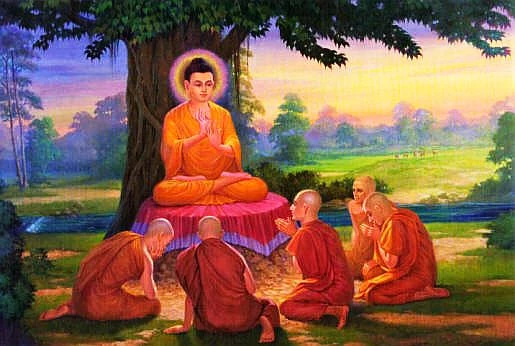
The turning of the Dharma Wheel is a metaphor the Buddha used when he first began to teach. With his first discourse in Sarnath, he said he had “set the wheel of Dharma in motion.”

Each spoke stands for a path:
• Right view
• Right intention
• Right speech
• Right action
• Right livelihood
• Right effort
• Right mindfulness
• Right concentration

This is the Noble Eightfold Path, the heart of Buddhist ethics and meditation. The Dharma Wheel reminds practitioners that each moment offers the chance to take one step on this path.

As noted in Britannica, the wheel is also found on temple gates, statues, prayer wheels, and even on national emblems like India’s Ashoka Chakra.

The Eightfold Path and the Spokes of Liberation

The symbolism of the Dharma Wheel is not abstract. It is deeply practical. Every spoke corresponds to a domain of practice. The right view and intention cultivate clarity. Right speech and action encourage ethical living. Right effort and mindfulness train the heart-mind. And right concentration anchors the awareness.

So, when you see a Dharma Wheel carved above a temple door or painted on a monastery wall, it’s not merely art. It’s a roadmap for liberation.

This is what makes it the most universal symbol of Buddhism as a religion: it contains the path, the purpose, and the perspective.

Other Important Symbols in Buddhism

While the Dharma Wheel is the official emblem, Buddhist symbolism is richly layered. Other symbols deepen and complement the meaning of the Wheel:

• Lotus Flower: Symbolizes purity and awakening. It grows from mud but remains unstained, just like our ability to awaken despite the challenges of samsara.

• Bodhi Tree: Under this tree, Siddhartha attained enlightenment. A living symbol of the possibility of realization.

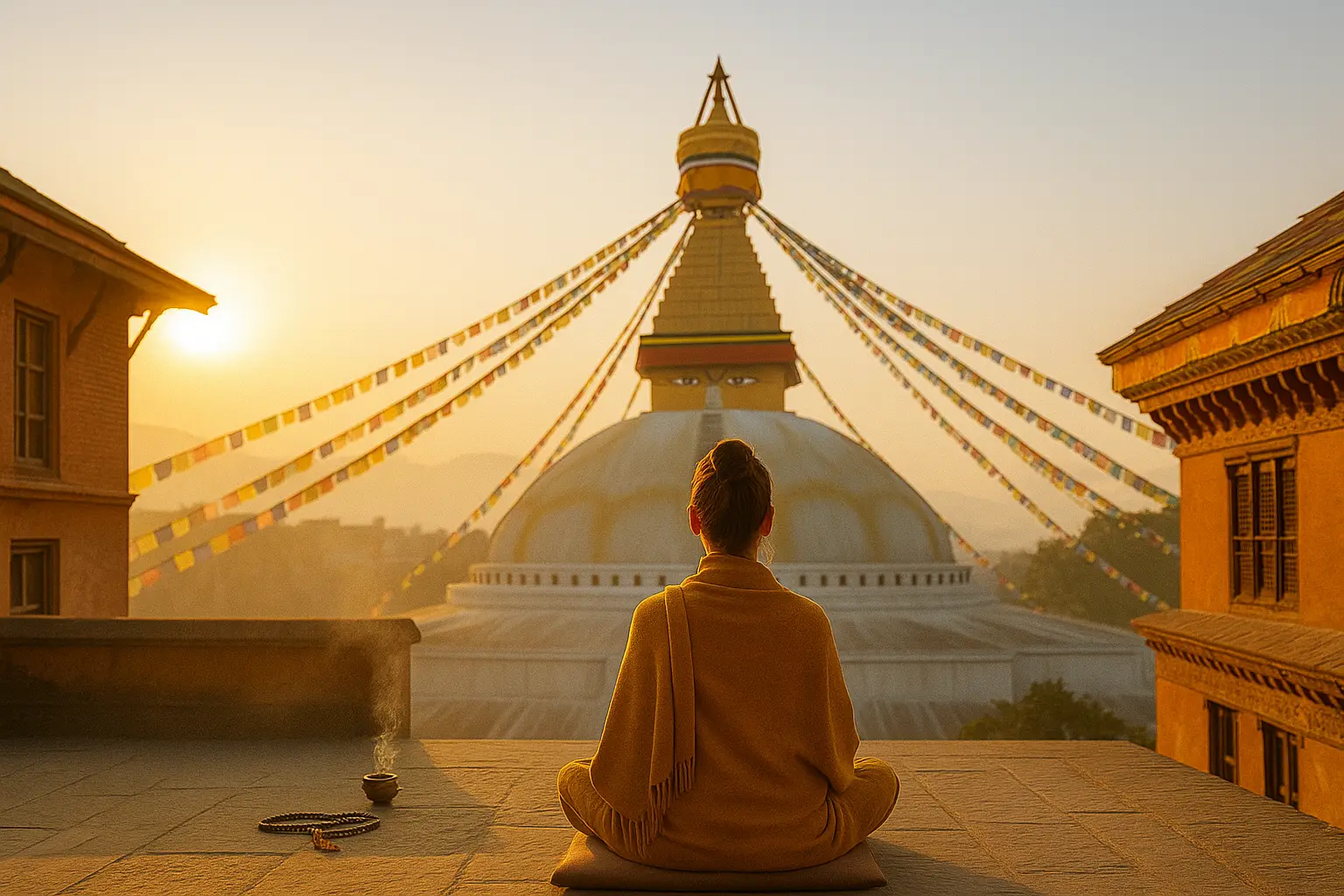
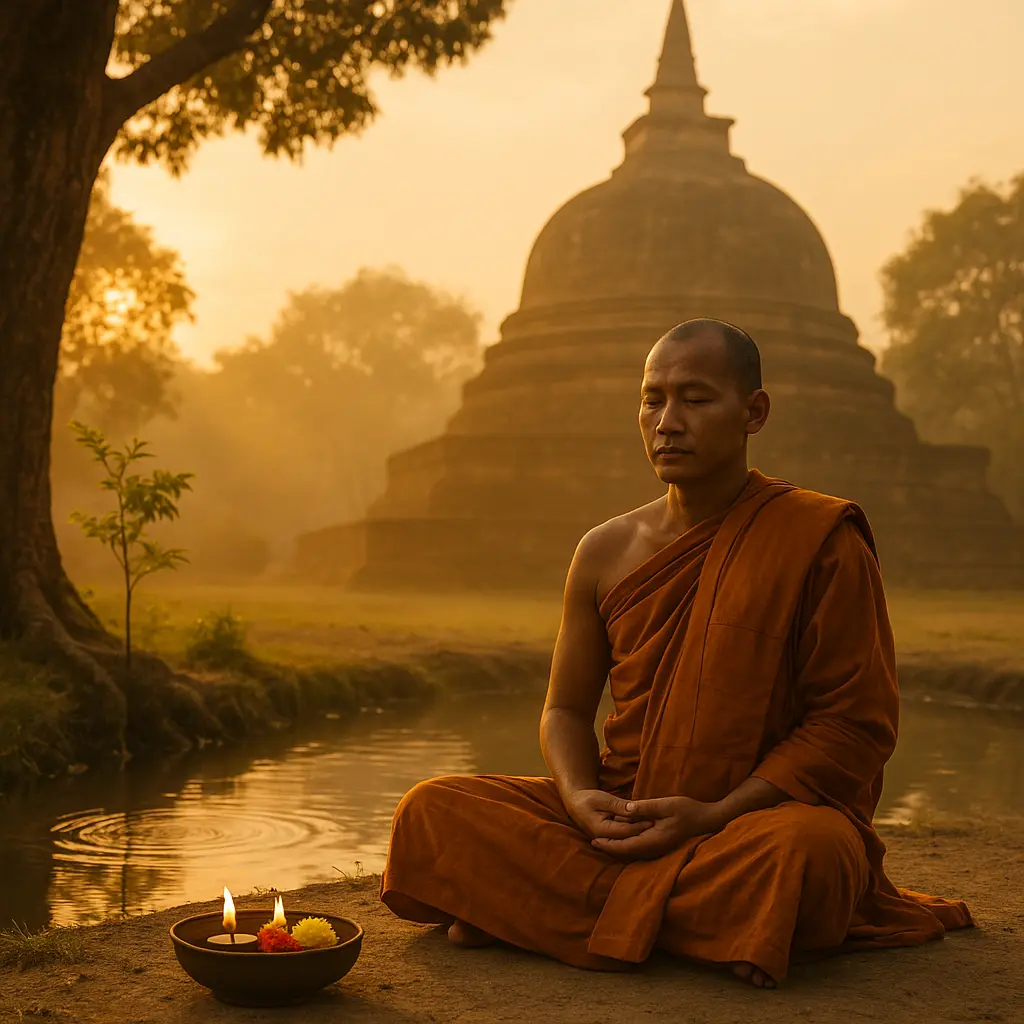
• Stupa: A dome-shaped structure holding relics or symbolizing the Buddha’s awakened mind. It represents both remembrance and refuge.

• Ashtamangala: The Eight Auspicious Symbols used especially in Vajrayāna Buddhism:
– Parasol (protection)
– Golden fish (freedom)
– Treasure vase (spiritual wealth)
– Lotus (purity)
– Conch shell (proclamation)
– Endless knot (interdependence)
– Victory banner (overcoming obstacles)
– Wheel (Dharma)

According to Oxford Reference, these symbols are found in temple murals, ritual implements, and monastic offerings.

Where You’ll See These Symbols Today
Across Nepal, Tibet, Bhutan, and beyond, these symbols are living elements of the Buddhist cultural landscape.

• The gates of Boudhanath Stupa feature the Dharma Wheel flanked by two deer, symbolizing the Deer Park where the Buddha first taught

• The lotus appears on altars, murals, and in every monastery garden

• The Eight Auspicious Symbols are printed on prayer flags, engraved on bronze bowls, and painted across Tibetan thangkas

They are not decorations. They are reminders. Each one pulls the mind back to the path.

Why Symbols Matter on the Inner Path

Buddhism often warns against clinging to form. But it also embraces the power of symbolic form to transmit timeless truths.

These symbols act as bridges between visible and invisible realities. You may forget a teaching, but a symbol stays with you. A wheel over a temple door may call you to pause. A lotus beside a stupa may help you breathe through difficulty.They are the quiet language of awakening, available without words.

The Eightfold Path and the Spokes of Liberation

The wheel keeps turning. Not because we chase it, but because the path of Dharma continues in each breath, step, and choice.

You don’t need to wear the Dharma Wheel to live its meaning. Just take one step. Choose one spoke. Live it sincerely. And the wheel turns. If you’re walking the path, the symbols will meet you wherever you are.

Stay Near the Dharma Wheel Itself. There’s no better place to reflect on Buddhist symbols than Boudha, one of the most sacred pilgrimage sites in the world.

Just steps from the great stupa, you’ll find a peaceful retreat where the wheel turns quietly.

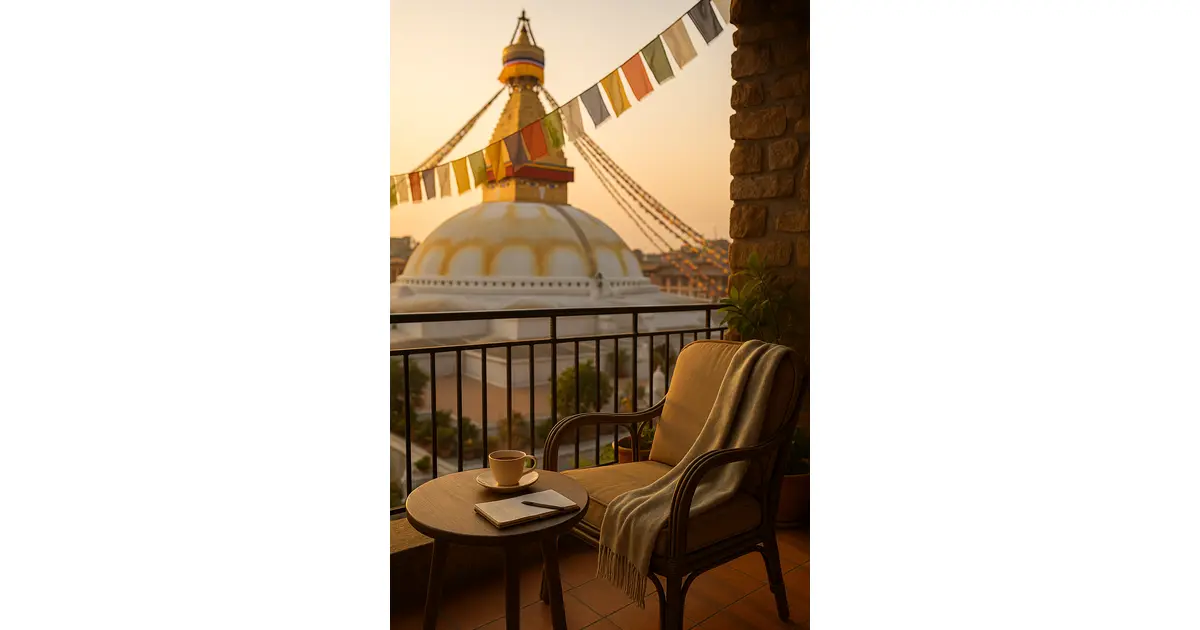
At Boudha Mandala Hotel, you can wake to the chants of monks, sip tea while gazing at the stupa, and feel surrounded by the same symbols that have guided seekers for centuries.

If you’re looking for a peaceful boutique hotel in Boudha, our space is designed to support your inner and outer journey.
What Buddhist Festivals Are Celebrated at Boudhanath?

If you’re planning to visit Boudhanath, don’t just come for the view, come for the feeling. The festivals celebrated here are not tourist spectacles; they are sacred, vibrant moments that reveal the beating heart of Tibetan Buddhist life in Nepal. Walk the kora during Losar and you’ll feel it: incense in the air, chants echoing from monastery walls, every step soaked in centuries of devotion.

This guide offers a clear, heartfelt path to experiencing the most important Buddhist festivals at Boudhanath and how you can witness them meaningfully.

Key Takeaways:

If you want to experience the living heart of Buddhist culture in Kathmandu, time your visit to Boudhanath during a local festival. From the vibrant colors of Losar to the quiet devotion of Gunla, each celebration offers a window into centuries-old traditions and the deep spirituality that surrounds the stupa. Come not just to watch, but to listen, learn, and feel the pulse of this sacred place.

The Magic of Boudhanath During Festival Season

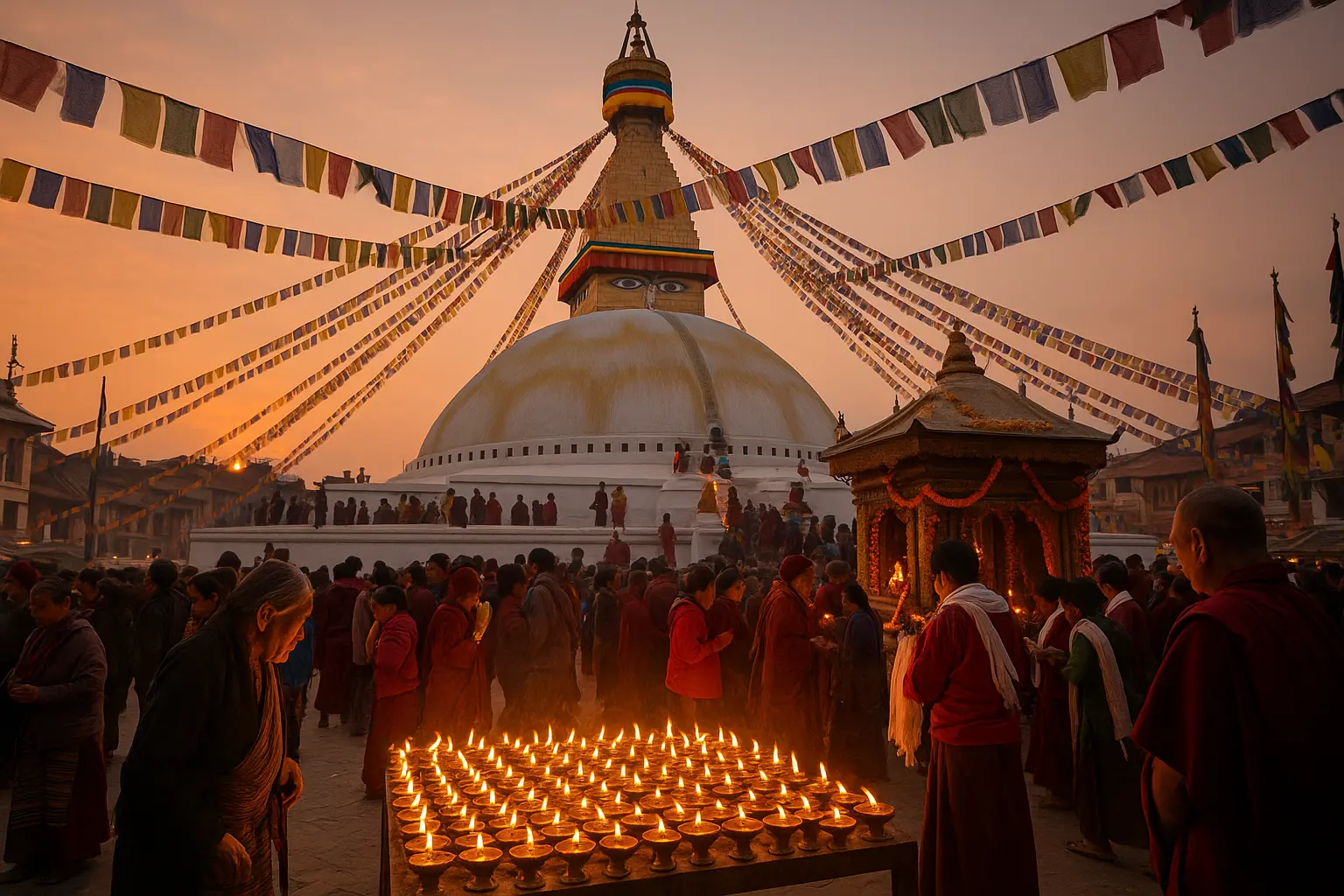
I still remember my first Losar at Boudhanath. The air smelled like juniper smoke. The stupa shimmered with rows of butter lamps, each flame flickering a silent prayer. Children darted between pilgrims. Monks chanted late into the night. It wasn’t just beautiful, it was deeply moving.
Festivals at Boudhanath aren’t tourist events. They’re living rituals that shape the rhythm of the community. They mark time, honor ancestors, call blessings, and bring people together. If you’re planning a visit to Boudha, aligning it with one of these festivals can turn your stay into something unforgettable.

1. Losar (Tibetan New Year)

  • When: Usually February or March, depending on the lunar calendar

– Why It Matters: Losar is the most important festival in Tibetan Buddhism. It marks the beginning of a new year, and with it, a deep spiritual reset.

During Losar, Boudhanath becomes a vibrant sea of color, movement, and sound. Monks perform traditional Cham dances in the monasteries. Families clean their homes and offer khatas (white scarves) at the stupa. Butter lamps are lit by the thousands, sending prayers into the coming year.

Local Tip: Arrive early on the main day to witness monks at Shechen Monastery perform the intricate Vajrakilaya rituals.

2. Buddha Jayanti (Buddha Purnima)

– When: Full moon of Baisakh (April–May)

– Why It Matters: This day celebrates the birth, enlightenment, and parinirvana (passing) of the Buddha, all in one.

At Boudhanath, thousands gather to offer prayers, chant sutras, and circumambulate the stupa in silence and reverence. It’s one of the most peaceful yet powerful days of the year.

I once watched a young boy offer a single marigold with both hands, eyes closed in sincerity. That tiny moment said more than any ceremony could.

3. Gunla (Sacred Month for Newar Buddhists)

– When: August–September

– Why It Matters: Gunla is a month-long devotional period where Newar Buddhists walk to Boudha from different parts of the valley, often at dawn, playing traditional Gunla Bajan music.

The atmosphere is rich with the sound of dhime drums and long flutes. Sacred art and scriptures are displayed publicly, and daily rituals intensify in monasteries.

Don’t Miss: The morning processions. They’re humble, musical, and deeply rooted in local devotion.

4. Mamla Jatra

– When: Full moon of Magh (January–February)

Why It Matters: Unique to the Boudha area, this jatra (festival) honors Mamo Pukasi, a protective deity. A chariot procession encircles the stupa, invoking her blessings.

You’ll see offerings made in every corner, rice, flowers, and torma (ritual cakes). There’s a quiet sense of protection woven through the day.

5. Chechyu Puja (Guru Rinpoche Day)

– When: 10th day of each lunar month; major celebration in January

– Why It Matters: This puja honors Padmasambhava (Guru Rinpoche), who brought Vajrayana Buddhism to Tibet. It’s especially important to the Nyingma school.

Monks chant long-form texts like the Seven-Line Prayer. Butter sculptures and torma are created. Laypeople offer kataks and seek blessings.
Reflection: During one Chechyu, I sat for hours just watching an elder repeat his mantra bead by bead. He wasn’t performing. He was communing.

6. Tamu Lhosar (Gurung New Year)

– When: December–January

– Why It Matters: Though not traditionally Tibetan, Tamu Lhosar is celebrated widely at Boudhanath by the Gurung community, who are also Buddhists.

Expect lively processions, traditional dress, and flag hoisting at the stupa. It’s a joyful, family-centered celebration.

How to Experience These Festivals Respectfully

If you’re visiting Boudhanath during any of these festivals, remember:
Dress modestly. Cover shoulders and legs.

– Don’t point your feet at monks, statues, or shrines.

– Always walk clockwise around the stupa.

– Ask before taking photos, especially during rituals.

– Consider lighting a butter lamp with a prayer or intention.

Locals will welcome your presence if you arrive with humility.

Final Thought

Boudhanath isn’t just a place; it’s a living mandala of community, devotion, and rhythm. When you witness its festivals, you’re stepping into an ancient story that’s still unfolding today.

And if you’re looking for a peaceful space just steps from the stupa, Boudha Mandala Hotel offers a warm, quiet retreat where you can experience these moments with intention and comfort.

Does Buddhism Believe in Karma? Teachings Explained

What Karma Really Means in Buddhism

In my early years of monastic life, I asked a senior teacher what karma was. He didn’t reach for scriptures. He didn’t even speak right away. He held up a cup of tea and simply said, “Everything that led to this moment, and what you choose next.”

In Buddhism, karma means volitional action. It’s not fate, not superstition, not reward or punishment from above. It is the natural echo of intention. What you plant in your speech, your thoughts, your hands, those seeds grow.

And here’s the nuance: karma is not only about the act. It’s about the intention behind it. Two people can give the same donation. One gives to impress, the other out of compassion. The outer action looks identical. But karmically, they are as different as storm and stillness.

Karma Isn’t About Blame. It’s About Possibility.

We often hear people say, “That’s my karma.” Usually with resignation, as if they’re stuck. But in the Buddha’s teaching, karma isn’t a prison. It’s an invitation. A chance to look closely at how our lives unfold, not because we’re being judged, but because we’re being shown something.

Think of karma as a kind and unrelenting teacher. If I speak with anger, I carry the heaviness of that anger in my body. If I lie, I fracture trust in the world around me. But if I respond with patience or generosity, peace becomes a little more available.

This is why mindfulness matters. Without seeing what we’re planting, how can we hope for a harvest of peace?

According to the Dhammapada:Key Takeaways

• Buddhism recognizes karma as intentional action, what we think, say, and do matters

• It’s not divine punishment, nor destiny. It’s a mirror, and a chance to wake up

• Karma influences not just rebirth, but how peace or suffering unfolds in each moment

• Buddhist practice invites us to see karma clearly, so we can live and respond with freedom

Our past shapes us, but never defines us. The future is shaped by how we meet this moment

“Mind is the forerunner of all actions. All deeds are led by mind. If one speaks or acts with an impure mind, suffering follows… If one speaks or acts with a pure mind, happiness follows.”
Source: Access to Insight

Does Karma Carry Into the Next Life?

Yes, in Buddhist cosmology, karma travels. It moves across lifetimes like wind shaping dunes. But it’s not a simple bookkeeping of good versus bad. It’s subtler.

At the time of death, the quality of mind we’ve nurtured matters deeply. Have we practiced letting go? Are we still clinging? That momentum carries forward, shaping where and how we’re reborn.
But, and this is essential, karma is not deterministic. A single moment of true insight can shift lifetimes of conditioning. The past is influential, yes. But never absolute.

According to the BBC, karma in Buddhism is both cause and condition, but the emphasis is always on responsibility, not guilt.

How Karma Differs From Other Views

Many religious traditions speak of karma, but Buddhism approaches it differently. There is no eternal soul (no atman), no divine scorekeeper. Karma in Buddhism flows through causal interdependence, the same principle that governs wind, decay, and sunrise.

Western interpretations often reduce karma to “you get what you deserve.” But the Dharma doesn’t moralize that way. It simply says: action has consequence. Craving creates suffering. Clarity opens peace.

And crucially, karma is not just about what happens to us. It’s about how we respond. Even if pain arises from past causes, our present response can transform that trajectory.

The Role of Karma in Liberation

Why does karma matter so deeply on the Buddhist path?
Because it helps us wake up to our patterns. The moment you realize that reacting with irritation only strengthens the roots of restlessness, you begin to soften. The first time you hold your tongue in compassion, a different path opens.

Through mindfulness, precepts, meditation, and especially wise intention, we begin to interrupt the cycles of suffering. Karma becomes less about avoiding pain, and more about planting conditions for awakening.

We are not bound by our past. We are bound by unawareness of our past. That’s what the Dharma helps undo.

Final Reflection

If you remember one thing from this, karma is not there to trap you. It’s there to reveal you, to reflect the causes we’ve set in motion, and the freedom we still have to choose differently.

At the heart of Buddhist hospitality is this: we greet each guest as a being with stories, causes, and possibilities. Just as we care for the outer space, we learn to care for the karmic space, the unseen atmosphere shaped by thought, speech, and deed.

You are not the sum of your past actions. You are the potential for a new one, right now.

A Space to Reflect on Karma

If you’re seeking a space in Kathmandu where the teachings aren’t just read, but lived, where the silence of the stupa echoes the stillness you’re cultivating, consider staying at Boudha Mandala Hotel.

If you’re searching for a peaceful hotel near Boudha, we welcome you with warmth, clarity, and the stillness to walk your path.

FAQs on Karma in Buddhism

Is karma the same as fate?

No. Karma is not fixed or final. It’s dynamic. We are always shaping it. Each mindful breath, each kind gesture, can shift old patterns.

Can karma be changed or purified?

Yes. Not through magic, but through sincere effort, ethical living, and awareness. Karma isn’t about punishment, it’s about patterns. And all patterns can be softened with clarity and love.

Is karma only about rebirth?

Not at all. While it influences rebirth, karma is also moment-to-moment. What you do now shapes your experience of now.

Can good karma cancel bad karma?

It’s not arithmetic. Karma isn’t a ledger. It’s a flow. Skillful actions shift the flow toward freedom, unskillful actions toward suffering. Both can exist simultaneously. But clarity changes everything.

Digital Nomad Visa for Nepal: A Comprehensive Guide

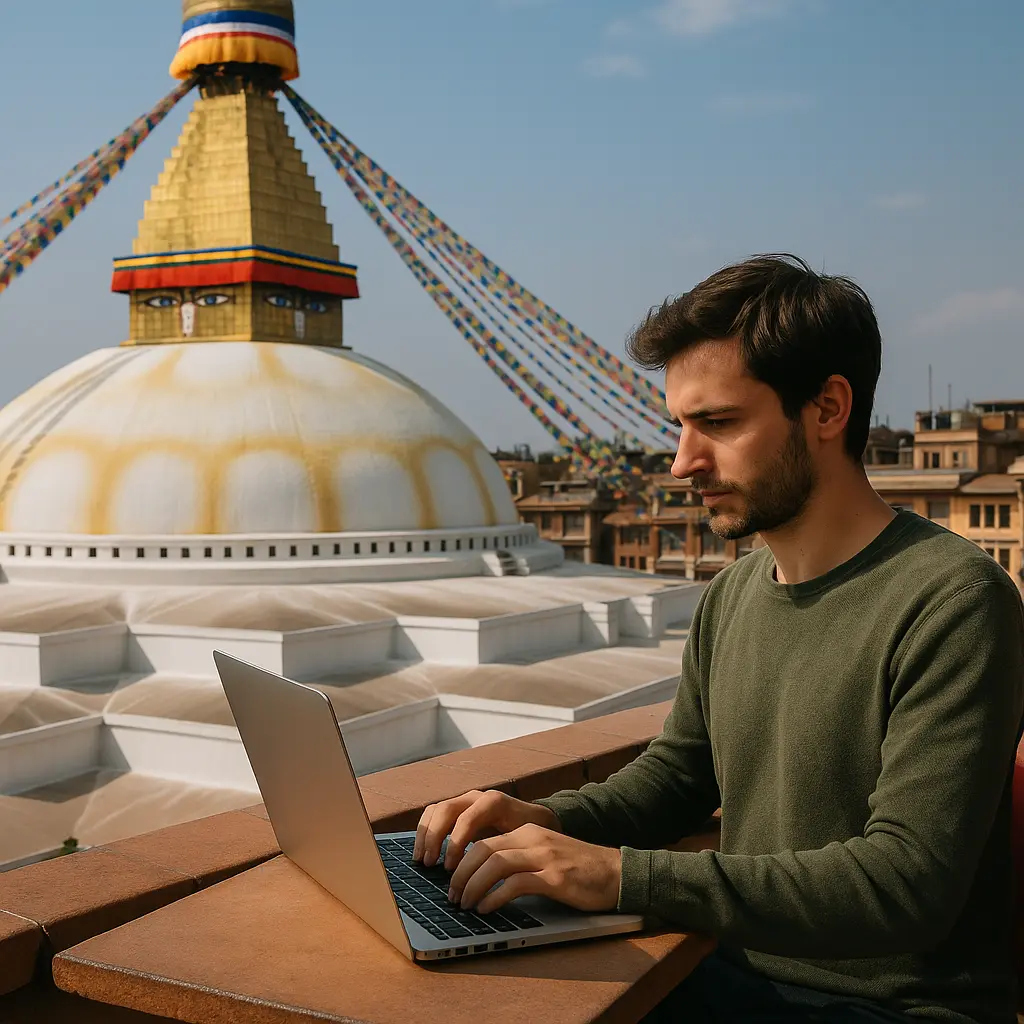
The first time I arrived in Boudha, I didn’t come looking for a remote work base. I came seeking stillness.

But like many digital nomads before me, I quickly realized something rare: Nepal, and especially Boudhanath, wasn’t just a place to visit. It was a place where you could build a rhythm. Where mornings began with the hum of mantras instead of notifications. Where your workspace was a rooftop with stupa views. And where slow, meaningful living wasn’t a trend, it was the air itself.

If you’ve felt the call to live more intentionally, while still keeping your remote job or creative work flowing, here’s what you need to know about staying in Nepal as a digital nomad.

Does Nepal offer a Digital Nomad Visa?

Not officially. There is no dedicated “digital nomad visa” in Nepal as of 2025. But that doesn’t mean you can’t stay, work remotely, or immerse yourself in daily life here.

Thousands of writers, designers, developers, spiritual seekers, and remote creatives live in Nepal legally, usually by using a tourist visa, extending it strategically, or affiliating with a local organization.

You just need to understand the options and more importantly, move through them mindfully.

The Tourist Visa: Your Gateway In

For most digital nomads, the tourist visa is the most flexible and accessible entry point.

You can get it on arrival at Tribhuvan International Airport in Kathmandu. Choose from 15, 30, or 90 days, and once you’re here, you can extend your stay up to 150 days per calendar year.

It’s not complicated. But it’s important to remember: this visa is meant for tourism. That means while working remotely for international clients is generally tolerated, you should avoid working for Nepali businesses unless you’re on a different visa type.

Still, if you’re freelancing, consulting, or running your business online, the tourist visa is the path most take. Just make sure your passport has six months of validity left, and carry some passport photos. The immigration office in Kalikasthan handles extensions smoothly, though expect a bit of paperwork and waiting.

What About Long-Term Stay?

If you’re thinking about staying beyond 150 days or returning year after year, you might explore other paths.

Some spiritual travelers affiliate with monasteries or NGOs and apply for non-tourist visas. Others set up consulting arrangements through business visas. These require more effort, local contacts, and paperwork, but they’re viable for those truly committed to making Nepal a long-term spiritual and creative home.

Still, for most nomads, especially those here for a few months of retreat, writing, building, or healing, the 150-day window offers enough time to settle into a beautiful rhythm without overcomplicating things.

Why Boudha is the Perfect Base for Remote Workers
The stupa doesn’t ask questions. It just holds space.
That’s what makes Boudhanath so magnetic to remote workers and mindful nomads. You’re just minutes from strong Wi-Fi cafés and coworking-friendly rooftops, but the atmosphere remains one of silence and reverence.

You’ll see it in small ways:
• Monks walking slowly in early light
• The soft tap of butter lamps being lit before dusk
• Local artists sketching the stupa from a shaded bench
• Freelancers writing books or building apps with incense rising beside their laptop

There’s no rush here. And for digital nomads, that’s a gift.

If you’re used to the hustle of Bali or Lisbon, Boudha feels like a quiet invitation: to work deeply and live fully present.

The Practical Side: Wi-Fi, Cafes, and Coworking

Don’t let the spiritual vibe fool you, Boudha is tech-ready in its own way.

Several rooftop cafés offer strong Wi-Fi and calm, quiet corners. Popular among remote workers are:

• Stupa View Café (great light, power outlets, herbal teas)
• Utpala Garden (vegetarian food, open courtyard, gentle energy)
• La Casita de Boudhanath (Spanish-Nepali fusion and peaceful vibe)

Most nomads simply rotate between these spots, working in the morning, walking kora at lunch, then settling into focus mode again after a pot of masala chai.

You’ll also find affordable SIM cards with 4G data (Ncell or Namaste), and if you stay long enough, it’s easy to get portable routers for backup.

Where to Stay: The Value of Proximity

Living close to the stupa changes everything. You’re not commuting to calm , you’re inside it.

At Boudha Mandala Hotel, you’re just ten seconds from the gate. That means:

• You can join the early morning kora before work
• Hear the evening chants from your room window
• Step into stillness whenever your mind needs a reset

The hotel offers long-stay rooms, strong Wi-Fi, a peaceful breakfast café, and a deeply respectful local team who understands the needs of spiritual travelers and remote workers.

If you’re planning to stay weeks or months, having a space that feels safe, sacred, and work-friendly makes all the difference.

Final Thoughts

Nepal may not yet have a flashy “digital nomad visa,” but it has something far more lasting: space to breathe.

Boudha doesn’t promise productivity hacks. It offers presence. And sometimes, that’s exactly what your work and your life need most.

So if you’re thinking of setting up your next creative season, sabbatical, or soul-led remote work chapter in Nepal, know this:
The visas are possible. The internet works. The community is here.
But more than anything? The stupa is waiting.

If you’re looking for a peaceful, long-stay-friendly hotel just steps from the stupa, Boudha Mandala offers stupa-view rooms, reliable Wi-Fi, and a warm, spiritually supportive welcome.

Difference Between Hotel and Motel: What Fits Your Journey?

If you’re planning a trip to a meaningful place like Boudhanath in Kathmandu or anywhere that requires reflection, safety, and comfort, you’ve likely searched:

What’s the difference between a hotel and a motel?

Here’s the short answer:

Hotels are built for longer, more intentional stays. They offer indoor-access rooms, guest services like daily housekeeping, dining, and reception support.

Motels are designed for short-term convenience. They typically have rooms that open directly to the parking lot, offer minimal service, and suit travelers passing through.

But if you’re planning a retreat, working remotely, or exploring spiritual spaces like Boudhanath
Stupa, there’s more to consider. The place you stay will shape your experience.

What is a Hotel?

A hotel is a guest lodging facility that offers more than just a bed. You’ll usually find hotels in cities, near airports, and around cultural landmarks—like Boudhanath.
Hotels often include:

– Reception/front desk support

– Indoor rooms with elevators or hallways

– Housekeeping and private bathrooms

– On-site cafés or restaurants

– Extra services like Wi-Fi, airport pickup, or laundry

Whether you’re staying a few days or a few weeks, hotels are designed to help you settle in especially when you need peace, quiet, and support.

What is a Motel?

A motel (short for “motor hotel”) is designed for travelers on the move. Originally built for road-trippers, motels prioritize function over experience.
Typical motel features:

– Rooms with doors that open directly outside.

– Located near highways or outskirts.

– Minimal services, no dining, reception, or extras.

– Lower cost, but also lower comfort.

– Good for short stays, not extended trips.

Motels are meant for sleep and go. They’re not designed to support meaningful travel.

When to Choose a Hotel

If your trip is about more than just passing through—a retreat, a quiet work week, or a spiritual experience, a hotel will offer what you need.

Choose a hotel when:

– You want peace, safety, and structure

– You’re working remotely and need good Wi-Fi

– You’re traveling solo and prefer helpful staff

– You want to stay close to culture or sacred spaces

– You plan to stay more than one or two nights

Example:
Imagine arriving in Boudhanath after a long flight. You’re not here for nightlife or fast sightseeing. You want to wake up to the sound of morning chants, sip tea overlooking the stupa, and write or meditate in silence. A hotel helps make that possible.

When a Motel Might Work

Motels serve a different kind of traveler.

Choose a motel when:

– You’re on a road trip and just need a place to sleep

– You want to park right outside your door

– You’re on a tight budget and don’t need services

– Your stay is short and unplanned

Motels meet basic needs, but they’re not designed for presence, peace, or cultural immersion.

Why This Matters at Boudhanath

Boudhanath is one of the most sacred Buddhist sites in the world. The energy here is different, calmer, more intentional.

Choosing where you stay affects how you experience this space. That’s where Boudha Mandala Hotel stands out.

Why Boudha Mandala Hotel Is Built for This Kind of Travel

Just 10 seconds from the stupa, Boudha Mandala Hotel offers exactly what you are looking for.

What makes it the right fit:

– Stupa-view rooms with balconies – wake up to chanting and incense, not traffic.

– Long-stay apartments with kitchens- perfect for working remotely or taking a spiritual sabbatical.

– Organic breakfast café – with healthy, local and Western options.

– Multilingual staff- trained to understand the needs of solo travelers and pilgrims.

– Quiet setting- away from the noise of Thamel, yet walkable to everything you need.

– Extra touches- free Wi-Fi, laundry, airport shuttle, and thoughtful, local hospitality.

Whether you’re here to work, rest, or reconnect with yourself, Boudha Mandala doesn’t just give you a room. It gives you space to belong.

Final Takeaways

– Hotels are built for presence, care, and longer stays.

– Motels are built for movement, convenience, and overnight rest.

– If you’re traveling with intention to retreat, reflect, or create a hotel gives you the peace and structure to do that well.

And if you’re heading to Boudhanath Stupa, Boudha Mandala Hotel offers the kind of stay that meets you where you are with simplicity, peace, and purpose.

What is the Cost of Living in Kathmandu for Digital Nomads?

Introduction

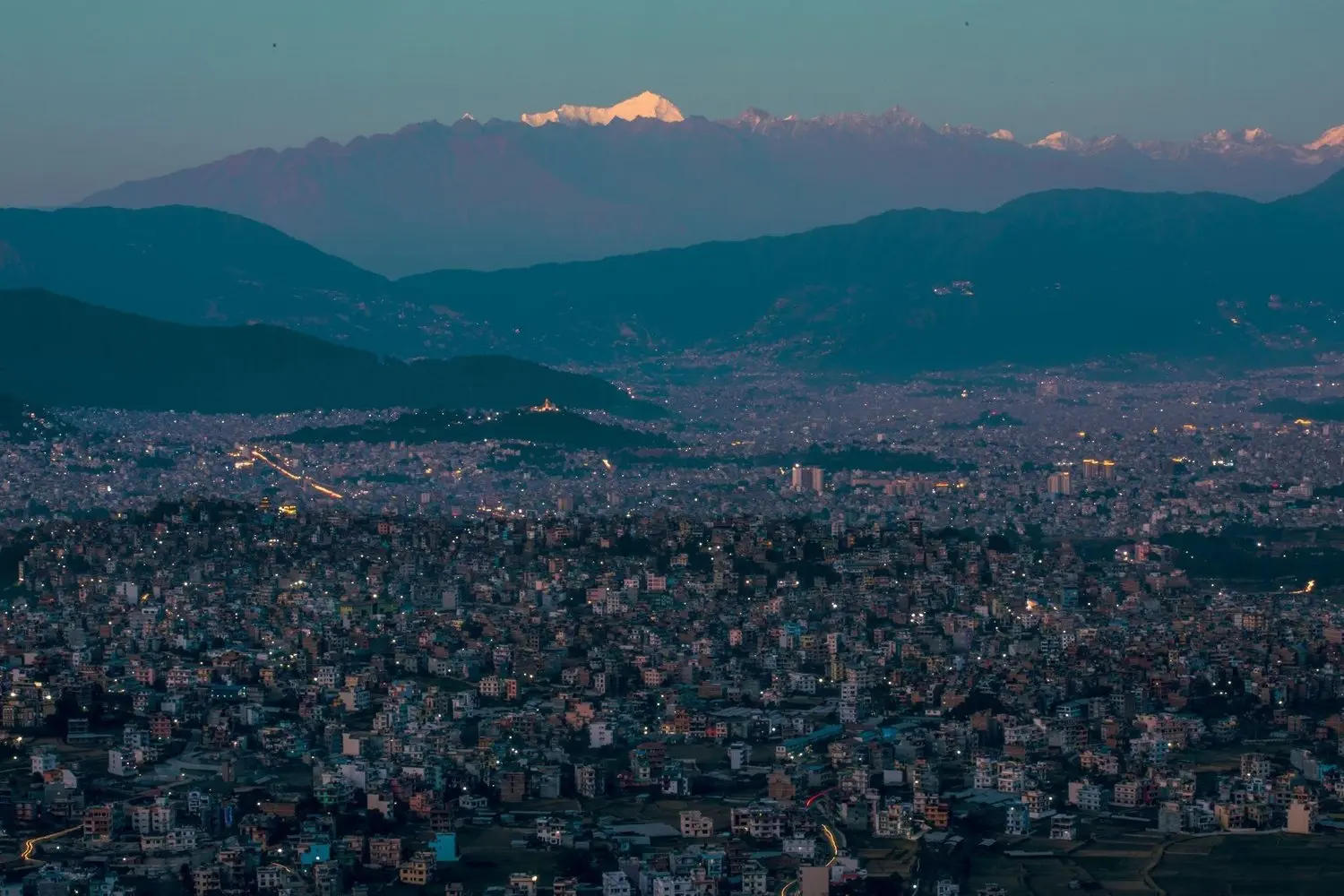
Kathmandu isn’t just affordable, it’s soulful. Nestled in the Kathmandu Valley and layered in centuries of Buddhist and Hindu history, it offers something rare: a city where ancient rituals blend with modern cafes, and where quiet rooftop mornings can cost less than your daily coffee back home.

But cost is only part of the story. The real value lies in how much you can slow down here, how easily you can find presence. Whether you’re a digital nomad on a sabbatical, a remote worker seeking calm, or a creative soul looking for somewhere sacred to write, Kathmandu, and particularly Boudha, can be your base.

Here’s what life actually costs when you choose to live slowly and meaningfully in Nepal’s capital.

Rent: What You’ll Pay to Stay

If you stay in Boudha, the peaceful, stupa-centered neighborhood favored by monks, writers, and long-stay travelers, prices are surprisingly reasonable.

For a fully furnished apartment in Boudha with reliable Wi-Fi, you can expect to pay:

• $250–400/month for a studio or one-bedroom
• $500–700/month for two bedrooms with more modern amenities

Utilities usually run around $30–50/month, and many places include them in the rent. The key here is knowing your needs. If you’re okay with simpler Nepali-style kitchens and a fan instead of AC, you’ll find long-term living both affordable and fulfilling.

Boudha Mandala Hotel also offers long-stay options with the bonus of housekeeping, security, and a stupa-view cafe, perfect for those easing into Kathmandu without the stress of setting up everything from scratch.

Food: Local Meals, Organic Cafes, and Cooking at Home

Kathmandu’s food scene ranges from momos at roadside stalls to wood-fired pizza and organic quinoa salads. In Boudha, you’ll find everything: Tibetan thalis, Ayurvedic meals, and Western breakfasts served with Himalayan honey.

• eating at local restaurants: $1.50–$4 per meal
• Western cafes or expat-friendly spots: $5–$10 per meal
• Monthly groceries (if cooking yourself): around $120–180, depending on your diet

Places like La Casita, Roadhouse Cafe, and Utpala offer calm spaces where you can eat, work, or journal for hours. The cost feels secondary to the peace they provide.

Internet and Coworking: Staying Connected

Kathmandu’s internet has improved drastically. In Boudha, you’ll find strong, consistent Wi-Fi in most apartments, cafes, and hotels.

• Monthly home internet (for long stays): $15–25

• SIM card with data (Ncell or NTC): $2 for the card, $8–10/month for data

• Coworking spaces (Thamel or Lazimpat): $50–150/month, depending on location and services

Most digital nomads working from Boudha skip coworking spaces and just rotate between calm cafes with reliable Wi-Fi. You’ll rarely feel the need for a formal desk unless your work is highly collaborative or call-heavy.

Transport: Getting Around the Valley

Boudha is walkable. That’s one of the biggest gifts of living there. The stupa is at the center, and everything else, shops, monasteries, cafes, orbits around it.

• Local taxi ride: $2–4 around the area, $6–10 to downtown
• Public bus: Under $0.50, but crowded and not for everyone
• Scooter rental: $60–90/month
• Ride-sharing apps (Pathao or InDrive): growing in popularity, fair rates

If you stay near the stupa, you’ll barely need transport. The slower you live, the less you move.

Daily Life: What Adds Up and What Doesn’t

What surprises most nomads in Kathmandu isn’t how cheap things are, but how much they don’t feel the need to spend.

• Yoga or meditation classes: $5–10/session
• Weekend trips to Nagarkot or Bhaktapur: $10–20, including transport and meals
• Laundry services: $4–6 per load
• SIM top-ups, light shopping, coffee breaks, they rarely dent your wallet

Boudha life isn’t consumption-heavy. There’s little push to buy, no flashing ads, no malls calling your name. You pay for stillness, for tea and time, for space to think and breathe.

Why Boudha is the Ideal Base
Cost is only half the story. Boudha offers something few places do , a quiet spiritual rhythm. It’s not just affordable, it’s nourishing.

• You wake to monastery bells, not traffic
• You work surrounded by monks and prayer flags
• You sleep with a sense of safety and sacredness

At Boudha Mandala Hotel, just 10 seconds from the stupa, you’ll find a space designed for presence. Whether you’re working remotely, taking a sabbatical, or writing your next book, the environment supports your rhythm.

Final Reflection
Kathmandu can be chaotic. But Boudha holds a calm within it. For digital nomads, that balance between affordability and serenity is rare.

If you’re seeking a place where time stretches, where costs are low but value runs deep, then this little corner of Kathmandu might be what you’ve been looking for.

And if you need a place to arrive and settle in, Boudha Mandala Hotel offers more than a room; it offers you a rhythm to come home to.

A Traveler’s Look at the Role of Gods, Chariots, and Processions in Kathmandu

Kathmandu comes alive through its gods, chariots, and processions. These events move through the streets the way seasons move through a valley. They show how deeply faith sits in everyday life here. If you’re visiting the city for the first time, watching a procession roll past you can feel both surprising and exciting. You hear drums, see ropes pulling a tall wooden structure, and notice how everyone around you pays attention in a way that feels old and personal. This guide helps you understand what you’re seeing without getting lost in details.

What role do gods play in Kathmandu’s major festivals?

Gods play a central role in Kathmandu’s major festivals because each celebration focuses on bringing a deity into the streets to bless the community.

Instead of staying inside temples, the gods come out so people can see them, offer food, and ask for protection.

How gods appear in festivals

• Placed in chariots
• Carried in palanquins
• Seated inside small shrines
• Dressed with flowers and fresh cloth
• Surrounded by music, drums, and dancers

These moments show the connection between homes, temples, and everyday life.

Why are chariots important in Kathmandu’s celebrations?

Chariots are important in Kathmandu’s celebrations because they carry the gods through neighborhoods and let entire communities join in the festival.

The chariots don’t move smoothly. They sway, roll, pause, and sometimes get stuck on narrow turns. That unpredictable movement is part of the excitement.

What chariots represent

• Movement of the gods
• Protection for the community
• Connection between people and deities
• Shared responsibility to pull together
• A tradition kept alive for centuries

When a chariot turns a corner, the energy shifts in the whole street.

How do processions work during these festivals?

Processions work by guiding the god’s chariot or shrine from one important point to another with drums, horns, and crowds leading the way.

These walks can be long or short. Some take a few hours. Some stretch across many days.

Common elements in processions

• Drummers setting the rhythm
• Elders leading the route
• Families lining the streets
• Children running alongside
• Offerings placed on the path

A procession feels like a moving piece of living history.

Which festivals in Kathmandu include large chariots and gods on the move?

Festivals in Kathmandu that include large chariots and gods on the move include Indra Jatra, Rato Machhindranath Jatra, Seto Machhindranath Jatra, and Bisket Jatra.

These are the events travelers often hear about because the chariots are tall, heavy, and full of meaning.

Major chariot festivals

• Indra Jatra in Kathmandu Durbar Square
• Rato Machhindranath Jatra between Patan and Bungamati
• Seto Machhindranath Jatra in central Kathmandu
• Bisket Jatra in Bhaktapur

Each one has its own personality and rhythm.

What makes Indra Jatra special for travelers?

Indra Jatra feels special for travelers because it mixes dance, chariots, masks, and powerful street energy in the center of Kathmandu.

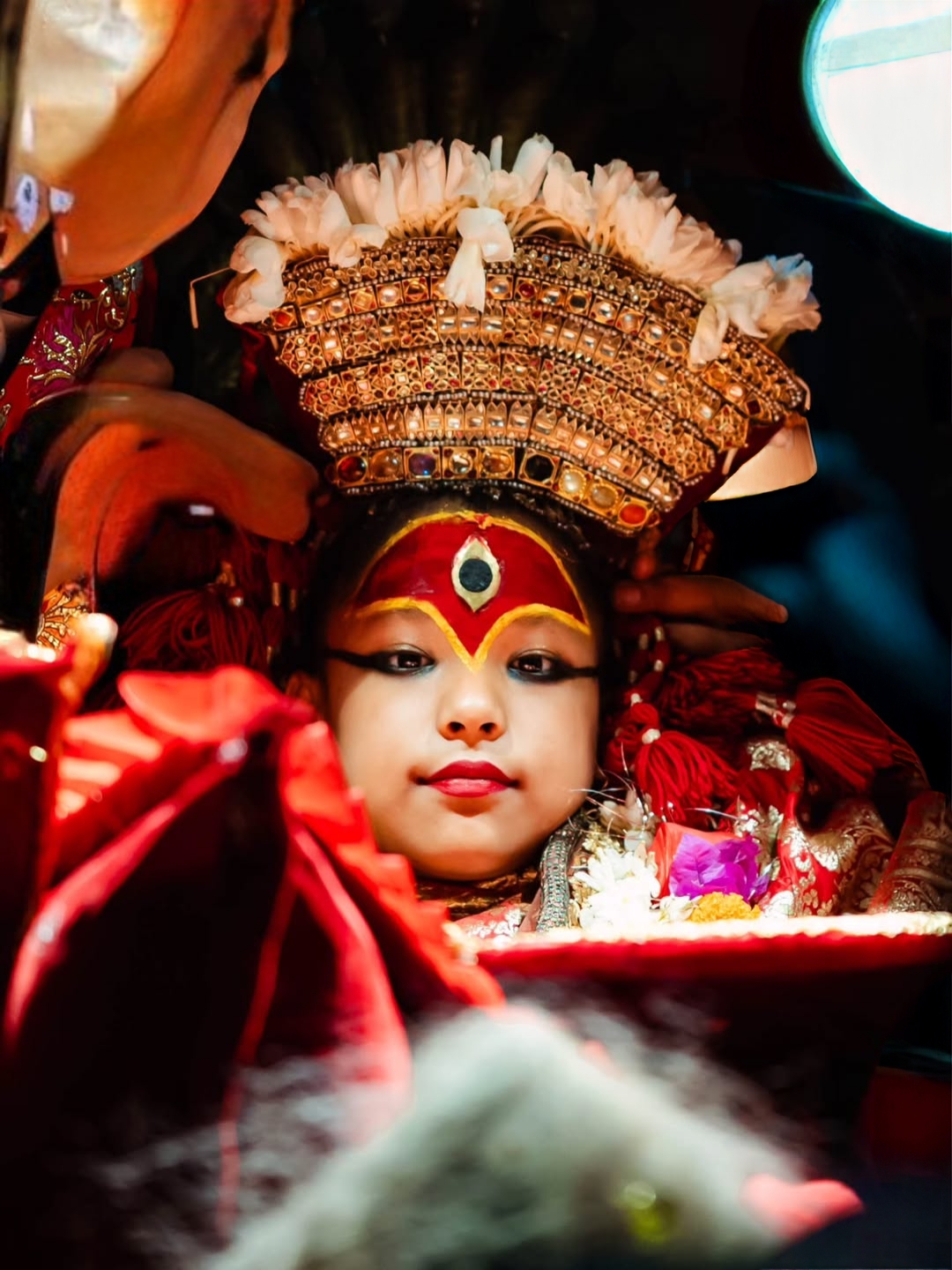
You see the Kumari chariot, the Bhairab mask, and processions that stretch across the square.

What you’ll notice

• The living goddess Kumari in her chariot
• Masked dancers moving through the crowd
• Tall ceremonial poles
• Drums echoing through Durbar Square
• Thousands of people watching together

Indra Jatra is one of the valley’s most exciting moments.

What makes Rato Machhindranath Jatra different from other chariot festivals?

Rato Machhindranath Jatra is different because it has one of the longest and slowest chariot journeys in Nepal.

The chariot moves between Patan and Bungamati over many weeks. The pace is slow, and the movement feels emotional for many locals.

Unique parts of this jatra

• A towering wooden chariot
• A long route that crosses neighborhoods
• People pulling ropes for hours
• Crowds blessing the path
• A deep sense of community

This jatra shows patience, strength, and devotion.

Why do Newar communities lead most of these traditions?

Newar communities lead most of these traditions because they have preserved the valley’s oldest cultural and religious practices.

Their festivals blend Hindu and Buddhist elements, family rituals, and community responsibilities.

How Newar culture shapes these festivals

• Strong ties between families and temples
• Skilled artisans building chariots
• Priests performing ancient rituals
• Drummers trained from childhood
• Communities working together

Without these traditions, the valley would feel very different.

How can travelers watch these festivals respectfully?

Travelers can watch these festivals respectfully by staying to the side, avoiding blocking the chariot path, and observing how locals behave.

You don’t need to push forward to see everything. The best views often come from calm spots slightly away from the crowd.

Simple respectful habits

• Stand back when ropes tighten
• Let elders pass first
• Avoid touching the chariot
• Keep a soft tone
• Follow the flow of the crowd

These festivals carry deep meaning, and small gestures matter.

How do these festivals show Kathmandu’s connection across the valley?

These festivals show Kathmandu’s connection across the valley through routes that link Kathmandu, Patan, and Bhaktapur.

Some celebrations travel through multiple cities. Others stay local but follow traditions shared across Newar communities.

Connections you’ll see

• Shared deities
• Shared music styles
• Shared artisan skills
• Shared rituals
• Shared community responsibilities

These links form the cultural foundation of the valley.

Why do these events feel emotional for locals?

These events feel emotional for locals because the deities represent protection, continuity, and identity.

Seeing a god move through the streets feels like part of life rather than a performance.

What creates the emotion

• Childhood memories
• Family involvement
• Community pride
• Blessings for the year
• The feeling of being together

Travelers can sense this energy even without knowing the full history.

Why is Boudha Mandala Hotel a comfortable base for exploring these festivals?

Boudha Mandala Hotel is a comfortable base for exploring these festivals because it sits in a calm neighborhood with easy access to all three cities.

You can visit Indra Jatra in Kathmandu, head to Patan for Machhindranath, or reach Bhaktapur for Bisket Jatra, then return to a peaceful place afterward.

Why the location works well

Quick taxi access
• Quiet evenings
• Easy morning starts
• Close to calm walking routes
• A relaxing space after busy festival days

The balance between cultural energy and rest makes your festival experience smoother and more enjoyable.

Buddhist Meditation Techniques You Should Know

If you’ve ever searched for a meditation retreat in Kathmandu, you’ve likely felt that pull, the need to step away from noise and move toward something quieter and more grounded.

That’s why so many end up in Boudha.

Boudha feels like a different rhythm. Mornings begin with the low hum of chants and the soft turning of prayer wheels. So, what do you actually learn on a meditation retreat in Boudha?

Let’s take a closer look at the Buddhist meditation techniques from foundational breath practices to compassion-based methods rooted in Tibetan Buddhism.

Key Takeaways

The most common Buddhist meditation techniques techniques taught at Boudha retreats include:

– Shamatha (Calm-Abiding Meditation): A foundational breath-based practice to develop focus and mental stillness.

– Vipassana (Insight Meditation): Teaches you to observe sensations, thoughts, and impermanence with clarity and presence.

– Tonglen & Loving-Kindness (Metta): Compassion-based techniques that help open the heart and reduce self-centered thinking.

– Walking Meditation Around the Stupa: A unique local ritual of mindful walking and mantra recitation around Boudhanath Stupa.

– Mantra & Chanting Meditation: Sound-based practices using Tibetan mantras to calm the mind and connect with intention.

Why Boudhanath Feels Different

The stupa here has stood for centuries. It’s one of the most important sites in Tibetan Buddhism not just in Nepal, but in the world.
Around it, over fifty monasteries form a living circle of practice. You’ll hear chants, see butter lamps flickering at dusk, and feel something hard to describe.
Unlike Thamel or other tourist-heavy areas, Boudha moves slowly. It gives you permission to do the same.

Buddhist Meditation Techniques Taught in Boudha Retreats

Most retreats in this area are grounded in Buddhist tradition, especially Tibetan lineages. Whether you’re joining a group or practicing on your own, these are the buddhist mediation techniques you’re likely to learn.

Shamatha (Calm-Abiding Meditation)

This is the foundation. You focus on the breath, or sometimes a visual object. When your mind wanders which it will, you gently return.

That’s it. No pressure.

Shamatha trains attention and steadies the nervous system. You begin to notice space between thoughts. Many meditation retreats in Kathmandu use this as a base for deeper practices.

Vipassana (Insight Meditation)

Vipassana helps you see clearly. It’s not dramatic. You sit, observe sensations, and notice how everything changes, breath, sound, mood, thought.

This technique can be taught in both silent retreats and more interactive sessions. In Boudha, you’ll often find a Tibetan approach that includes guided reflection and time for questions.

It’s not about analyzing your life. It’s about learning to be with it, as it is.

Tonglen and Loving-Kindness (Metta)

These practices shift the focus from clarity to compassion.

In Tonglen, you breathe in discomfort or pain your own, or the world’s and breathe out relief, warmth, kindness.

Metta practice involves sending goodwill to others. You might begin with someone you love, then extend it to someone neutral, and eventually, even someone difficult.

Both techniques are common in retreats around Boudha, especially those led by Tibetan teachers. They balance awareness with heart.

Walking Meditation Around the Stupa

This isn’t always listed in retreat brochures, but it’s one of the most powerful practices here.

Each morning and evening, people walk slowly around Boudhanath Stupa. Some spin prayer wheels. Some count mala beads. Others just walk quietly, steady and present.

It’s informal but deeply meditative. You’re welcome to join anytime. No one will stare. No one will stop you.
You just walk.

Mantra and Sound Practices

Chanting is part of daily life in Boudha. Retreats often begin or end sessions with mantras, Om Mani Padme Hum is the most common.

You don’t need to sing well or believe in anything specific. You just let the rhythm carry your focus.

Some retreats include explanations. Others let the practice speak for itself. Both work.

Who Teaches These Practices?

Teachers in Boudha come from different traditions. Some are Tibetan lamas who’ve trained since childhood.

Others are Nepali monks, Western practitioners, or nuns fluent in English.

Most retreats are beginner-friendly. No robes, no dogma. Just real people sharing what they’ve learned, often with great care and humility.

You’ll find both structured retreats and informal drop-in sessions. The common thread is kindness and clarity.

What a Retreat Day Feels Like

Here’s a simple flow many Boudha retreats follow:

– Early morning meditation

– Silent breakfast

– Teaching or group practice

– Breaks for journaling or rest

– Afternoon session (chanting, compassion practice, walking meditation)

– Light dinner and evening reflection

Some retreats are silent. Others allow for questions and conversation. Most are gentle, respectful, and allow space for your own rhythm.

Where to Stay If You’re Practicing Near Boudha

Not everyone comes for a formal retreat. Some arrive needing quiet, and create their own rhythm.

Boudha Mandala Hotel is the one of the best hotels in Boudha that feels like a retreat.

It’s about 10 seconds from the stupa gates, but far enough from the crowds to stay peaceful. Here’s what it offers:

– Stupa-view rooms with small balconies

– Long-stay apartments with kitchens

– An organic café for quiet breakfasts

– Staff who understand retreat culture and respect your space

If you’re attending a meditation retreat in Kathmandu, or looking to do your own in a gentle way, this is a solid base.

What You’ll Actually Learn

The techniques matter. The teachers matter. But what you’ll really learn in Boudha is how to slow down.

How to listen. How to sit with yourself without fixing anything. How to walk a little more lightly in the world.

If that’s what you’re looking for, you don’t need to have it all figured out. Just come. Stay a few days. Let the place do its work.

Sometimes, the simplest practice is the most honest one.

Buddhist Meditation: Returning to the Stillness Within

TL;DR
• Buddhist meditation is a way of seeing, not escaping

• It begins with the breath, but leads to compassion, clarity, and liberation

• Practices like Vipassanā, Samatha, and Metta reveal the truth of impermanence and the nature of self

• You don’t need robes or rituals to begin, just sincerity and presence

• Meditation is the heart of Buddhism, because it shows us how to suffer less, and love more

A Practice Older Than the Dust on Pilgrim Paths

To understand Buddhist meditation, you have to begin not with technique, but with the reason.

Why do we sit? Why do monks rise before dawn, why do pilgrims walk in circles around stupas, beads in hand, breath quiet?

Not to chase peace. Not to block out the world. But to remember something we forget, again and again.

That the mind is not the enemy. That silence is not empty. That in stillness, we can hear what’s true.

The Buddha, after years of extremes, sat beneath the Bodhi tree with no expectation. Just breath, body, and unwavering attention. What he saw there wasn’t supernatural, it was ordinary, seen clearly. That everything changes, that clinging brings suffering, and that freedom is possible.

Three Paths, One Heart

Though the lineages vary across countries and centuries, the essence of Buddhist meditation rests on three pillars. These are not categories to master, but companions that unfold together, like breath, body, and sky.

Vipassanā, Seeing Things As They Are

In the Theravāda tradition, this is often the first formal training. Vipassanā, or insight meditation, invites you to observe the body, thoughts, and emotions without decorating them, without editing.

What happens when you simply watch the breath, or a rising feeling, without judgment?

You start to notice: this moment is moving. Sensations rise, pass. Thought loops dissolve when you don’t feed them. Self becomes more like a story than a solid fact.

The insight doesn’t come from believing. It comes from looking.

“Just as footprints follow the ox that pulls the cart, so too does suffering follow the untrained mind,” said the Buddha.
This practice is the training.

For foundational texts on this, explore Access to Insight’s guide to Vipassana.

Samatha , Calming the Waters

Before the mind can see clearly, it often needs to settle. That’s where Samatha, or calm-abiding meditation, comes in.

Focus on the breath, not to force it, but to soften the mind’s grip on distraction. Over time, the mental static quiets. You begin to rest, not in sleep, but in awareness.

This isn’t sedation. It’s alert stillness. The kind that monks describe as “resting like a bird on a branch”, light, unshaken.

Samatha is not the goal, but it’s the ground from which insight blooms.

Metta , A Soft Heart in a Harsh World

In this practice, we turn toward the heart. Metta, or loving-kindness meditation, begins with a simple wish: May I be well. May I be safe. May I live with ease.

Then it expands: to a loved one, to a stranger, to someone who hurt you, and finally, to all beings.

It may feel mechanical at first. But something shifts. You begin to meet your own wounds with gentleness. You begin to see others, not as threats, but as fellow travelers.

Learn more about this heart-centered practice through Lion’s Roar’s explanation of Metta.

Meditation Is Not Perfection. It’s Presence.

In Boudhanath, I’ve seen travelers from every corner of the world try to sit. Some try to stop their thoughts. Others try to float in bliss. But true practice begins when we drop the trying.
Meditation is not a performance. It’s not about achieving anything.

It’s a way of being honest, with the breath, with the ache in the knees, with the mess of the mind. And in that honesty, something opens. A tenderness. A truth. A peace that doesn’t depend on things going right.

Where to Begin (Even If You’re Not in a Monastery)

You don’t need a mountain hut to meditate. You don’t need to chant in Pali or light incense.

Start with what you have:
• A quiet space

• A posture that’s steady, not stiff

• A few minutes of watching the breath, just rising, falling

• When the mind wanders (and it will), gently return

In Boudha, Meditation Is in the Air

I’ve lived near the stupa for years. Here, meditation isn’t separate from life. You feel it in the rhythm of prayer wheels, the murmur of monks before dawn, the scent of incense mixing with the morning fog.

It’s a place where silence speaks.

At Boudha Mandala Hotel, guests often come for quiet, but they find something deeper: presence. We are not a monastery, but we offer stillness. A room with light. A balcony that sees the stupa. A place to breathe, reflect, and begin again.

If you’re looking for a peaceful hotel near Boudha, not just to stay, but to reconnect, you’ll be welcome here.

FAQs on Buddhist Meditation

Q1: Do I need to become a Buddhist to meditate this way?

No. The practice is open to anyone with sincerity. You don’t have to believe in anything, just be willing to look.

Q2: What if I can’t sit still or feel restless?

That’s normal. Restlessness is part of the path. The practice is not about stopping it, but seeing it clearly and gently staying.

Q3: Can I walk or move during meditation?

Yes. Walking meditation is common, especially in monasteries. In Boudha, you’ll often see pilgrims circumambulating the stupa mindfully.

Q4: How do I know if I’m doing it right?

If you’re being honest, kind, and returning when you wander, you’re practicing. There’s no perfect form, only sincere presence.

Q5: How long before I feel peaceful?

Sometimes moments. Sometimes months. The goal is not to feel peaceful, but to see clearly. Peace follows naturally.

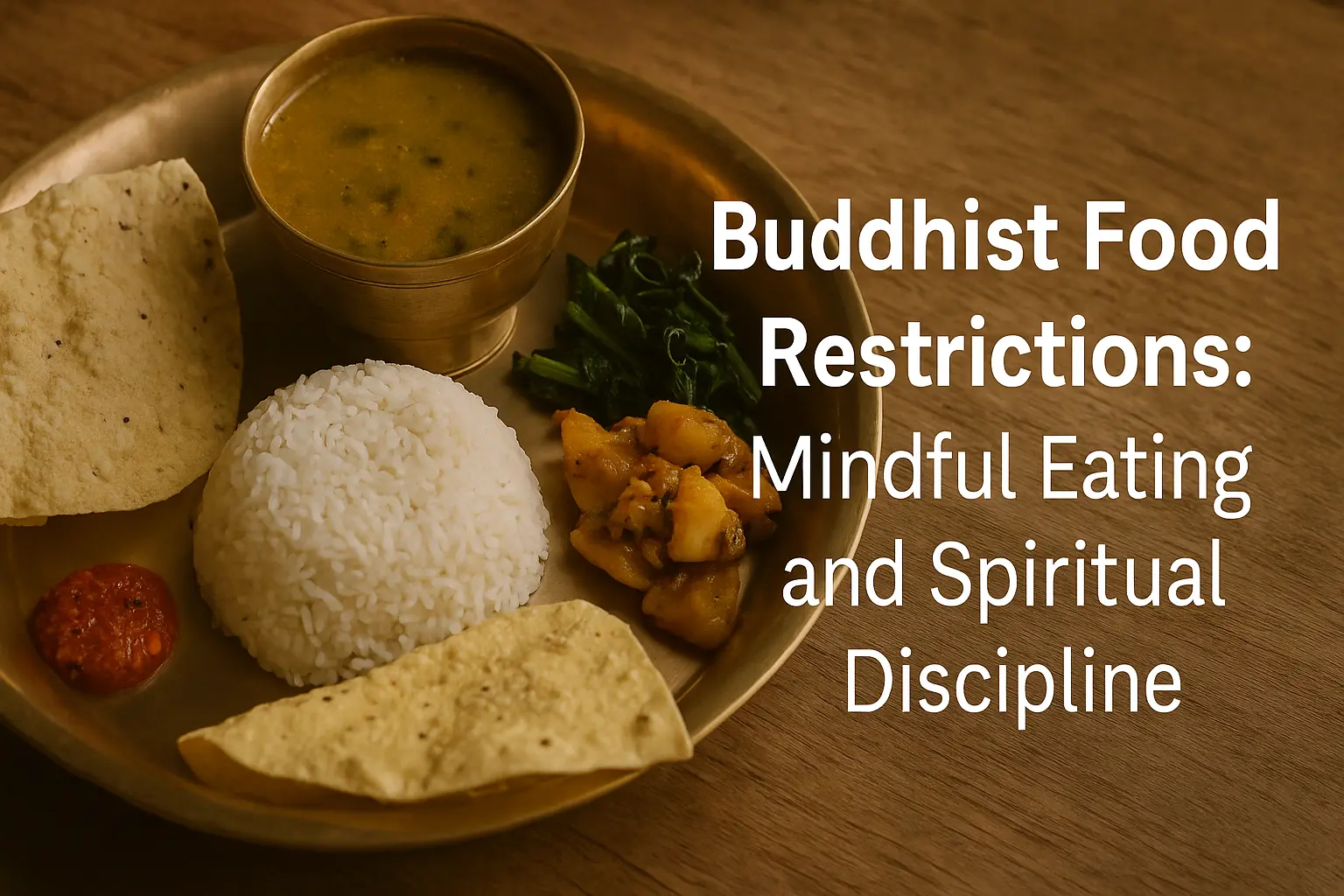
Buddhist Food Restrictions: Mindful Eating and Spiritual Discipline

Food in Buddhism goes beyond mere nourishment. It’s an essential part of spiritual practice, mindfulness, and ethical living. Buddhist dietary practices are influenced by teachings around compassion, non-attachment, and respect for life.

This guide explores Buddhist food restrictions, why they exist, and how mindful eating is a core part of spiritual growth for Buddhists and mindful travelers alike.

Core Principles Behind Buddhist Food Restrictions

Buddhist food guidelines aren’t just rules; they reflect deeper spiritual values:

• Ahimsa (Non-Harming): Avoiding harm to living beings, leading many Buddhists to adopt vegetarianism or veganism.

• Mindfulness and Moderation: Eating to nourish the body rather than indulging desire.

• Non-Attachment: Food is viewed as sustenance, not pleasure or indulgence.

These principles guide dietary choices and everyday eating habits.

Vegetarianism and Veganism in Buddhism

While not all Buddhists are vegetarians, many choose vegetarian or vegan diets as an expression of compassion and non-harming. Mahayana Buddhists are more likely to follow strict vegetarianism, believing that abstaining from meat reduces suffering in the world.

Monks and nuns in many Buddhist traditions also follow vegetarian or vegan diets as part of their monastic discipline.

Foods Typically Avoided in Buddhism

Certain foods are traditionally avoided by many practicing Buddhists, especially monastics:

• Meat and Fish: Especially avoided during important religious observances or by stricter practitioners.

• Alcohol and Intoxicants: Alcohol and mind-altering substances are usually prohibited as they impair mindfulness.

• Garlic, Onion, and Strongly Flavored Foods: These are often avoided, particularly in Mahayana monasteries, due to their perceived impact on spiritual balance and meditation.

Mindful Eating: How Buddhists Approach Meals

Eating mindfully is central in Buddhism. It involves:

• Eating slowly and consciously, fully appreciating each bite.
• Being aware of where the food comes from and expressing gratitude.
• Consuming just enough to nourish the body without excess or waste.

This mindfulness transforms a simple act into a spiritual practice.

Buddhist Food Practices Around Boudhanath

If you’re exploring spiritual life around Boudhanath, you’ll find many restaurants and cafes offering meals aligned with Buddhist food guidelines:

1. Boudha Cafe De Mandala

Located within the Boudha Mandala Hotel, it offers vegetarian and vegan options, mindful dishes prepared with local ingredients, ideal for travelers who appreciate food as spiritual nourishment.

2. Ananda Treehouse

Known for its organic vegan and vegetarian options, this rooftop café provides mindful, flavorful meals suited to spiritual and health-conscious travelers.

3. Zen Bistro

Offers a variety of vegetarian dishes without onion or garlic, catering specifically to Buddhist dietary principles.

Incorporating Buddhist Food Practices at Home

Whether you’re traveling or staying in Boudha long-term, you can incorporate Buddhist principles into your meals:

• Choose vegetarian or vegan meals several times a week.
• Practice mindful eating by eating slowly, without distraction.
• Reflect on the source of your food, fostering gratitude and awareness.

You can find local ingredients at Boudha’s fresh market, enhancing your mindfulness practice through cooking and meal preparation.

Why Buddhist Dietary Restrictions Matter

Understanding Buddhist food restrictions isn’t just about rules; it’s about adopting a mindful approach to life. Eating becomes a practice of compassion, ethical living, and spiritual discipline.
For travelers staying near Boudhanath, embracing these practices enriches the travel experience, aligning daily meals with spiritual intentions and cultural respect.

Final Reflection: Food as a Path to Awakening

Food in Buddhism is more than sustenance. It’s a pathway to awakening. By observing food restrictions and mindful eating practices, you nourish not only your body but your spirit.

Next time you sit down to eat near Boudha, pause. Feel grateful for the food before you. Remember, every meal is an opportunity for mindfulness and spiritual growth.